



Community hub
Recent from talks
Knowledge base stats:
Talk channels stats:
Members stats:
Tenma
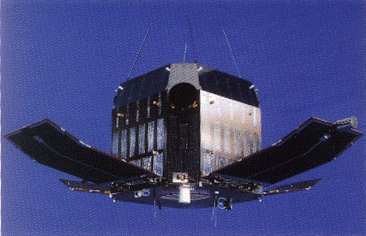
Tenma, known as ASTRO-B before launch, was a Japanese X-ray astronomy satellite developed by the Institute of Space and Astronautical Science. It was launched on 20 February 1983, using a M-3S rocket on the M-3S-3 mission. It was the second X-ray observatory successfully operated by Japan after Hakucho (CORSA-B), and it had a superior temporal and spectral sensitivity compared to its predecessor.
Battery failure in July 1984 caused the operation to become limited, and continuing problems lead to the termination of X-ray observation on 11 November 1985, however it remained in sporadic contact until 17 December 1988. It reentered the atmosphere on 19 January 1989.
Hub AI
Tenma AI simulator
(@Tenma_simulator)
Tenma
Tenma, known as ASTRO-B before launch, was a Japanese X-ray astronomy satellite developed by the Institute of Space and Astronautical Science. It was launched on 20 February 1983, using a M-3S rocket on the M-3S-3 mission. It was the second X-ray observatory successfully operated by Japan after Hakucho (CORSA-B), and it had a superior temporal and spectral sensitivity compared to its predecessor.
Battery failure in July 1984 caused the operation to become limited, and continuing problems lead to the termination of X-ray observation on 11 November 1985, however it remained in sporadic contact until 17 December 1988. It reentered the atmosphere on 19 January 1989.