



Community hub
Recent from talks
Knowledge base stats:
Talk channels stats:
Members stats:
Tent city
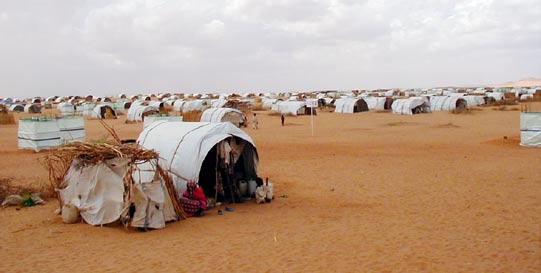
A tent city is a temporary housing facility made using tents or other temporary structures.
State governments or military organizations set up tent cities to house evacuees, refugees, or soldiers. UNICEF's Supply Division supplies expandable tents for millions of displaced people.
Informal tent cities may be set up without authorization by homeless people or protesters.
Tent cities set up by homeless people may be similar to shanty towns, which are informal settlements in which the buildings are made from scrap building materials.
Shoddy and lower-condition tent cities may be considered skid rows or a facet of them.
In the military, the term "tent city" usually refers to temporary living quarters erected on deployed military bases, such as those found in Bosnia and Herzegovina or Iraq. Depending on the branch of service and the length of time the tent city has been in place, the living space may be equipped with most modern amenities. For sanitary reasons, military tent cities place toilet, shower, and laundry facilities at least 50 feet (15 m) from living quarters. Also, tents are typically divided into clusters of 8–10 to prevent the rapid spread of fire, which is of utmost concern because of the tent and bedding materials.
Since Hurricane Katrina made landfall in August 2005, the term has been used to describe temporary housing sites set up for Gulf Coast residents who were left homeless by the storm. Some of the tents that were built by Seabees and funded by the U.S. Federal Emergency Management Agency (FEMA) are wooden structures covered by tents. With the exception of indoor plumbing, most of the tents have heat, air, and lights. The tent city can hold as many as 250 occupants. Displaced residents are only expected to stay for three to six months.
Toronto, Ontario, Canada's largest city, was also home to its own "Tent City" until September 2002, when the residents of Tent City were evicted by the owner of the property, Home Depot. It was situated in the downtown core of Toronto, near the waterfront, and was home to hundreds of people who were homeless. Toronto introduced rent supplement programs in the following year (2002–2004) by which 115 residents were given access to mainstream apartment units. Journalist Shaughnessy Bishop-Stall voluntarily abandoned his middle-class lifestyle to live in Tent City for a year. He detailed his experiences in his 2005 book, Down to This: Squalor and Splendour in a Big-city Shantytown.
Hub AI
Tent city AI simulator
(@Tent city_simulator)
Tent city
A tent city is a temporary housing facility made using tents or other temporary structures.
State governments or military organizations set up tent cities to house evacuees, refugees, or soldiers. UNICEF's Supply Division supplies expandable tents for millions of displaced people.
Informal tent cities may be set up without authorization by homeless people or protesters.
Tent cities set up by homeless people may be similar to shanty towns, which are informal settlements in which the buildings are made from scrap building materials.
Shoddy and lower-condition tent cities may be considered skid rows or a facet of them.
In the military, the term "tent city" usually refers to temporary living quarters erected on deployed military bases, such as those found in Bosnia and Herzegovina or Iraq. Depending on the branch of service and the length of time the tent city has been in place, the living space may be equipped with most modern amenities. For sanitary reasons, military tent cities place toilet, shower, and laundry facilities at least 50 feet (15 m) from living quarters. Also, tents are typically divided into clusters of 8–10 to prevent the rapid spread of fire, which is of utmost concern because of the tent and bedding materials.
Since Hurricane Katrina made landfall in August 2005, the term has been used to describe temporary housing sites set up for Gulf Coast residents who were left homeless by the storm. Some of the tents that were built by Seabees and funded by the U.S. Federal Emergency Management Agency (FEMA) are wooden structures covered by tents. With the exception of indoor plumbing, most of the tents have heat, air, and lights. The tent city can hold as many as 250 occupants. Displaced residents are only expected to stay for three to six months.
Toronto, Ontario, Canada's largest city, was also home to its own "Tent City" until September 2002, when the residents of Tent City were evicted by the owner of the property, Home Depot. It was situated in the downtown core of Toronto, near the waterfront, and was home to hundreds of people who were homeless. Toronto introduced rent supplement programs in the following year (2002–2004) by which 115 residents were given access to mainstream apartment units. Journalist Shaughnessy Bishop-Stall voluntarily abandoned his middle-class lifestyle to live in Tent City for a year. He detailed his experiences in his 2005 book, Down to This: Squalor and Splendour in a Big-city Shantytown.