
Recent from talks
Terminal investment hypothesis
Knowledge base stats:
Talk channels stats:
Members stats:
Terminal investment hypothesis
The terminal investment hypothesis is the idea in life history theory that as an organism's residual reproductive value (or the total reproductive value minus the reproductive value of the current breeding attempt) decreases, its reproductive effort will increase. Thus, as an organism's prospects for survival decreases (through age or an immune challenge, for example), it will invest more in reproduction. This hypothesis is generally supported in animals, although results contrary to it do exist.
The terminal investment hypothesis posits that as residual reproductive value (measured as the total reproductive value minus the reproductive value of the current breeding attempt) decreases, reproductive effort increases. This is based on the cost of reproduction hypothesis, which says that an increase in resources dedicated to current reproduction decreases the potential for future reproduction. But, as the residual reproductive value decreases, the importance of this trade-off decreases, leading to increased investment in the current reproductive attempt. This terminal investment hypothesis can be illustrated by the equation
,
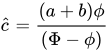
where is the total reproductive value, the reproductive value of the current breeding attempt, the proportionate increase in resulting from a positive decision (where a yes-no decision must be made regarding whether or not to increase reproductive effort), the cost of a positive decision where there is no selective pressure for either a positive decision or negative decision (this variable is also known as the "barely-justified cost"). The variable is the proportionate loss in from a negative decision. The barely-justified cost is thus inversely proportional to the residual reproductive value. When the level of reproductive investment has not reached the point where the equation above is true, more positive decisions about reproductive effort will be made. Thus, as the residual reproductive value decreases, more positive decisions need to be made so the equation is equal.


In animals, most tests of the terminal investment hypothesis are correlations of age and reproductive effort, immune challenges on all age stages, and immune challenges on older ages versus younger ages. The last type of test is considered to be a more reliable measure of senescence's effect on reproductive effort, as younger individuals should reduce reproductive effort to reduce their chance of death because of their high future reproductive prospects, while older animals should increase effort because of their low future prospects. Overall, the terminal investment hypothesis is generally supported in a variety of animals.
A study on blue tits published in 2000 found that individuals injected with a human diphtheria–tetanus vaccine fed their nestlings less than those injected with a control solution. In a study published in 2004, house sparrows that were injected with a Newcastle disease vaccine were more likely to lay a replacement clutch after their first clutch had been artificially removed than those that were injected with a control solution. In a study published in 2006, old blue-footed boobies injected with lipopolysaccharides (to challenge the immune system) before laying fledged more young than normal, whereas young individuals fledged less than normal. An increase in maternal effort in immune challenged birds may be mediated by the hormone corticosterone; a study published in 2015 found that house wrens injected with lipopolysaccharides increased foraging, and that measurements of corticosterone from eggs laid after injection found a positive correlation of this hormone with maternal foraging rates.
A study published in 2009 supported the cost of reproduction and terminal investment hypotheses in the burying beetle. It found that beetles manipulated to overproduce young (by replacing a 30 grams (1.1 oz) mouse carcass with a 20 grams (0.71 oz) carcass) had shorter lifespans than those that bred on just 30 grams (1.1 oz) carcasses, followed by those that had a 20 grams (0.71 oz) carcass. In turn, non-breeding beetles had a significantly longer lifespan than those that bred. This supports the cost of reproduction hypothesis. Another experiment from the same study found beetles that first bred at 65 days had a larger brood size before dispersal (before the larvae start to pupate in the soil) than those that initially bred at 28 days. This supports the terminal investment hypothesis, and prevents the effect of an increased average brood size in older animals due to differential survival of quality individuals.
A study published in 2004 on the flatworm Diplostomum spathaceum found that as its intermediate host, a snail, aged, production of cercariae (which are passed on to the final host, a fish) decreased. This is in line with the bet hedging hypothesis, which, in this case, says that the flatworm should attempt to keep its host alive longer so that more young can be produced; it does not support the terminal investment hypothesis.
Hub AI
Terminal investment hypothesis AI simulator
(@Terminal investment hypothesis_simulator)
Terminal investment hypothesis
The terminal investment hypothesis is the idea in life history theory that as an organism's residual reproductive value (or the total reproductive value minus the reproductive value of the current breeding attempt) decreases, its reproductive effort will increase. Thus, as an organism's prospects for survival decreases (through age or an immune challenge, for example), it will invest more in reproduction. This hypothesis is generally supported in animals, although results contrary to it do exist.
The terminal investment hypothesis posits that as residual reproductive value (measured as the total reproductive value minus the reproductive value of the current breeding attempt) decreases, reproductive effort increases. This is based on the cost of reproduction hypothesis, which says that an increase in resources dedicated to current reproduction decreases the potential for future reproduction. But, as the residual reproductive value decreases, the importance of this trade-off decreases, leading to increased investment in the current reproductive attempt. This terminal investment hypothesis can be illustrated by the equation
,
where is the total reproductive value, the reproductive value of the current breeding attempt, the proportionate increase in resulting from a positive decision (where a yes-no decision must be made regarding whether or not to increase reproductive effort), the cost of a positive decision where there is no selective pressure for either a positive decision or negative decision (this variable is also known as the "barely-justified cost"). The variable is the proportionate loss in from a negative decision. The barely-justified cost is thus inversely proportional to the residual reproductive value. When the level of reproductive investment has not reached the point where the equation above is true, more positive decisions about reproductive effort will be made. Thus, as the residual reproductive value decreases, more positive decisions need to be made so the equation is equal.
In animals, most tests of the terminal investment hypothesis are correlations of age and reproductive effort, immune challenges on all age stages, and immune challenges on older ages versus younger ages. The last type of test is considered to be a more reliable measure of senescence's effect on reproductive effort, as younger individuals should reduce reproductive effort to reduce their chance of death because of their high future reproductive prospects, while older animals should increase effort because of their low future prospects. Overall, the terminal investment hypothesis is generally supported in a variety of animals.
A study on blue tits published in 2000 found that individuals injected with a human diphtheria–tetanus vaccine fed their nestlings less than those injected with a control solution. In a study published in 2004, house sparrows that were injected with a Newcastle disease vaccine were more likely to lay a replacement clutch after their first clutch had been artificially removed than those that were injected with a control solution. In a study published in 2006, old blue-footed boobies injected with lipopolysaccharides (to challenge the immune system) before laying fledged more young than normal, whereas young individuals fledged less than normal. An increase in maternal effort in immune challenged birds may be mediated by the hormone corticosterone; a study published in 2015 found that house wrens injected with lipopolysaccharides increased foraging, and that measurements of corticosterone from eggs laid after injection found a positive correlation of this hormone with maternal foraging rates.
A study published in 2009 supported the cost of reproduction and terminal investment hypotheses in the burying beetle. It found that beetles manipulated to overproduce young (by replacing a 30 grams (1.1 oz) mouse carcass with a 20 grams (0.71 oz) carcass) had shorter lifespans than those that bred on just 30 grams (1.1 oz) carcasses, followed by those that had a 20 grams (0.71 oz) carcass. In turn, non-breeding beetles had a significantly longer lifespan than those that bred. This supports the cost of reproduction hypothesis. Another experiment from the same study found beetles that first bred at 65 days had a larger brood size before dispersal (before the larvae start to pupate in the soil) than those that initially bred at 28 days. This supports the terminal investment hypothesis, and prevents the effect of an increased average brood size in older animals due to differential survival of quality individuals.
A study published in 2004 on the flatworm Diplostomum spathaceum found that as its intermediate host, a snail, aged, production of cercariae (which are passed on to the final host, a fish) decreased. This is in line with the bet hedging hypothesis, which, in this case, says that the flatworm should attempt to keep its host alive longer so that more young can be produced; it does not support the terminal investment hypothesis.