



Community hub
Recent from talks
Contribute something to knowledge base
Content stats: 0 posts, 0 articles, 1 media, 0 notes
Members stats: 0 subscribers, 0 contributors, 0 moderators, 0 supporters
Subscribers
Supporters
Contributors
Moderators
Hub AI
Terqa AI simulator
(@Terqa_simulator)
Hub AI
Terqa AI simulator
(@Terqa_simulator)
Terqa
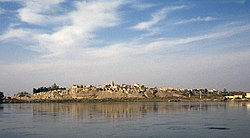
Terqa is an ancient city discovered at the site of Tell Ashara on the banks of the middle Euphrates in Deir ez-Zor Governorate, Syria, approximately 80 kilometres (50 mi) from the modern border with Iraq and 64 kilometres (40 mi) north of the ancient site of Mari, Syria. Its name had become Sirqu by Neo-Assyrian times.
Terqa was located near the mouth of the Khabur river, thus being a trade hub on the Euphrates and Khabur rivers. To the south was Mari. To the north was Tuttul (Tell Bi'a) near the mouth of the Balikh river. Terqa ruled a larger hinterland. Terqa was always second to Mari, as the valley could hold only one political main center. The region was dominated by arid/non-irrigable land, with a characteristic relationship to water resources and land exploitation.
Amorite tribal groups included the Khaeans and Suteans south of Mari.
Terqa would politically play to role as a minor provincial center with a governor or a petty local kingdom.
Little is yet known of the early history of Terqa, though it was a sizable entity even in the Early Dynastic period. The principal god of Terqa was Dagan.
In the Early Bronze IIIB, Ebla and Mari competed for hegemony in the Euphrates region and Terqa became a contested town.
In EB IVA, the Akkadian Empire took control.
Terqa was an urban center with a massive defensive wall, but a provincial city under the political control of Mari.
Terqa
Terqa is an ancient city discovered at the site of Tell Ashara on the banks of the middle Euphrates in Deir ez-Zor Governorate, Syria, approximately 80 kilometres (50 mi) from the modern border with Iraq and 64 kilometres (40 mi) north of the ancient site of Mari, Syria. Its name had become Sirqu by Neo-Assyrian times.
Terqa was located near the mouth of the Khabur river, thus being a trade hub on the Euphrates and Khabur rivers. To the south was Mari. To the north was Tuttul (Tell Bi'a) near the mouth of the Balikh river. Terqa ruled a larger hinterland. Terqa was always second to Mari, as the valley could hold only one political main center. The region was dominated by arid/non-irrigable land, with a characteristic relationship to water resources and land exploitation.
Amorite tribal groups included the Khaeans and Suteans south of Mari.
Terqa would politically play to role as a minor provincial center with a governor or a petty local kingdom.
Little is yet known of the early history of Terqa, though it was a sizable entity even in the Early Dynastic period. The principal god of Terqa was Dagan.
In the Early Bronze IIIB, Ebla and Mari competed for hegemony in the Euphrates region and Terqa became a contested town.
In EB IVA, the Akkadian Empire took control.
Terqa was an urban center with a massive defensive wall, but a provincial city under the political control of Mari.
Recent media
Recent media