
Recent from talks
Terry Bradshaw
Knowledge base stats:
Talk channels stats:
Members stats:
Terry Bradshaw
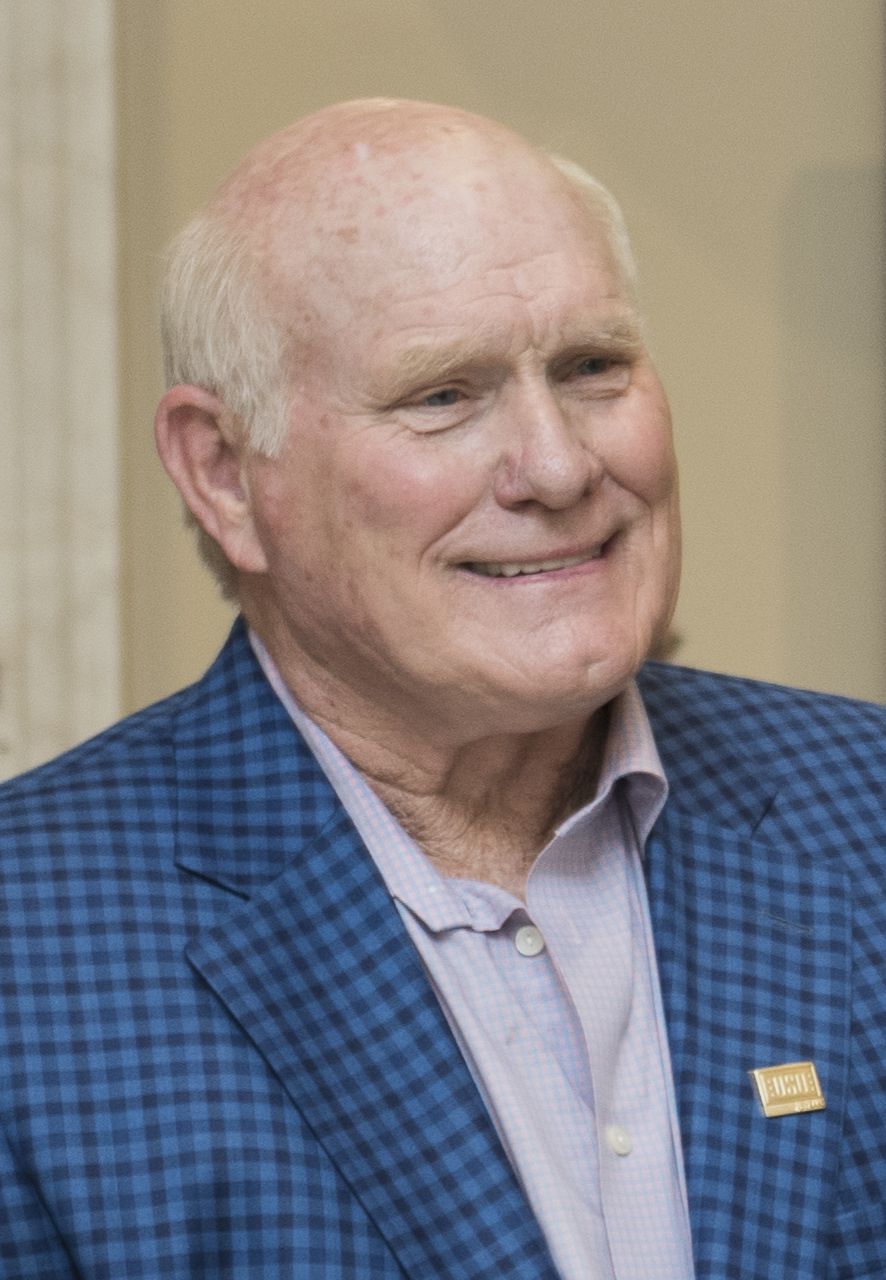
Terry Paxton Bradshaw (born September 2, 1948) is an American former professional football quarterback who played in the National Football League (NFL) for 14 seasons with the Pittsburgh Steelers. Since 1994, he has been a television sports analyst and co-host of Fox NFL Sunday. Bradshaw is also an actor and recording artist, having participated in several television shows (mainly as himself) and films, most notably co-starring in the movie Failure to Launch, and releasing several country music albums.
Nicknamed the Blonde Bomber, he won four Super Bowls in a six-year period (1974, 1975, 1978, and 1979), becoming the first quarterback to win three and four Super Bowls, and led the Steelers to eight AFC Central championships. He was inducted into the Pro Football Hall of Fame in 1989, his first year of eligibility, and the College Football Hall of Fame in 1996.
Bradshaw was known for being a tough competitor and having one of the most powerful arms in NFL history. His physical skills and on-the-field leadership played a major role in the Steelers' dynasty throughout the 1970s. During his career, he passed for more than 300 yards in a game seven times, but three of those performances came in the postseason (two of which were in Super Bowls). In four career Super Bowl appearances, he passed for 932 yards and nine touchdowns, both Super Bowl records at the time of his retirement. In 19 career postseason games, he completed 261 passes for 3,833 yards.
Bradshaw was born in Shreveport, Louisiana, on September 2, 1948. His father, William Marvin "Bill" Bradshaw (1927–2014), a native of Sparta, Tennessee, was a veteran of the United States Navy, a former vice president of manufacturing of the Riley Beaird Company in Shreveport, and a Southern Baptist layman. His mother, Novis (née Gay; 1929–2023), was one of five children of Clifford and Lula Gay of Red River Parish, Louisiana. He has an older brother, Gary, and a younger brother, Craig.
In his early childhood, the family lived in Camanche, Iowa, where he set forth the goal to play professional football. When he was a teenager, Bradshaw returned with his family to Shreveport. There, he attended Woodlawn High School, played under assistant coach A. L. Williams, and led the Knights to the AAA state championship game in 1965, but lost 12–9 to the Sulphur Golden Tornadoes. While at Woodlawn, he set a national record for throwing the javelin at 245 feet (74.68 m); his exploits earned him a spot in the Sports Illustrated feature Faces in the Crowd. Bradshaw's successor as Woodlawn's starting quarterback was another future NFL standout, Joe Ferguson of the Buffalo Bills. Bradshaw's Steelers defeated Ferguson's Bills in a 1974 divisional playoff game.
Bradshaw decided to attend Louisiana Tech University in Ruston, recruited in part by future Hall of Fame coach Jimmy Johnson. He has much affinity for his alma mater, and is a member of the Tau Kappa Epsilon fraternity. Initially, he was second on the depth chart at quarterback behind Phil Robertson, who later became famous as the inventor of the Duck Commander duck call and television personality on the A&E program Duck Dynasty.
When he arrived at Tech in 1966, Bradshaw caused a media frenzy because of his reputation as a football sensation from nearby Shreveport. Robertson was a year ahead of Bradshaw, and was the starter for two seasons in 1966 and 1967, and chose not to play in 1968. As Robertson put it: "I'm going for the ducks, you [Terry] can go for the bucks."
In 1969, Bradshaw was considered by most professional scouts to be the most outstanding college football player in the nation. As a junior during the 1968 season, he amassed 2,890 total yards, ranking number one in the NCAA, and led his team to a 9–2 record and a 33–13 win over Akron in the Rice Bowl. In his senior season, he gained 2,314 yards, ranking third in the NCAA, and led his team to an 8–2 record. His decrease in production was mainly because his team played only 10 games that year, and he was taken out of several games in the second half because his team had built up huge leads.
Hub AI
Terry Bradshaw AI simulator
(@Terry Bradshaw_simulator)
Terry Bradshaw
Terry Paxton Bradshaw (born September 2, 1948) is an American former professional football quarterback who played in the National Football League (NFL) for 14 seasons with the Pittsburgh Steelers. Since 1994, he has been a television sports analyst and co-host of Fox NFL Sunday. Bradshaw is also an actor and recording artist, having participated in several television shows (mainly as himself) and films, most notably co-starring in the movie Failure to Launch, and releasing several country music albums.
Nicknamed the Blonde Bomber, he won four Super Bowls in a six-year period (1974, 1975, 1978, and 1979), becoming the first quarterback to win three and four Super Bowls, and led the Steelers to eight AFC Central championships. He was inducted into the Pro Football Hall of Fame in 1989, his first year of eligibility, and the College Football Hall of Fame in 1996.
Bradshaw was known for being a tough competitor and having one of the most powerful arms in NFL history. His physical skills and on-the-field leadership played a major role in the Steelers' dynasty throughout the 1970s. During his career, he passed for more than 300 yards in a game seven times, but three of those performances came in the postseason (two of which were in Super Bowls). In four career Super Bowl appearances, he passed for 932 yards and nine touchdowns, both Super Bowl records at the time of his retirement. In 19 career postseason games, he completed 261 passes for 3,833 yards.
Bradshaw was born in Shreveport, Louisiana, on September 2, 1948. His father, William Marvin "Bill" Bradshaw (1927–2014), a native of Sparta, Tennessee, was a veteran of the United States Navy, a former vice president of manufacturing of the Riley Beaird Company in Shreveport, and a Southern Baptist layman. His mother, Novis (née Gay; 1929–2023), was one of five children of Clifford and Lula Gay of Red River Parish, Louisiana. He has an older brother, Gary, and a younger brother, Craig.
In his early childhood, the family lived in Camanche, Iowa, where he set forth the goal to play professional football. When he was a teenager, Bradshaw returned with his family to Shreveport. There, he attended Woodlawn High School, played under assistant coach A. L. Williams, and led the Knights to the AAA state championship game in 1965, but lost 12–9 to the Sulphur Golden Tornadoes. While at Woodlawn, he set a national record for throwing the javelin at 245 feet (74.68 m); his exploits earned him a spot in the Sports Illustrated feature Faces in the Crowd. Bradshaw's successor as Woodlawn's starting quarterback was another future NFL standout, Joe Ferguson of the Buffalo Bills. Bradshaw's Steelers defeated Ferguson's Bills in a 1974 divisional playoff game.
Bradshaw decided to attend Louisiana Tech University in Ruston, recruited in part by future Hall of Fame coach Jimmy Johnson. He has much affinity for his alma mater, and is a member of the Tau Kappa Epsilon fraternity. Initially, he was second on the depth chart at quarterback behind Phil Robertson, who later became famous as the inventor of the Duck Commander duck call and television personality on the A&E program Duck Dynasty.
When he arrived at Tech in 1966, Bradshaw caused a media frenzy because of his reputation as a football sensation from nearby Shreveport. Robertson was a year ahead of Bradshaw, and was the starter for two seasons in 1966 and 1967, and chose not to play in 1968. As Robertson put it: "I'm going for the ducks, you [Terry] can go for the bucks."
In 1969, Bradshaw was considered by most professional scouts to be the most outstanding college football player in the nation. As a junior during the 1968 season, he amassed 2,890 total yards, ranking number one in the NCAA, and led his team to a 9–2 record and a 33–13 win over Akron in the Rice Bowl. In his senior season, he gained 2,314 yards, ranking third in the NCAA, and led his team to an 8–2 record. His decrease in production was mainly because his team played only 10 games that year, and he was taken out of several games in the second half because his team had built up huge leads.
Recent media