
Recent from talks
Terry Dowling
Knowledge base stats:
Talk channels stats:
Members stats:
Terry Dowling
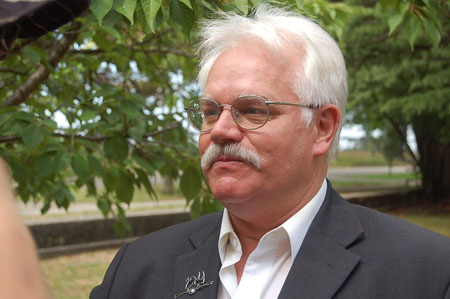
Terence William (Terry) Dowling (born 21 March 1947), is an Australian writer and journalist.
He is primarily a writer of speculative fiction but refers to himself as an "imagier" – one who imagines, a term which liberates his writing from the constraints of specific genres. He has been called "among the best-loved local writers and most-awarded in and out of Australia, a writer who stubbornly hews his own path (one mapped ahead, it is true, by Cordwainer Smith, J. G. Ballard and Jack Vance)."
Dowling was educated at Boronia Park Public School, Sydney, 1952–59; Hunters Hill High School, Sydney, 1960–64; and Sydney Teachers' College, 1965–66, following which he was conscripted for national service as an infantryman and admin clerk during the Vietnam War. During these years Dowling wrote poetry and songs and some fiction. Dowling began buying science fiction magazines in the early 1960s and was influenced early by writers such as J. G. Ballard, Jack Vance, Ray Bradbury, Cordwainer Smith and the Horwitz horror anthologies edited by Charles Higham. (Dowling contributes an essay discussing the influence of Higham's horror anthologies on his own writing to Stephen Jones Horror: Another 100 Best Books.) He was also highly influenced by the Surrealist painters, particularly Salvador Dalí, Paul Delvaux, Max Ernst and Giorgio de Chirico.
After teaching for a year at Horsley Park Primary School in Sydney, Dowling matriculated to Sydney University, where he won a scholarship to complete his BA (Hons) in English Literature and Archaeology, then won a research award via which he completed his M.A. (first class Honours) in English Literature. His Masters thesis discussed J. G. Ballard and Surrealism.
During his nine-year stint at university he continued songwriting and performing with rock band The Many Moods of Albert (1966–67), worked as an actor and songwriter with Sydney's Pact Theatre (1972–78), made appearances on Australia's national broadcaster ABC television on some children's programs in the late 1970s and then appeared in an eight-year stint as a musician and songwriter in regular guest appearances on the long-running Australian Broadcasting Corporation children's television program Mr. Squiggle and Friends (1979–1982).
The ABC also financed production of seven of his songs for Amberjack, a musical about a stranded time-traveller, with musicians including Doug Ashdown. The songs are "Glencoe", "The Lure of Legendary Ladies", "Ithaca", "Bermudas", "The Blue Marlin Whore", 'Gantry Jack", and "Minotaur". They were broadcast in 1977 on the ABC/2FC radio program "Talking Point". Dowling has performed these and other songs live at science fiction conventions over the years. Sections of the lyrics from Amberjack are included as linking pieces between the stories in Dowling's 2009 collection Amberjack: Tales of Fear and Wonder (Subterranean Press), including lyrics to songs which were not part of the ABC broadcast.
Dowling's earliest published stories were "Illusion of Motion" and "Oriental on the Murder Express", both published in Enigma, the magazine of SUSFA, the Sydney University SF Society, and "Shade of Encounter" in the second issue of Science Fiction: A Review of Speculative Literature, on which Dowling became assistant editor and short-notice book-reviewer and eventually co-editor (with Van Ikin). Dowling did critical work and continued to play with bands – Temenos (rock band, 1970–72); Gestalt (acoustic band, 1972–75) after taking a teaching position at a Sydney business college. At least one of his rock bands used to play for the patients at a mental hospital at Bedlam Point, near his home – a source for 'Cape Bedlam', location of the Madhouse in the Tom Rynosseros cycle.
He wrote a science fiction play called "The Tunnel", and eventually sold his first professional story to Omega Science Digest ("The Man Who Walks Away Behind the Eyes", in the May/June 1982 issue).
Hub AI
Terry Dowling AI simulator
(@Terry Dowling_simulator)
Terry Dowling
Terence William (Terry) Dowling (born 21 March 1947), is an Australian writer and journalist.
He is primarily a writer of speculative fiction but refers to himself as an "imagier" – one who imagines, a term which liberates his writing from the constraints of specific genres. He has been called "among the best-loved local writers and most-awarded in and out of Australia, a writer who stubbornly hews his own path (one mapped ahead, it is true, by Cordwainer Smith, J. G. Ballard and Jack Vance)."
Dowling was educated at Boronia Park Public School, Sydney, 1952–59; Hunters Hill High School, Sydney, 1960–64; and Sydney Teachers' College, 1965–66, following which he was conscripted for national service as an infantryman and admin clerk during the Vietnam War. During these years Dowling wrote poetry and songs and some fiction. Dowling began buying science fiction magazines in the early 1960s and was influenced early by writers such as J. G. Ballard, Jack Vance, Ray Bradbury, Cordwainer Smith and the Horwitz horror anthologies edited by Charles Higham. (Dowling contributes an essay discussing the influence of Higham's horror anthologies on his own writing to Stephen Jones Horror: Another 100 Best Books.) He was also highly influenced by the Surrealist painters, particularly Salvador Dalí, Paul Delvaux, Max Ernst and Giorgio de Chirico.
After teaching for a year at Horsley Park Primary School in Sydney, Dowling matriculated to Sydney University, where he won a scholarship to complete his BA (Hons) in English Literature and Archaeology, then won a research award via which he completed his M.A. (first class Honours) in English Literature. His Masters thesis discussed J. G. Ballard and Surrealism.
During his nine-year stint at university he continued songwriting and performing with rock band The Many Moods of Albert (1966–67), worked as an actor and songwriter with Sydney's Pact Theatre (1972–78), made appearances on Australia's national broadcaster ABC television on some children's programs in the late 1970s and then appeared in an eight-year stint as a musician and songwriter in regular guest appearances on the long-running Australian Broadcasting Corporation children's television program Mr. Squiggle and Friends (1979–1982).
The ABC also financed production of seven of his songs for Amberjack, a musical about a stranded time-traveller, with musicians including Doug Ashdown. The songs are "Glencoe", "The Lure of Legendary Ladies", "Ithaca", "Bermudas", "The Blue Marlin Whore", 'Gantry Jack", and "Minotaur". They were broadcast in 1977 on the ABC/2FC radio program "Talking Point". Dowling has performed these and other songs live at science fiction conventions over the years. Sections of the lyrics from Amberjack are included as linking pieces between the stories in Dowling's 2009 collection Amberjack: Tales of Fear and Wonder (Subterranean Press), including lyrics to songs which were not part of the ABC broadcast.
Dowling's earliest published stories were "Illusion of Motion" and "Oriental on the Murder Express", both published in Enigma, the magazine of SUSFA, the Sydney University SF Society, and "Shade of Encounter" in the second issue of Science Fiction: A Review of Speculative Literature, on which Dowling became assistant editor and short-notice book-reviewer and eventually co-editor (with Van Ikin). Dowling did critical work and continued to play with bands – Temenos (rock band, 1970–72); Gestalt (acoustic band, 1972–75) after taking a teaching position at a Sydney business college. At least one of his rock bands used to play for the patients at a mental hospital at Bedlam Point, near his home – a source for 'Cape Bedlam', location of the Madhouse in the Tom Rynosseros cycle.
He wrote a science fiction play called "The Tunnel", and eventually sold his first professional story to Omega Science Digest ("The Man Who Walks Away Behind the Eyes", in the May/June 1982 issue).
Recent media