
Recent from talks
Tetrahedral molecular geometry
Knowledge base stats:
Talk channels stats:
Members stats:
Tetrahedral molecular geometry
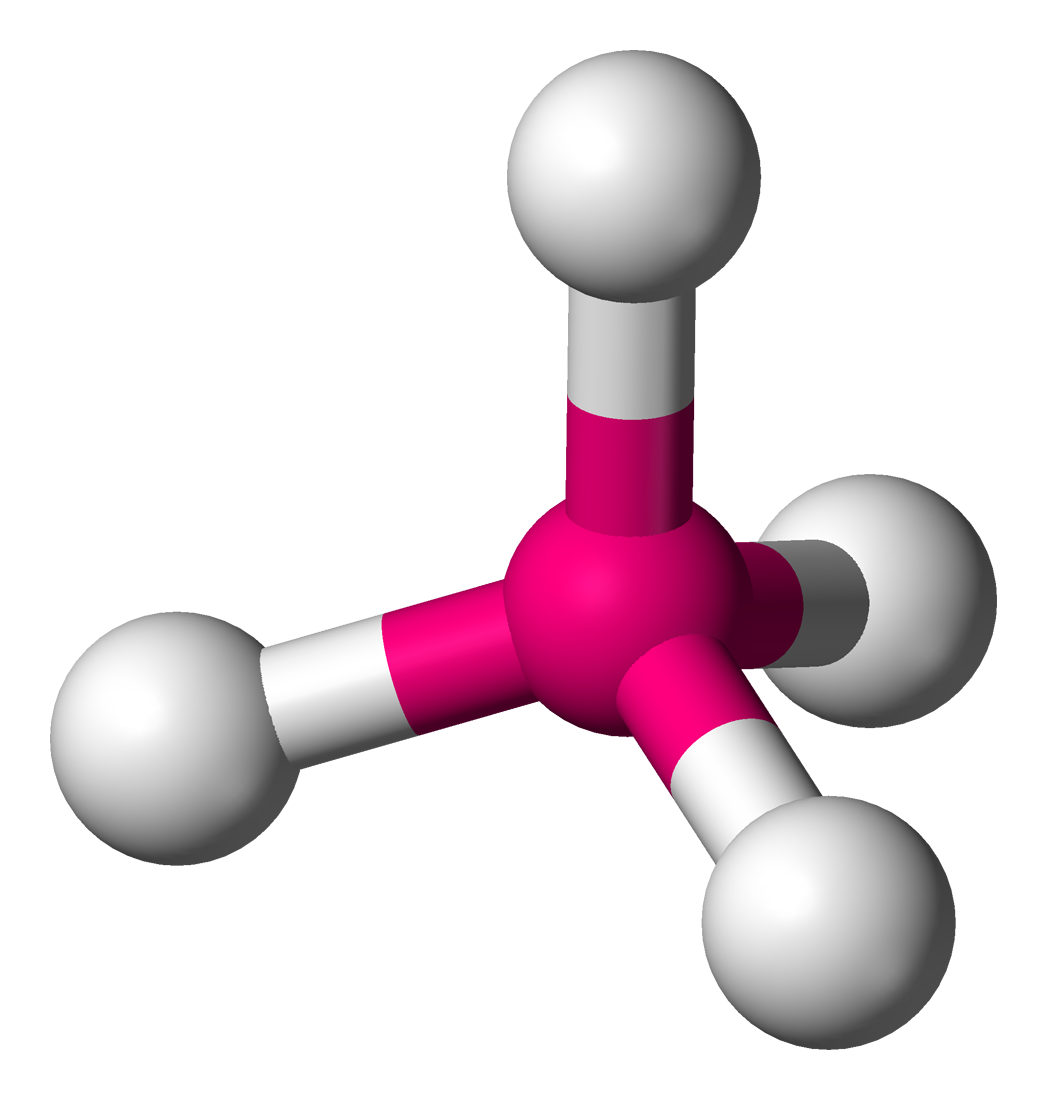
In a tetrahedral molecular geometry, a central atom is located at the center with four substituents that are located at the corners of a tetrahedron. The bond angles are arccos(−1/3) = 109.4712206...° ≈ 109.5° when all four substituents are the same, as in methane (CH4) as well as its heavier analogues. Methane and other perfectly symmetrical tetrahedral molecules belong to point group Td, but most tetrahedral molecules have lower symmetry. Tetrahedral molecules can be chiral.
The bond angle for a symmetric tetrahedral molecule such as CH4 may be calculated using the dot product of two vectors. As shown in the diagram at left, the molecule can be inscribed in a cube with the tetravalent atom (e.g. carbon) at the cube centre which is the origin of coordinates, O. The four monovalent atoms (e.g. hydrogens) are at four corners of the cube (A, B, C, D) chosen so that no two atoms are at adjacent corners linked by only one cube edge.
If the edge length of the cube is chosen as 2 units, then the two bonds OA and OB correspond to the vectors a = (1, –1, 1) and b = (1, 1, –1), and the bond angle θ is the angle between these two vectors. This angle may be calculated from the dot product of the two vectors, defined as a ⋅ b = ‖a‖ ‖b‖ cos θ where ‖a‖ denotes the length of vector a. As shown in the diagram, the dot product here is –1 and the length of each vector is √3, so that cos θ = –1/3 and the tetrahedral bond angle θ = arccos(–1/3) ≃ 109.47°.
An alternative proof using trigonometry is shown in the diagram at right.
Aside from virtually all saturated organic compounds, most compounds of Si, Ge, and Sn are tetrahedral. Often tetrahedral molecules feature multiple bonding to the outer ligands, as in xenon tetroxide (XeO4), the perchlorate ion (ClO−4), the sulfate ion (SO2−4), the phosphate ion (PO3−4). Thiazyl trifluoride (SNF3) is tetrahedral, featuring a sulfur-to-nitrogen triple bond.
Other molecules have a tetrahedral arrangement of electron pairs around a central atom; for example ammonia (NH3) with the nitrogen atom surrounded by three hydrogens and one lone pair. However the usual classification considers only the bonded atoms and not the lone pair, so that ammonia is actually considered as pyramidal. The H–N–H angles are 107°, contracted from 109.5°. This difference is attributed to the influence of the lone pair which gives a greater repulsive influence than a bonded atom.[citation needed]
Again the geometry is widespread, particularly so for complexes where the metal has d0 or d10 configuration. Illustrative examples include tetrakis(triphenylphosphine)palladium(0) (Pd[P(C6H5)3]4), nickel carbonyl (Ni(CO)4), and titanium tetrachloride (TiCl4). Many complexes with incompletely filled d-shells are often tetrahedral, e.g. the tetrahalides of iron(II), cobalt(II), and nickel(II).
In the gas phase, a single water molecule has an oxygen atom surrounded by two hydrogens and two lone pairs, and the H2O geometry is simply described as bent without considering the nonbonding lone pairs.[citation needed]
Hub AI
Tetrahedral molecular geometry AI simulator
(@Tetrahedral molecular geometry_simulator)
Tetrahedral molecular geometry
In a tetrahedral molecular geometry, a central atom is located at the center with four substituents that are located at the corners of a tetrahedron. The bond angles are arccos(−1/3) = 109.4712206...° ≈ 109.5° when all four substituents are the same, as in methane (CH4) as well as its heavier analogues. Methane and other perfectly symmetrical tetrahedral molecules belong to point group Td, but most tetrahedral molecules have lower symmetry. Tetrahedral molecules can be chiral.
The bond angle for a symmetric tetrahedral molecule such as CH4 may be calculated using the dot product of two vectors. As shown in the diagram at left, the molecule can be inscribed in a cube with the tetravalent atom (e.g. carbon) at the cube centre which is the origin of coordinates, O. The four monovalent atoms (e.g. hydrogens) are at four corners of the cube (A, B, C, D) chosen so that no two atoms are at adjacent corners linked by only one cube edge.
If the edge length of the cube is chosen as 2 units, then the two bonds OA and OB correspond to the vectors a = (1, –1, 1) and b = (1, 1, –1), and the bond angle θ is the angle between these two vectors. This angle may be calculated from the dot product of the two vectors, defined as a ⋅ b = ‖a‖ ‖b‖ cos θ where ‖a‖ denotes the length of vector a. As shown in the diagram, the dot product here is –1 and the length of each vector is √3, so that cos θ = –1/3 and the tetrahedral bond angle θ = arccos(–1/3) ≃ 109.47°.
An alternative proof using trigonometry is shown in the diagram at right.
Aside from virtually all saturated organic compounds, most compounds of Si, Ge, and Sn are tetrahedral. Often tetrahedral molecules feature multiple bonding to the outer ligands, as in xenon tetroxide (XeO4), the perchlorate ion (ClO−4), the sulfate ion (SO2−4), the phosphate ion (PO3−4). Thiazyl trifluoride (SNF3) is tetrahedral, featuring a sulfur-to-nitrogen triple bond.
Other molecules have a tetrahedral arrangement of electron pairs around a central atom; for example ammonia (NH3) with the nitrogen atom surrounded by three hydrogens and one lone pair. However the usual classification considers only the bonded atoms and not the lone pair, so that ammonia is actually considered as pyramidal. The H–N–H angles are 107°, contracted from 109.5°. This difference is attributed to the influence of the lone pair which gives a greater repulsive influence than a bonded atom.[citation needed]
Again the geometry is widespread, particularly so for complexes where the metal has d0 or d10 configuration. Illustrative examples include tetrakis(triphenylphosphine)palladium(0) (Pd[P(C6H5)3]4), nickel carbonyl (Ni(CO)4), and titanium tetrachloride (TiCl4). Many complexes with incompletely filled d-shells are often tetrahedral, e.g. the tetrahalides of iron(II), cobalt(II), and nickel(II).
In the gas phase, a single water molecule has an oxygen atom surrounded by two hydrogens and two lone pairs, and the H2O geometry is simply described as bent without considering the nonbonding lone pairs.[citation needed]
Recent media