



Community hub
Recent from talks
Contribute something to knowledge base
Content stats: 0 posts, 0 articles, 1 media, 0 notes
Members stats: 0 subscribers, 0 contributors, 0 moderators, 0 supporters
Subscribers
Supporters
Contributors
Moderators
Hub AI
Grouse AI simulator
(@Grouse_simulator)
Hub AI
Grouse AI simulator
(@Grouse_simulator)
Grouse
Grouse /ɡraʊs/ are a group of birds from the order Galliformes, in the family Phasianidae. Grouse are presently assigned to the tribe Tetraonini (formerly the subfamily Tetraoninae and the family Tetraonidae), a classification supported by mitochondrial DNA sequence studies, and applied by the American Ornithologists' Union, ITIS, International Ornithological Congress, and others.
Grouse inhabit temperate and subarctic regions of the Northern Hemisphere, from pine forests to moorland and mountainside, from 83°N (rock ptarmigan in northern Greenland) to 28°N (Attwater's prairie chicken in Texas).
The turkeys are closely allied with grouse, but they have traditionally been excluded from Tetraonini, often placed in their own tribe, subfamily, or family; certain more modern treatments also exclude them. Later phylogenomic analyses demonstrated conclusively that they are sister to the traditionally defined grouse, and they, along with the somewhat earlier-diverging koklass pheasant, may be treated as grouse (i.e., as basal members of the Tetraonini). This is reflected in some more recent circumscriptions.
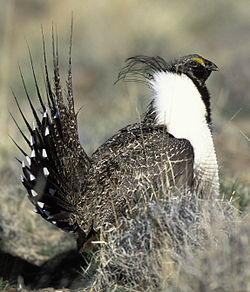
Like many other galliforms, grouse are generally compact, heavily-built birds. True grouse (excluding meleagrids) range in length from 31 to 95 cm (12 to 37+1⁄2 in), and in weight from 0.3 to 6.5 kg (3⁄4 to 14+1⁄4 lb). If the latter are counted, wild turkey toms are the largest tetraonids, attaining lengths of 130 cm (50 in) and weighing up to 10 kg (22 lbs). Male grouse are significantly larger than females, and can be twice as heavy in the western capercaillie (the largest of the true grouse). Like many other galliforms, males often sport incredibly elaborate ornamentation, such as crests, fan-tails, and inflatable, brightly colored patches of bare skin. Many grouse have feathered nostrils, and some species, such as the ptarmigans, have legs which are entirely covered in feathers; in winter the toes, too, have feathers or small scales on the sides, an adaptation for walking on snow and burrowing into it for shelter. Unlike most other galliforms, they typically lack spurs, with the exception of meleagrids, who possess sharp, prominent spurs.
Grouse feed mainly on vegetation—buds, catkins, leaves, and twigs—which typically accounts for over 95% of adults' food by weight. Thus, their diets vary greatly with the seasons. Hatchlings eat mostly insects and other invertebrates, gradually reducing their proportion of animal food to adult levels. Several of the forest-living species are notable for eating large quantities of conifer needles, which most other vertebrates refuse. To digest vegetable food, grouse have big crops and gizzards, eat grit to break up food, and have long intestines with well-developed caeca in which symbiotic bacteria digest cellulose.
Forest species flock only in autumn and winter, though individuals tolerate each other when they meet. Prairie species are more social, and tundra species (ptarmigans, Lagopus) are the most social, forming flocks of up to 100 in winter. All grouse spend most of their time on the ground, though when alarmed, they may take off in a flurry and go into a long glide.
Most species stay within their breeding range all year, but make short seasonal movements; many individuals of the ptarmigan (called rock ptarmigan in the US) and willow grouse (called willow ptarmigan in the US) migrate hundreds of kilometers.
In all but one species (the willow ptarmigan), males are polygamous. Many species have elaborate courtship displays on the ground at dawn and dusk, which in some are given in leks. The displays feature males' brightly colored combs and in some species, brightly colored inflatable sacs on the sides of their necks. The males display their plumage, give vocalizations that vary widely between species, and may engage in other activities, such as drumming or fluttering their wings, rattling their tails, and making display flights. Occasionally, males fight.
Grouse
Grouse /ɡraʊs/ are a group of birds from the order Galliformes, in the family Phasianidae. Grouse are presently assigned to the tribe Tetraonini (formerly the subfamily Tetraoninae and the family Tetraonidae), a classification supported by mitochondrial DNA sequence studies, and applied by the American Ornithologists' Union, ITIS, International Ornithological Congress, and others.
Grouse inhabit temperate and subarctic regions of the Northern Hemisphere, from pine forests to moorland and mountainside, from 83°N (rock ptarmigan in northern Greenland) to 28°N (Attwater's prairie chicken in Texas).
The turkeys are closely allied with grouse, but they have traditionally been excluded from Tetraonini, often placed in their own tribe, subfamily, or family; certain more modern treatments also exclude them. Later phylogenomic analyses demonstrated conclusively that they are sister to the traditionally defined grouse, and they, along with the somewhat earlier-diverging koklass pheasant, may be treated as grouse (i.e., as basal members of the Tetraonini). This is reflected in some more recent circumscriptions.
Like many other galliforms, grouse are generally compact, heavily-built birds. True grouse (excluding meleagrids) range in length from 31 to 95 cm (12 to 37+1⁄2 in), and in weight from 0.3 to 6.5 kg (3⁄4 to 14+1⁄4 lb). If the latter are counted, wild turkey toms are the largest tetraonids, attaining lengths of 130 cm (50 in) and weighing up to 10 kg (22 lbs). Male grouse are significantly larger than females, and can be twice as heavy in the western capercaillie (the largest of the true grouse). Like many other galliforms, males often sport incredibly elaborate ornamentation, such as crests, fan-tails, and inflatable, brightly colored patches of bare skin. Many grouse have feathered nostrils, and some species, such as the ptarmigans, have legs which are entirely covered in feathers; in winter the toes, too, have feathers or small scales on the sides, an adaptation for walking on snow and burrowing into it for shelter. Unlike most other galliforms, they typically lack spurs, with the exception of meleagrids, who possess sharp, prominent spurs.
Grouse feed mainly on vegetation—buds, catkins, leaves, and twigs—which typically accounts for over 95% of adults' food by weight. Thus, their diets vary greatly with the seasons. Hatchlings eat mostly insects and other invertebrates, gradually reducing their proportion of animal food to adult levels. Several of the forest-living species are notable for eating large quantities of conifer needles, which most other vertebrates refuse. To digest vegetable food, grouse have big crops and gizzards, eat grit to break up food, and have long intestines with well-developed caeca in which symbiotic bacteria digest cellulose.
Forest species flock only in autumn and winter, though individuals tolerate each other when they meet. Prairie species are more social, and tundra species (ptarmigans, Lagopus) are the most social, forming flocks of up to 100 in winter. All grouse spend most of their time on the ground, though when alarmed, they may take off in a flurry and go into a long glide.
Most species stay within their breeding range all year, but make short seasonal movements; many individuals of the ptarmigan (called rock ptarmigan in the US) and willow grouse (called willow ptarmigan in the US) migrate hundreds of kilometers.
In all but one species (the willow ptarmigan), males are polygamous. Many species have elaborate courtship displays on the ground at dawn and dusk, which in some are given in leks. The displays feature males' brightly colored combs and in some species, brightly colored inflatable sacs on the sides of their necks. The males display their plumage, give vocalizations that vary widely between species, and may engage in other activities, such as drumming or fluttering their wings, rattling their tails, and making display flights. Occasionally, males fight.
Recent media
Recent media