Recent from talks
Nothing was collected or created yet.
Texas Brigade
View on Wikipedia
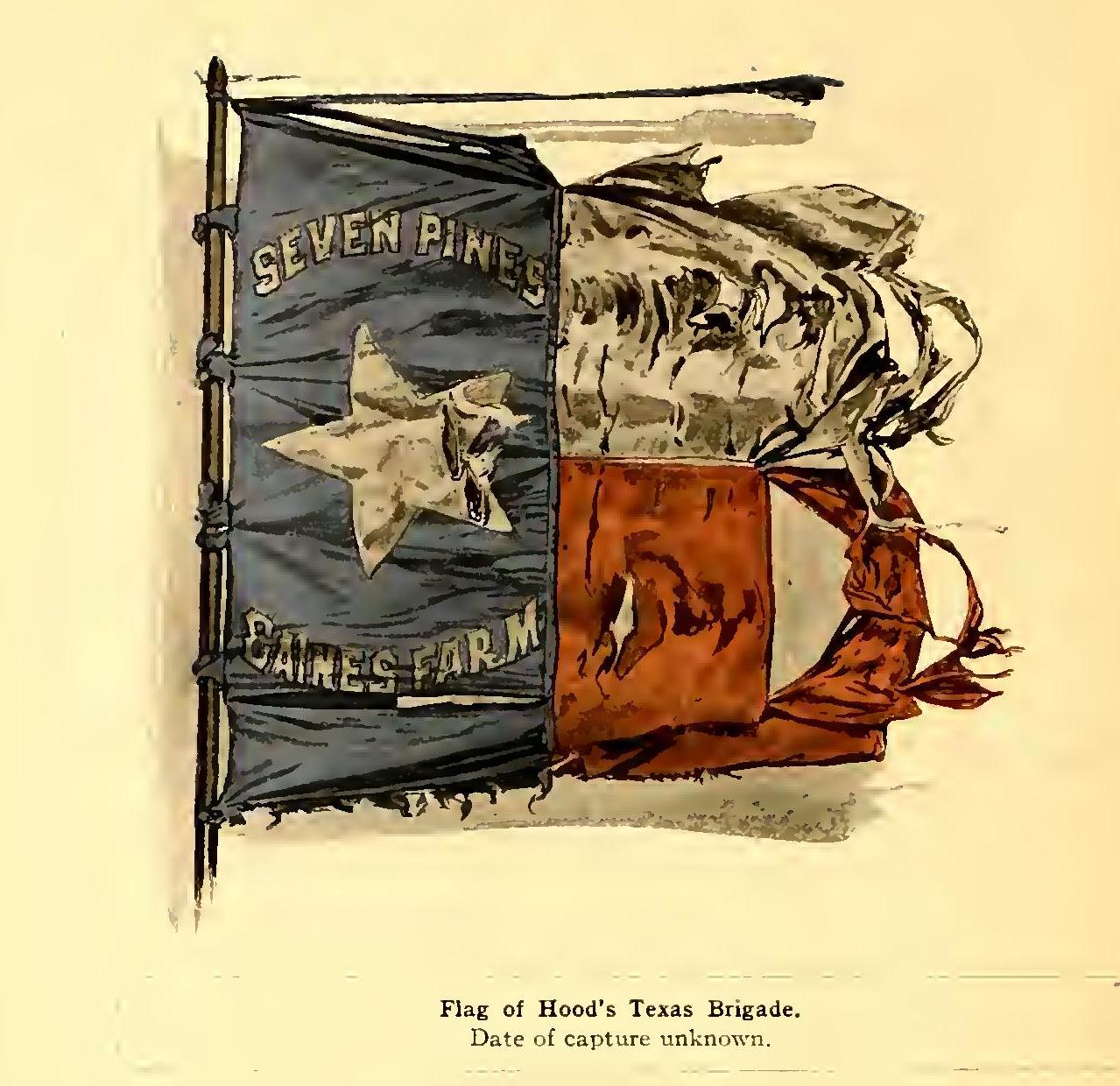
The Texas Brigade (also known as Hood's Brigade) was an infantry formation of the Confederate Army that distinguished itself in the American Civil War. Along with the Stonewall Brigade, they were considered the Army of Northern Virginia's shock troops. It fought in every major battle of the Eastern Theater except Chancellorsville.
Organization
[edit]

The Texas Brigade was organized on October 22, 1861, primarily through the efforts of John Allen Wilcox, afterwards a member of congress from Texas, who remained as the brigade's political patron until his death in 1864. The brigade was initially and briefly under the command of Louis T. Wigfall until he took a seat in the Confederate Senate. Command was then given to John Bell Hood (hence the Texas Brigade was often known as "Hood's Brigade" or "Hood's Texas Brigade"). The brigade left Texas poorly armed and many men had no weapons at all. Others took whatever was available; this resulted in soldiers carrying almost anything that would shoot—shotguns, hunting rifles, pistols, old flintlock muskets used in the Texas Revolution, model 1841 Mississippi rifles, Colt revolving rifles, and more. At least two companies are reported to have carried model 1855 Springfield rifles, which would have been the only modern weapons in the brigade. The Texans were held in high regard thanks to the legend of the Alamo and the Texas Revolution, and the Confederate government made sure that they got the best equipment available. Most of the brigade were soon issued Enfield rifles aside from the 1st Texas Infantry, which had mostly smoothbore muskets and appear to have still been using them well into 1864.
The brigade was originally assigned as part of Maj. Gen. Gustavus W. Smith's division, which was sometimes commanded by Brig. Gen. William H.C. Whiting. For much of the war, it was assigned to Lt. Gen. James Longstreet's Corps in General Robert E. Lee's Army of Northern Virginia. It was commanded for much of the war by Brig. Gen. Jerome B. Robertson. It initially comprised the 1st Texas, 4th Texas, 5th Texas, and 18th Georgia Regiments. After the Battle of Seven Pines, Hampton's Legion from South Carolina joined the brigade. After the general reorganization of Lee's army following the Battle of Antietam in September 1862, the Georgians and South Carolinians were reassigned to brigades from their respective states; the 3d Arkansas was added because it was the only other trans-Mississippi regiment serving with Lee's army.
Battle actions
[edit]
The brigade's first general engagement was at Eltham's Landing on May 7, 1862, where it lost 36 men killed and wounded. During the Battle of Seven Pines, it was directed to support Longstreet's command. Although the rest of Whiting's division was heavily engaged with considerable casualties, the Texas Brigade sat mostly idle during the battle and lost just 10 men killed and wounded.
The brigade distinguished itself during the Seven Days Battle where it routed the enemy at Gaines' Mill, captured a battery of guns, and repulsed a cavalry counterattack. Casualties at Gaines Mill were severe, amounting to at least 25% of the Texas Brigade's total strength. At Malvern Hill, the brigade was held in reserve despite Hood's requests to assault the Union entrenchments on the hill. Following the Seven Days Battles, Whiting went on sick leave and by early August, Robert E. Lee named Hood as permanent division commander. During the week following Malvern Hill, Lee wrote to Senator Wigfall that 1,336 new recruits were needed to replenish the depleted brigade, which likely numbered fewer than 1000 men in early July. Within a month, the Texas Brigade was brought back up to strength with new recruits and men with minor wounds returning to duty and it had close to 3000 men at the start of the Northern Virginia Campaign.
Its reputation increased when it spearheaded Longstreet's assault on Pope's left at the battle of Second Manassas. The brigade overran two Union regiments, nearly annihilated the 5th New York Zouaves, and captured a battery of guns, losing 628 men in the battle. Its reputation for fighting was sealed at the Battle of Sharpsburg, when it closed a gap in the Confederate line and drove back the two Union Corps that were attacking. Out of 854 that went into battle at Sharpsburg, 550 of the Texas Brigade were killed or wounded.
The brigade's most famous action took place on the second day of the Battle of Gettysburg, during its fight for Devil's Den. Though the Confederacy ultimately lost that battle, the 1st Texas, 4th Texas, 5th Texas, and 3d Arkansas distinguished themselves in taking Devil's Den despite being greatly outnumbered and suffering heavy casualties, to include General Robertson being wounded. The brigade's failure to take Little Round Top marked the failure of that day's fighting.[1]
By the war's end, the Texas Brigade had fought in all the battles engaged in by the Army of Northern Virginia except Chancellorsville. Battles included the Battle of Seven Pines, Seven Days Battle, Battle of South Mountain, Battle of Sharpsburg, Battle of Fredericksburg, Battle of Gettysburg, and the Battle of the Wilderness. They later fought with the Army of Tennessee at Chickamauga and during the Knoxville Campaign, as well as with Longstreet at Suffolk.[2] Of the estimated 5,353 men who enlisted in the three Texas and one Arkansas regiments, only 617 remained to surrender on April 9, 1865, at Appomattox Court House in Virginia.[2] The Texas Brigade, along with the Stonewall Brigade from Virginia, were considered to be the Army of Northern Virginia's shock troops.[3]
Orders of battle
[edit]- Battle of Eltham's Landing (May 7, 1862); assigned to Whiting's Division; Brigade commanded by Brig. Gen. John Bell Hood
- 1st, 4th, and 5th Texas Infantry regiments
- 18th Georgia Infantry Regiment
- Battle of Seven Pines (May 31 – June 1, 1862); assigned to Whiting's Division; Brigade commanded by Brig. Gen. John Bell Hood
- 1st, 4th, and 5th Texas Infantry regiments
- 18th Georgia Infantry Regiment
- Battle of Gaines' Mill (June 27, 1862) (the primary engagement of Seven Days Battle); assigned to Whiting's Division; Brigade commanded by Brig. Gen. John Bell Hood
- 1st, 4th, and 5th Texas Infantry regiments
- 18th Georgia Infantry Regiment
- Hampton (South Carolina) Legion
- Second Manassas (August 28–30, 1862); assigned to Hood's Division; Brigade commanded by Brig. Gen. John Bell Hood
- 1st, 4th, and 5th Texas Infantry regiments
- 18th Georgia Infantry Regiment
- Hampton (South Carolina) Legion
- Antietam (September 17, 1862); assigned to Hood's Division; Brigade commanded by Col. William T. Wofford
- 1st, 4th, and 5th Texas Infantry regiments
- 18th Georgia Infantry Regiment
- Hampton (South Carolina) Legion
- Fredericksburg (December 11–15, 1862); assigned to Hood's Division; Brigade commanded by Brig. Gen. Jerome B. Robertson
- 1st, 4th, and 5th Texas Infantry regiments
- 3d Arkansas Infantry Regiment
- Gettysburg (July 1–3, 1863); assigned to Hood's Division; Brigade commanded by Brig. Gen. Jerome B. Robertson
- 1st, 4th, and 5th Texas Infantry regiments
- 3d Arkansas Infantry Regiment
- Chickamauga (September 18–20, 1863); assigned to Hood's Division; Brigade commanded by Brig. Gen. Jerome B. Robertson
- 1st, 4th, and 5th Texas Infantry regiments
- 3d Arkansas Infantry Regiment
- Wilderness (May 5–7, 1864); assigned to Field's Division; Brigade commanded by Brig. Gen. John Gregg
- 1st, 4th, and 5th Texas Infantry regiments
- 3d Arkansas Infantry Regiment
- Cold Harbor (May 21 – June 3, 1864); assigned to Field's Division; Brigade commanded by Brig. Gen. John Gregg
- 1st, 4th, and 5th Texas Infantry regiments
- 3d Arkansas Infantry Regiment
See also
[edit]References
[edit]- ^ "Hood's Texas Brigade joins battle at Gettysburg". tshaonline.org. Texas State Historical Association. Retrieved 10 November 2013.
- ^ a b Frameset Hq
- ^ Greene, A. Wilson. "Granbury's Texas Brigade: Diehard Western Confederates". cwbr.com. Civil War Book Review. Archived from the original on 10 November 2013. Retrieved 10 November 2013.
Further reading
[edit]- Polley, J. B., Hood's Texas Brigade: Its Marches, Its Battles, Its Achievements, Morningside Bookshop, 1988, ISBN 0-89029-037-7.
- Simpson, Harold B., Hood's Texas Brigade: Lee's Grenadier Guard, Texas Press, 1970, ISBN 1-56013-009-1.
- Fletcher, William A, Rebel Private: Front and Rear, Meridian Book, The Penguin Group, 1997, ISBN 978-0-452-01157-1
- Schmutz, John F., The Bloody Fifth, The 5th Texas Infantry Regiment, Hood's Texas Brigade, Army of Northern Virginia Vol. 1 Secession to the Suffolk Campaign & Vol. 2 Gettysburg to Appomattox
- Ural, Susannah. 2017. Hood's Texas Brigade: The Soldiers and Families of the Confederacy's Most Celebrated Unit. Baton Rouge: Louisiana State University Press.
External links
[edit]- Regimental flag of Fifth Texas Infantry, Hood's Texas Brigade
- Re-union of Hood's Brigade at Shady View Park, Dallas, Texas, June 27th and 28th 1884, hosted by the Portal to Texas History
- "For Ninety Nine Years or the War" The Story of the 3rd Arkansas at Gettysburg
- Brig. Gen. J. B. Robertson, after action report, Devil's Den
Texas Brigade
View on GrokipediaHood's Texas Brigade, formally the 4th Brigade of the Confederate Army of Northern Virginia, was an infantry unit during the American Civil War composed primarily of regiments raised in Texas, distinguished by its combat effectiveness and exceptionally high casualty rates in the Eastern Theater.[1][2]
Organized on October 22, 1861, in Richmond, Virginia, under Brigadier General Louis T. Wigfall, its initial strength included the 1st, 4th, and 5th Texas Infantry regiments, soon joined by the 18th Georgia Infantry, with later additions of the 3rd Arkansas Infantry and elements from South Carolina.[1]
Command successively passed to John Bell Hood, Jerome B. Robertson, and John Gregg, whose leadership emphasized bold assaults that propelled the brigade through pivotal engagements, including Gaines' Mill, Second Manassas, Antietam, Fredericksburg, Gettysburg, Chickamauga, and the Wilderness Campaign.[1][2]
As the sole Texas contingent in Robert E. Lee's army, it garnered acclaim from Confederate leaders like Stonewall Jackson, James Longstreet, and Lee for its tenacity and shock troop role, despite suffering a 61 percent casualty rate among its roughly 4,400 total enlistees, culminating in the surrender of about 600 men at Appomattox in 1865.[1][3]
Formation and Early History
Organization in 1861
The Texas Brigade was formally organized on October 22, 1861, in Richmond, Virginia, comprising the 1st, 4th, and 5th Texas Infantry Regiments raised from volunteers across the state earlier that spring and summer.[1][4] These regiments arrived piecemeal in Virginia, where companies from east Texas militias, such as the Washington Light Guards and Crockett Southrons, were reorganized into the brigade's core structure under Confederate authority.[4] Brigadier General Louis T. Wigfall, a Texas politician with military ambitions, was appointed the initial brigade commander.[1] Regimental command included Lieutenant Colonel Hugh McLeod leading the 1st Texas, Colonel John Bell Hood commanding the 4th Texas, and Colonel James J. Archer heading the 5th Texas, with Lieutenant Jerome B. Robertson also prominent in the latter.[1] In fall 1861, Wigfall addressed the troops, emphasizing their fighting reputation to foster unit cohesion.[4] On November 20, 1861, the 18th Georgia Infantry Regiment under William T. Wofford was attached, broadening the brigade beyond its Texas origins while retaining its distinctive identity.[1] That same month, Lula Wigfall, daughter of the brigade commander, presented the first battle flag to the 4th Texas Regiment, symbolizing early unit pride and commitment.[5]Recruitment and Composition
The Texas Brigade, formally organized as a Confederate infantry brigade on October 22, 1861, in Richmond, Virginia, drew its initial recruits primarily from volunteer companies raised across Texas in the spring and summer of 1861, following the state's secession from the Union on March 2, 1861.[1] These volunteers, motivated by a sense of duty, regional honor, and the desire to uphold Texas's frontier reputation for martial prowess, enlisted through local militias such as the Washington Light Guards and Crockett Southrons in east Texas, as well as units like the Tom Green Rifles from Austin in the west.[4] The regiments traveled by steamer and rail to Virginia, where they mustered into Confederate service, reflecting Texas's disproportionate contribution of manpower to the eastern theater despite its remote location and limited population of approximately 600,000 in 1860.[1] The brigade's core composition centered on three Texas volunteer infantry regiments: the 1st, 4th, and 5th Texas Infantry, each typically mustering around 800–1,000 men at formation, for an initial brigade strength of approximately 3,500 soldiers.[1] These units originated from at least 26 counties statewide, encompassing rural farmers, laborers, students, and a scattering of professionals, with many enlistees hailing from agrarian east Texas communities but also including western pioneers accustomed to independent, rugged lifestyles.[4] Over the war, total enlistments swelled to about 4,400, though attrition from combat reduced effective strength to roughly 600 by the April 10, 1865, surrender at Appomattox.[1] Temporary augmentations diversified the early composition, including the 18th Georgia Infantry added on November 20, 1861; eight companies from Wade Hampton's South Carolina Legion incorporated on June 1, 1862; and the 3rd Arkansas Infantry joining in November 1862, which remained until the end.[1] The non-Texas elements—Georgia and South Carolina units—were transferred out by late 1862, preserving the brigade's identity as predominantly Texan, though the enduring presence of Arkansans underscored the fluid realities of Confederate unit assignments amid manpower shortages.[1] This structure emphasized volunteer zeal over conscription initially, with recruits bonded by shared Texan exceptionalism rather than uniform socioeconomic profiles.[4]Leadership and Command Structure
Key Commanders
The Texas Brigade was initially organized and commanded by Brigadier General Louis T. Wigfall from October 22, 1861, to February 20, 1862, when he resigned to serve in the Confederate Senate.[1] Wigfall, a former U.S. Senator from Texas, played a key role in recruiting the brigade's regiments from Texas volunteers.[1] Command briefly transitioned through acting officers such as James T. Archer before Colonel John Bell Hood assumed leadership on March 2, 1862, and was promoted to brigadier general shortly thereafter.[6] [1] Hood commanded the brigade until November 1, 1862, leading it in pivotal engagements like the Seven Days Battles and the Second Battle of Bull Run, where its aggressive assaults earned widespread acclaim within the Army of Northern Virginia.[1] The brigade's enduring nickname, "Hood's Texas Brigade," stems from his tenure, despite his later commands at higher levels.[1] Following Hood's promotion to major general and division command, Brigadier General Jerome B. Robertson took over on November 1, 1862, and led the brigade through the Antietam, Fredericksburg, Chancellorsville, and Gettysburg campaigns until February 1864.[1] Robertson, a Mexican-American War veteran, maintained the unit's discipline and combat effectiveness amid heavy casualties.[1] Brigadier General John Gregg succeeded Robertson in February 1864, commanding until his death on October 7, 1864, during operations near Richmond.[1] Gregg, previously wounded at Gettysburg, directed the brigade in the Overland Campaign and early Petersburg defenses.[1] Subsequent leadership fell to temporary commanders, including colonels Clinton M. Winkler and Frederick S. Bass, with Colonel Robert M. Powell in charge at the brigade's surrender on April 10, 1865, near Appomattox.[1]Internal Dynamics and Discipline
The Texas Brigade maintained exceptional unit cohesion through a profound sense of regional identity and pride in their Texan heritage, which permeated internal dynamics and bolstered morale amid severe hardships. Soldiers drew motivation from exceptionalism tied to their state's frontier legacy, often manifesting in unified battle cries of "Texas!" that reinforced camaraderie even among non-Texan elements, such as Georgians who adopted brigade symbols after engagements like Gaines' Mill on June 27, 1862. This esprit de corps endured periodic morale dips from exhaustion and furlough denials in 1863–1864, yet letters from men like James Manahan in 1864 noted persistent optimism and fine spirits despite privations.[4] Leadership significantly shaped internal relations, with John Bell Hood cultivating deep loyalty by embodying the brigade's aggressive ethos and leading charges personally, as at Gaines' Mill where his front-line presence earned praise as "one of the best generals" from soldiers like James Murray. Successors like Jerome B. Robertson sustained this bond through demonstrated bravery, such as surviving two horses shot out from under him at Chickamauga on September 19–20, 1863, fostering trust between officers and enlisted men rooted in shared risks rather than formal hierarchy. This dynamic contrasted with broader Confederate challenges, emphasizing personal valor over detached command.[4] Discipline remained robust, underpinned by reputational stakes and interpersonal ties that minimized desertion relative to other units, though not without early lapses like Harvey Pinson's 1861 attempt, from which he returned to die in service. By 1865, supply scarcities heightened desertion fears, as voiced in Samuel Watson's correspondence, yet the brigade's commitment—bolstered by stigma against absconding—held firm until surrender at Appomattox on April 9, 1865. Scholarly analyses, including Susannah J. Ural's examination of soldier motivations and desertion patterns, affirm that such cohesion challenged prevailing narratives of widespread Confederate volunteer erosion, attributing the brigade's resilience to sustained home-front support and ideological resolve.[4][7]Military Engagements
Peninsula Campaign and Seven Days Battles (1862)
The Texas Brigade, commanded by Brigadier General John B. Hood, entered the Peninsula Campaign after its organization in early 1862 and reinforcement of Confederate defenses around Richmond. The brigade's first combat occurred at Eltham's Landing on May 7, 1862, where elements including the 4th Texas Infantry repelled a Union amphibious landing by troops under Brigadier General William B. Franklin, preventing a potential flanking maneuver against General Joseph E. Johnston's retreating army.[8][9] During the Seven Days Battles from June 25 to July 1, 1862, the brigade, consisting of the 1st, 4th, and 5th Texas Infantry regiments, the 18th Georgia Infantry, and Hampton's Legion, played a decisive role at the Battle of Gaines' Mill on June 27. Positioned in reserve within Major General William H. C. Whiting's division on the Confederate right flank, Hood identified an opportunity amid faltering assaults by other units and ordered his brigade forward without awaiting explicit orders from superiors. Advancing across approximately 800 yards of open ground under intense artillery and musket fire from entrenched Union V Corps positions under Major General Fitz John Porter, the Texans pierced the Federal line near the Watt House, capturing at least 14 cannon and routing several brigades, thus creating the initial breakthrough that led to the Confederate victory.[10][11] This assault inflicted heavy casualties on the brigade, with combined losses in Hood's and adjacent brigades exceeding 1,000 men during the charge, reflecting the high cost of their aggressive tactics against prepared defenses. General Robert E. Lee commended Hood's initiative in his official report, noting the brigade's reinforcement from Richmond and its contribution to stemming Union threats, which factored into Hood's rapid promotion to major general on July 3, 1862. The brigade saw limited further engagement in the subsequent Seven Days actions such as Glendale and Malvern Hill, focusing instead on pursuit and securing the withdrawal of McClellan's Army of the Potomac toward Harrison's Landing on the James River.[12]Northern Virginia Campaign (1862)
Following the Peninsula Campaign, Hood's Texas Brigade, under Brigadier General John Bell Hood, transferred to Major General Thomas J. Jackson's corps in the Army of Northern Virginia and marched northward to join the Northern Virginia Campaign against Union Major General John Pope's Army of Virginia.[1] The brigade, comprising the 1st, 4th, and 5th Texas Infantry regiments along with the 18th Georgia Infantry, positioned for the decisive clash at the Second Battle of Manassas from August 28 to 30, 1862.[1] On August 30, as Union forces pressed Jackson's exposed flank, General Robert E. Lee ordered Lieutenant General James Longstreet's corps to counterattack. Hood's Texas Brigade spearheaded the assault, advancing against the Union left near the Chinn Ridge and Groveton.[13] The Texans charged through intense artillery and musket fire, breaking Federal lines held by units including the 5th New York Zouaves, capturing multiple Union batteries in fierce hand-to-hand combat.[14] In one notable action, elements of the brigade seized a Federal battery, suffering 11 killed while overrunning the position.[14] The brigade's aggressive push routed pursuing Union troops, driving them across Bull Run at nearly double-quick pace and securing the Confederate victory.[14] This performance solidified the Texas Brigade's reputation for tenacity, with Hood's men advancing under their distinctive red battle flag amid the evening sun.[15] Casualties were heavy, reflecting the brigade's frontline role, though exact figures for the engagement vary; the action marked a pivotal contribution to Lee's triumph in the campaign, paving the way for the subsequent Maryland invasion.[15]Maryland Campaign and Antietam (1862)
As part of Robert E. Lee's Army of Northern Virginia, the Texas Brigade crossed the Potomac River into Maryland between September 4 and 7, 1862, during the initial stages of the Maryland Campaign, marching northward toward Frederick.[16] The brigade, then comprising the 1st, 4th, and 5th Texas Infantry regiments along with the 18th Georgia Infantry and the Hampton (South Carolina) Legion, formed a key element of Brigadier General John Bell Hood's division in Lieutenant General James Longstreet's First Corps.[17] On September 16, 1862, Hood's division took position near the Mumma farm and church along the Hagerstown Pike, where it faced Union artillery fire and engaged in skirmishing that checked an enemy advance on the Confederate left flank.[18] The following day, September 17, as Major General Joseph Hooker's Union I Corps assaulted the Confederate left in the infamous Cornfield, Hood's men—held in reserve without breakfast or adequate ammunition—were urgently committed around 6 a.m. to reinforce the crumbling line of Major General Stonewall Jackson's corps.[18] Commanded temporarily by Colonel William T. Wofford due to Hood's division-level responsibilities, the Texas Brigade advanced into the Cornfield, fighting at right angles to the main line and driving back Union forces approximately 400 to 500 yards while capturing artillery pieces.[18] [17] The brigade's counterattack blunted the assault by Major General Joseph K. F. Mansfield's XII Corps and helped seal a critical gap in the Confederate defenses, though at tremendous cost.[17] Of roughly 850 men engaged over September 16–17, the Texas Brigade suffered more than 550 casualties, including 69 killed and 479 wounded or missing, representing a staggering 64 percent loss rate.[18] [17] The 1st Texas Infantry alone endured the highest regimental casualty rate of the war at 82 percent, losing 186 of 226 men, including their regimental colors and eight color-bearers, in the savage fighting within the Cornfield.[17] Hood later commended Wofford and the brigade for their gallantry, noting the severe toll exacted by superior Union numbers and firepower.[18] After replenishing ammunition in nearby woods, the brigade shifted to support the Confederate center by afternoon but saw no further major action that day.[18]
Fredericksburg and Chancellorsville (1862-1863)
Following the heavy losses at Antietam in September 1862, the Texas Brigade wintered near Fredericksburg, Virginia, as part of Maj. Gen. John Bell Hood's division in Lt. Gen. James Longstreet's First Corps of the Army of Northern Virginia.[1] In early December, as Maj. Gen. Ambrose E. Burnside's Union Army of the Potomac crossed the Rappahannock River and concentrated opposite Fredericksburg, Hood's division took up defensive positions to the south and west of the town, anchoring the Confederate right flank and guarding potential crossing sites like those near Skinker's Neck.[19] On December 13, 1862, during the principal fighting, the brigade remained in reserve and did not engage the repeated Union assaults against the Confederate lines on Marye's Heights or Prospect Hill.[3] Hood pressed for permission to advance into the fray but received orders from Longstreet to hold position, with the division marching toward the sound of battle only after Union attacks had faltered, arriving too late for commitment.[20] The brigade suffered negligible casualties, preserving its strength amid the Confederate victory that inflicted over 12,600 Union losses against fewer than 5,400 Confederate.[21] In late April 1863, Longstreet detached his corps—including Hood's division and the Texas Brigade—to conduct operations against Federal forces at Suffolk, Virginia, aimed at foraging supplies and threatening Union communications to alleviate pressure on Gen. Robert E. Lee's army.[1] This movement positioned the brigade far from the Rappahannock theater, resulting in its complete absence from the Battle of Chancellorsville (May 1–6, 1863), where Lee, operating with roughly 60,000 men after the detachment, divided his forces to outmaneuver Maj. Gen. Joseph Hooker's larger Army of the Potomac.[1] [22] During the Siege of Suffolk (April 11–May 4, 1863), the Texas Brigade participated in demonstrations and skirmishes but avoided major combat, contributing to Longstreet's capture of provisions equivalent to months of army rations while Union reinforcements under Maj. Gen. John A. Dix held the defenses.[20] The detachment's success in logistics came at the cost of missing Lee's tactical triumph at Chancellorsville, which shattered Hooker's command but resulted in the mortal wounding of Lt. Gen. Thomas J. Jackson.[1] Longstreet's corps rejoined Lee near Fredericksburg by late May, in preparation for the subsequent Gettysburg campaign.[1]Gettysburg Campaign (1863)
The Texas Brigade, commanded by Brigadier General Jerome B. Robertson, formed part of Major General John Bell Hood's division in Lieutenant General James Longstreet's First Corps of the Army of Northern Virginia during General Robert E. Lee's invasion of Pennsylvania in June 1863.[1] The brigade, consisting of the 1st, 4th, and 5th Texas Infantry regiments along with the 3rd Arkansas Infantry, marched northward with the army, covering over 100 miles from Fredericksburg, Virginia, to the vicinity of Gettysburg by July 1, but saw no combat that day as Longstreet's corps arrived after initial engagements had begun.[23] With approximately 1,729 officers and men present for duty, the brigade positioned on the Confederate right flank, prepared for the assault ordered against the Union left on July 2.[24] On July 2, around 4:30 p.m., the brigade advanced across the Emmitsburg Road under heavy artillery and musket fire, aligning its left with the 1st Texas and 3rd Arkansas against boulder-strewn terrain at Devil's Den, while the 4th and 5th Texas on the right pushed toward the slopes of Little Round Top.[23] Robertson's men overran Union sharpshooters and artillery positions in Devil's Den, securing three of six captured guns amid intense close-quarters fighting behind rocks and stone fences, but superior Union numbers and defensive advantages halted further progress up Little Round Top.[23] Hood sustained a severe wound to his right arm early in the attack, temporarily relinquishing division command to Colonel James K. Law, while Robertson himself was wounded above the knee; multiple regimental commanders, including Colonels Newton W. Manning (1st Texas), William P. Rogers (4th Texas, mortally), and Frederick S. Bass (5th Texas), also fell wounded.[25] [23] The brigade held its advanced positions through the night of July 2 and into July 3, engaging in continuous skirmishing while supporting the Confederate artillery bombardment preceding Pickett's Charge, though not directly participating in the main assault.[23] Robertson reported his troops repelled Union counterattacks and maintained alignment despite losses, withdrawing with the army on the evening of July 3 to positions south of the battlefield, where they remained until the general retreat southward on July 4-5 amid heavy rain.[23] [1] Casualties were severe, totaling 597 killed, wounded, missing, or captured out of 1,729 engaged, reflecting the brigade's exposure to concentrated fire in broken terrain:| Regiment | Men Engaged | Killed | Wounded | Missing/Captured | Total Losses |
|---|---|---|---|---|---|
| 1st Texas | 426 | 29 | 46 | 22 | 97 |
| 4th Texas | 415 | 28 | 53 | 31 | 112 |
| 5th Texas | 409 | 54 | 112 | 45 | 211 |
| 3rd Arkansas | 479 | 43 | 101 | 40 | 184 |
| Brigade Total | 1,729 | 154 | 312 | 138 | 597 |
