Hubbry Logo
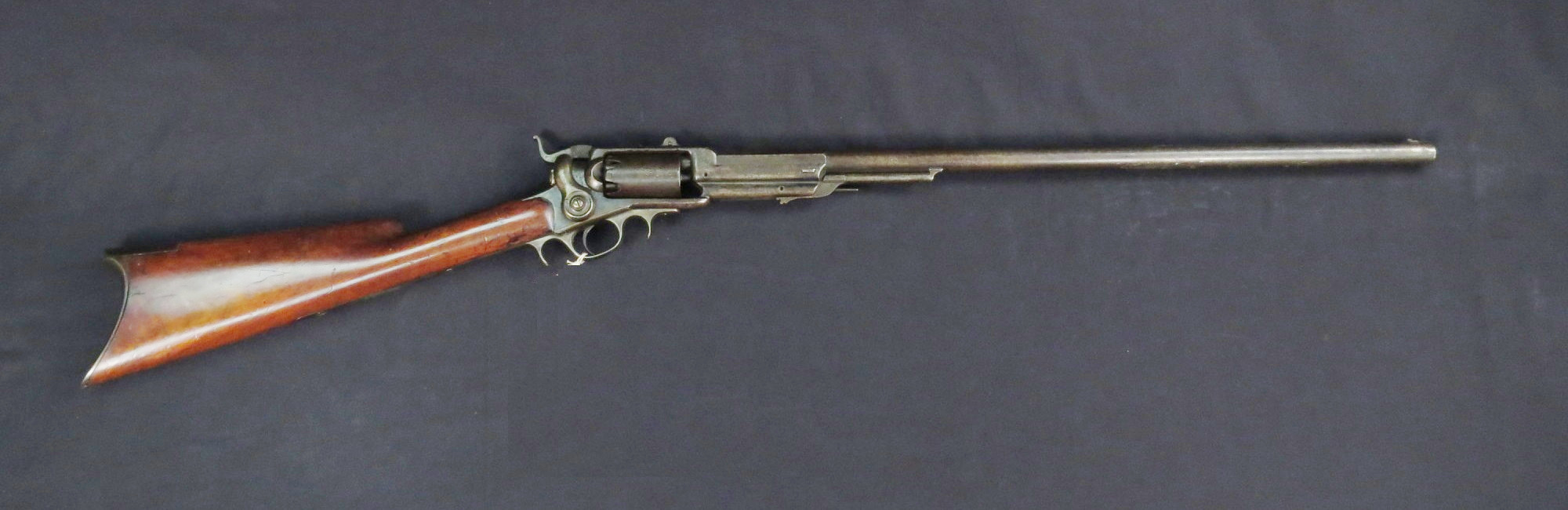
Colt's New Model revolving rifleColt's New Model revolving rifleMain
Open search
Colt's New Model revolving rifle
Community hub
Colt's New Model revolving rifle
logo
8 pages, 0 posts
0 subscribers
Be the first to start a discussion here.
Colt's New Model revolving rifle
from Wikipedia

The Colt New Model revolving rifles were early repeating rifles produced by the Colt's Manufacturing Company from 1855 until 1864. The design was essentially similar to revolver-type handguns, with a rotating cylinder that held five or six rounds in a variety of calibers from .36 to .64 inches.[1] They were mainly based upon the Colt Model 1855 Sidehammer Pocket Revolver developed by Elisha K. Root. Colt revolving pistols and rifles were attractive mainly because of their high rate of fire. They were used to a limited extent on the Pony Express and made a brief appearance in the American Civil War.[2][3] However, the rifles were generally disliked by soldiers, and were ultimately discontinued due to serious design flaws.

Key Information

History

[edit]

Revolving rifles were an attempt to increase the rate of fire of rifles by combining them with the revolving firing mechanism that had been developed earlier for revolving pistols. Colt began experimenting with revolving rifles in the early 19th century, making them in a variety of calibers and barrel lengths.[4]

Colt Paterson 1838 ring-lever rifle

Colt revolving rifles were the first repeating rifles adopted by the U.S. government, but they had their problems. They were officially given to soldiers because of their rate of fire. But after firing six shots, the shooter had to take an excessive amount of time to reload. On occasion Colt rifles discharged all their rounds at once, endangering the shooter. Even so, an early model was used in the Seminole Wars in 1838.[5]

In March 1836, Colt formed the Patent Arms Company and began operation in an unused silk mill along the banks of the Passaic River in Paterson, New Jersey. His first product was a ring-lever revolving rifle, available in .34, .36, .38, .40, and .44 caliber, in which a ring located forward of the trigger served to cock the hammer and advance the cylinder for each shot. This was soon followed with a revolving pistol. These five-shot "Paterson" revolvers featured folding triggers and were available both with and without loading levers in .28, .31 and .36 caliber.

Patent Arms produced smoothbore revolving carbines and shotguns. The outbreak of war between the U.S. government and the Seminole tribe provided Colt with his first break. Seminole warriors had learned that soldiers were vulnerable while reloading their single-shot firearms, and they developed a tactic of drawing fire, then rushing the temporarily defenseless soldiers and wiping them out before they could fire a second volley. Colt's revolving rifles were quite effective against this, and the army purchased his products for use by troops in the Florida campaign.[6]

In 1855, with his Model 1855 patent, Colt introduced a spur-trigger revolver that featured a fully enclosed cylinder. These handguns were officially named Sidehammer revolvers, but they also were known as "Root" revolvers after Elisha K. Root, who at that time was employed as Colt's factory superintendent and Chief Engineer.[7]

Based on the Sidehammer design, Colt produced the Sidehammer Model 1855 rifles and carbines for military and sporting use, as well as a revolving shotgun. In failing health, Colt expanded his factory on the eve of the Civil War, and began production of a new, lightweight .44 caliber Army revolver, followed a year later by a .36 caliber Navy version.[8]

This was produced in a rifle version as well as a shortened carbine. In 1855 it became the first repeating rifle to be adopted for service by the U.S. Military, but problems with the design prevented its use until 1857. The principal problem was that gunpowder would sometimes leak from the paper cartridges in field conditions, lodging in various recesses around the firing cylinder. Hot gas leaking from the gap between the firing cylinder and the barrel would ignite this powder, which would in turn, ignite all of the powder in the chambers waiting to be fired. This is known as a "chain fire" and was a relatively common failure with early percussion revolving firearms. When this happened with the Colt Revolving Rifle, a spray of metal would be sent forward into the left arm and hand of the user.[9]

A distrust in the weapon developed as a result. Commanders attempted to get around the problem in a number of ways. The rifle had to be properly and thoroughly cleaned, since sloppy cleaning would leave residue behind that would increase the risk of a chain fire. Some commanders instructed their men to fire the weapon only while supporting it directly in front of the trigger guard or by holding the lowered loading lever, which moved their left hand out of the path of danger during a chain fire. Other commanders instructed their men to load only a single chamber, preventing any chain fires from occurring. Loading a single chamber at a time also reduced the weapon to a single shot weapon, and effectively defeated the entire purpose of having a repeating rifle.[9]

Brevete Colt Dragoon revolving rifles were made in Belgium under license from Colt during the 1850s to 1860s.

Design and features

[edit]
Two Colt Model 1851 Navy revolvers with same caliber and a Colt Root Model 1855 rifle, .36 cal.
Colt Root carbines, .56 cal.

The design of the Colt revolving rifle was essentially similar to revolver-type pistols, with a rotating cylinder that held five or six rounds in a variety of calibers from .36 to .64 inches.[1]

The Model 1855, which was the most widely produced revolving rifle, was available in .36, .44 and .56 caliber. Four barrel lengths were available: 15, 18, 21 and 24 inches. A six shot cylinder was used if the caliber was .36 or .44. If the caliber was .56, a five-shot cylinder was used.[10]

A revolving rifle used percussion caps, like revolving pistols of the time. A cartridge (consisting of powder and a lead ball) was loaded into the front of the chamber and then compressed with a plunger that was located beneath the barrel. Once the cylinder's chambers were loaded, percussion caps were placed over the vent nipples at the rear of the cylinder. The weapon was now ready to fire. In addition to being susceptible to chain fire problems, the revolving cylinder design also tended to spray lead splinters into the wrist and hand of the user.[11] Revolving pistols did not suffer from this problem since the user kept both hands behind the cylinder while firing a pistol.

Some models could be fitted with sword or socket bayonets. The front sight would double as the bayonet lug for use with a socket bayonet, and those adapted for sword bayonets had lugs on the right side.

Use

[edit]

A combination of Colt revolving pistols and revolving rifles were used on the Pony Express by the eight men who guarded the dangerous run between Independence, Missouri, and Santa Fe. When doubts were expressed about the ability of these eight men to deliver the letters on this run reliably, the in Missouri government declared that "these eight men are ready in case of attack to discharge 136 shots without having to reload. We have no fears for the safety of the mail." All mail deliveries on this route were completed safely.[12]

The U.S. government had purchased 765 Colt revolving carbines and rifles prior to the Civil War. Many of these were shipped to southern locations and ended up being used by the Confederacy.[11] After the war began, the Union purchased many more rifles and carbines. Sources disagree over the exact number purchased, but approximately 4,400 to 4,800 were purchased in total over the length of the war.

The weapon performed superbly in combat, seeing action with the 21st Ohio Volunteer Infantry Union forces at The Slaughter Pen while covering the withdrawal of John Miller's brigade during the Battle of Stones River[13] and Snodgrass Hill during the Battle of Chickamauga during the American Civil War.[2][3] The volume of fire from this weapon proved to be so useful that the Confederate forces were convinced that they were attacking an entire division, not just a single regiment, but still, the Ohioans ran out of ammunition, and surrendered.[1] Despite these victories, the rifle's faults would prove fatal for the weapon. A board of officers evaluated the evidence and decided to discontinue its use. The rifles were sold for 42 cents each, a fraction of the original purchase cost of 44 dollars.[9]

Many revolving rifles were purchased for the use of the militia of various states, and many militia companies entered the Civil War armed with them and never really used them in combat situations. The Colt Company made a number of sizes in the attempt to adapt the rifles to the various branches of the service. When used in the Civil War the soldiers in all branches of the service disliked them exceedingly on account of the flash and loud report so close to the face and dangerously strong recoil when several chambers went off at once.[14]

See also

[edit]

References

[edit]
[edit]
Revisions and contributorsEdit on WikipediaRead on Wikipedia
from Grokipedia
The Colt's New Model revolving rifle, introduced in 1855, was an innovative early repeating long arm produced by the Colt's Patent Fire-Arms Manufacturing Company, adapting the revolving cylinder mechanism from Samuel Colt's popular percussion revolvers to a platform for rapid fire capability in a cap-and-ball design. It featured a side-hammer action developed by Elisha K. Root, a 5-shot cylinder, and was chambered in .36, .44, or .56 calibers, with variants including full-stocked military rifles (with barrel lengths ranging from 31 to 37 inches), half-stocked sporting rifles, shorter carbines (around 24-inch barrels), and even revolving shotguns. Production of the Model 1855 series ran from 1855 to 1864, with approximately 18,300 revolving long arms manufactured in total, including about 1,100 shotguns and the remainder as rifled variants, marking a significant but limited output compared to muzzleloaders of the era. The design represented Colt's attempt to extend revolver technology to shoulder weapons for military and civilian markets, following earlier experimental revolving rifles like the Paterson model, but it gained modest adoption due to its formidable firepower in conflicts such as the , where small numbers were issued to Union and Confederate forces, Texas Rangers, and frontier militias. Despite its novelty, the rifle faced criticism for safety issues, particularly "chain fire" where ignition flash from one chamber could set off adjacent loaded rounds, posing a risk of multiple simultaneous discharges and burns to the shooter's supporting arm—a problem exacerbated by the longer barrel and shoulder-fired use compared to handguns. This led to limited military contracts, such as trial lots purchased by the U.S. Army and issuances to units like the militia in 1859, while civilian versions appealed to hunters and explorers for their repeating advantage over contemporary breechloaders. Production ceased in 1864 as metallic cartridge rifles emerged, but the New Model's legacy endures as a pioneering step in American development.

Development and production

Invention and early development

Samuel Colt, renowned for his innovative revolving-cylinder firearms patented in 1836, extended this technology to long arms during the mid-19th century, adapting the mechanism from his successful pistols of the 1830s and 1840s to create a suitable for military and frontier applications. The primary motivation stemmed from the limitations of single-shot muskets exposed during the Mexican-American War (1846–1848) and the ongoing demand for rapid-fire weapons amid U.S. territorial expansion into the West, where settlers and troops required superior firepower against irregular combatants. Colt envisioned a rifle that combined the reliability of his design with the range and power of a shoulder arm, addressing these needs through iterative experimentation at his , factory. In 1849, Colt hired Elisha King Root, an accomplished machinist and inventor previously with the Collins Axe Company, as factory superintendent to oversee production innovations and mechanical refinements. Their collaboration focused on integrating a lever-action loading system with the revolving cylinder, enabling efficient reloading under field conditions; Root's expertise in precision tooling was crucial for prototyping this hybrid design between 1851 and 1854. These early prototypes underwent testing to refine the cylinder alignment, hammer mechanism, and barrel integration, overcoming challenges like gas leakage while building on the enclosed-frame concepts from Colt's handguns. The effort culminated in Root's U.S. Patent No. 13,999, granted on December 25, 1855, for improvements in revolving fire-arms that formed the core of the New Model rifle's operation. The invention reached a milestone with its first public demonstrations in at Colt's armory in , where the rifle's multi-shot capability was showcased to military officials and potential buyers, demonstrating its potential to revolutionize . These events highlighted the design's promise as a bridge between traditional muskets and emerging repeating arms, setting the stage for formal trials and adoption despite ongoing refinements to address reliability issues.

Manufacturing and variants

The Colt's New Model revolving rifle was manufactured at the Colt's Patent Fire-Arms Manufacturing Company in , beginning in 1855 under the direction of and chief engineer Elisha K. Root. Initial production focused on small batches for testing and early civilian markets, with the first significant output including approximately 100 .44-caliber military-pattern rifles delivered to the U.S. government in 1856, followed by additional trials of 300 units in 1858. By the onset of the , demand surged, leading to expanded production without subcontracting to external facilities like Eli Whitney's armory, which had been used for earlier Colt designs. Total output of revolving long arms—including , carbines, and a smaller number of shotguns—reached approximately 18,300 units between 1855 and 1864, with the majority being rifled variants in configurations for both civilian and military use. Production emphasized precision machining of , a hallmark of Colt's factory methods, though chain fires and complexity limited scalability compared to single-shot alternatives. Key variants of the New Model series centered on the 1855 design with a side-mounted , featuring a five- or six-shot cylinder and loading lever. The Root Side Hammer model, named for its designer, was produced as both full-stock rifles and half-stock carbines in calibers including .36, .44, and .56, with barrel lengths ranging from 18 inches for carbines to 37.5 inches for military rifles equipped for bayonets. An improved 1857 iteration incorporated refinements to the frame and lever mechanism, while the 1860 Army variant adapted the design for .44- and .56-caliber contracts, producing over 3,700 .56-caliber rifles with 37.5-inch barrels between 1862 and 1863. Civilian models often featured shorter barrels and lighter stocks for sporting use, contrasting with the heavier patterns. Early sales targeted civilians and state forces, but federal contracts dominated from 1861 onward, with the U.S. Army ordering thousands for and . Production declined sharply after 1864 as the military shifted to breech-loading single-shot rifles like the Springfield, halting manufacture amid preferences for simpler, more reliable designs.

Design and operation

Key mechanical features

The Colt's New Model revolving rifle, introduced in , utilized a single-action firing mechanism in which the side-mounted was manually cocked by the shooter, engaging a pawl to rotate and index the revolving into alignment with the fixed barrel for the next shot. This design, adapted from Colt's successful percussion revolvers, allowed for sequential firing without reloading after each round, with the featuring a fluted, five- or six-shot capacity depending on the variant. A locking bolt secured the in position during firing to ensure accuracy and prevent misalignment. Loading was performed from the front of the cylinder using an underlever rammer positioned beneath the barrel, which doubled as a structural brace to support the extended barrel during operation. The process involved cocking the hammer to half-cock to rotate the cylinder and expose each chamber, pouring a measured charge of black powder directly into the chamber, seating a lead ball or conical projectile atop the powder, ramming it firmly with the lowered lever to compress the load, and finally affixing a percussion cap to the corresponding nipple on the rear of the cylinder. The frame, constructed of steel, enclosed the mechanism in a solid, closed-top configuration developed by engineer Elisha K. Root, providing greater rigidity compared to open-frame predecessors. Barrels were offered in octagonal or round profiles, measuring 24 to 37 1/2 inches in length depending on the variant (carbine, rifle, or musket), to balance portability, velocity, and military requirements, with rifling to impart spin on the projectile. Notable for its era, the rifle incorporated no dedicated safety devices, rendering it vulnerable to chain-fire—a hazardous condition where flame from the ignited chamber flashed over to adjacent loaded chambers via powder residue or cap ignition, potentially causing multiple simultaneous discharges. This risk was exacerbated by the forward hand position required to steady the long barrel, which could expose the shooter's support hand to escaping gases or fragments. Compared to prevailing single-shot muzzle-loading rifles and muskets, which achieved a practical rate of 2 to 3 rounds per minute under combat conditions, the New Model's repeating capability enabled a significantly higher rate of fire for a trained user, marking a significant advancement in firepower despite the complexities of percussion loading. The Root sidehammer variant, with its more compact frame, exemplified adaptations for lighter civilian or carbine configurations while retaining these core mechanics.

Calibers and ammunition

The Colt's New Model revolving rifle, produced as part of the Model 1855 series, was available in multiple calibers to suit various military and civilian applications. The standard Army models were typically chambered in .44 caliber with a six-shot cylinder, while larger military variants adopted a .56 caliber configuration with a five-shot cylinder to accommodate heavier loads. Smaller calibers ranging from .28 to .36 were employed in the Root sidehammer carbine variants, which featured a more compact design for cavalry use. Ammunition for the rifle consisted of black powder charges, lead round balls, and percussion caps in a cap-and-ball system, with options for loose components or pre-packaged paper cartridges containing the and ball for faster loading. The paper cartridges were combustible and designed to simplify the process, though loose and ball remained common for field adjustments. This percussion ignition relied on small caps struck by the to ignite the main charge, a standard of mid-19th-century firearms. Loading followed a sequential process similar to contemporary Colt revolvers but adapted for the rifle's longer barrel and plunger mechanism: powder was poured into each open chamber from , followed by the lead ball seated atop it, and then rammed firmly using the under-barrel loading to ensure a tight seal against the barrel. Percussion caps were subsequently placed on the 's nipples, with the rotated manually or via the cocking action for alignment. Proper seating was critical to prevent gas leakage, misfires, or dangerous chain-firing across chambers. Ballistic performance varied by caliber and load, with the .56-inch version delivering substantial through 360-grain lead balls propelled by black powder charges. Effective engagement ranges were typically 100 to 200 yards for accurate fire, though rear sights were graduated up to 600 yards, and historical accounts document hits at 300 yards under combat conditions. The design's reliance on round balls persisted into the era, limiting rifling utilization compared to rifles, though some users experimented with conical projectiles for improved accuracy.

Military and civilian use

Role in the American Civil War

The Colt's New Model revolving rifle, primarily in its .56-caliber five-shot carbine variant, saw significant procurement by the Union Army at the outset of the Civil War. At the end of January , the U.S. government received 1,000 units at the Washington Arsenal, building on pre-war acquisitions of over 700 similar rifles. Additional contracts followed, including 824 rifles delivered in October to Maj. Gen. William S. Rosecrans' and 1,600 more ordered in November for his cavalry forces, contributing to a total federal purchase of approximately 4,600 units. These weapons were mostly issued as carbines to mounted troops, with about 5,000 entering service overall, though their high cost limited widespread infantry adoption. Some units, such as Berdan's 1st and 2nd U.S. Sharpshooters, received them but preferred single-shot rifles like the Sharps, leading to instances of refusal or rioting. Union cavalry regiments, including the 2nd Michigan Cavalry under Col. Philip H. Sheridan, the 2nd Iowa Cavalry, the 7th Kansas Cavalry, and the , were primary recipients, valuing the rifle's capacity for rapid, repeating fire in mounted skirmishes. Infantry units like the , , and also employed them in select engagements. Confederate forces obtained limited numbers through battlefield captures, such as early-war seizures of carbines, but there is no evidence of significant imports via blockade runners. Tactically, the rifle provided a advantage in close-quarters actions, allowing five rapid shots before reloading, which proved effective against Confederate charges. At the , on July 1, , the 2nd repelled a larger Confederate force at 25 to 30 yards, with troopers firing multiple volleys and even using rifle butts in . During the on September 20, 1863, the 21st Ohio Infantry, armed with 347 Colt rifles, expended 43,550 rounds while holding defensive positions, scavenging ammunition from the fallen amid intense fighting. At Brice's Crossroads on June 10, 1864, 140 men from the 9th served as skirmishers behind cover, leveraging the weapon's repeating capability to delay Confederate advances. Berdan's Sharpshooters also used the rifles against Rebel artillery and infantry near Yorktown and Falmouth in , contributing to Union defensive efforts. Reports highlighted its value in such scenarios, though operational challenges like frequent repairs and ammunition shortages often hampered sustained use.

Other historical applications

Prior to the , the Colt Model 1855 revolving rifle saw limited military deployment in frontier conflicts. In 1857, during the (also known as the Mormon War), U.S. Army Captain Randolph B. Marcy's command of the 10th received 100 Colt revolving rifles while marching from to join the Utah Expedition, providing troops with repeating firepower amid tensions with Mormon settlers. These arms were part of early field trials, with approximately 318 rifles purchased by the U.S. government between July 1858 and June 1860 for distribution to state militias and frontier units engaged in Indian Wars. Civilians on the adopted the half-stock sporting variant of the Model 1855 for hunting and between 1855 and 1860, valuing its rapid-fire capability in remote areas. Stagecoach guards along the carried Colt revolving rifles, allowing rapid fire during potential ambushes by bandits or Native Americans. Migrants on trails like the similarly relied on these rifles for protection against wildlife and threats, as the design's revolver-based mechanism offered superior over single-shot muzzleloaders in isolated settings. Limited international exports of the Model 1855 occurred in the , primarily to Britain and amid growing demand for advanced . British proof marks appear on examples produced around , indicating shipments for evaluation or commercial sale during the lead-up to the , though the rifle was not formally adopted by British forces after trials. ordered quantities of the New Model revolving rifles to bolster firepower needs, but adoption remained minimal due to logistical challenges and competition from other designs. Following the Civil War, surplus Colt revolving rifles entered civilian hands through government sales to settlers expanding westward, serving as affordable repeating arms in the late 1860s. These surplus pieces appeared rarely in post-1865 Indian Wars engagements, as troops increasingly favored more reliable breech-loading repeaters like the Spencer and Henry rifles by the 1870s, leading to the Model 1855's phase-out. By the early , the rifle garnered interest among historians and collectors for its pioneering role in technology, as documented in period works like Charles Winthrop Sawyer's 1920 publication Our Rifles: Firearms in American History.

Limitations and legacy

Operational issues

The Colt's New Model revolving rifle suffered from several operational challenges that compromised its reliability and safety in field use. One primary hazard was chain-firing, where loose percussion caps or powder leakage allowed sparks to ignite multiple chambers simultaneously, resulting in uncontrolled discharge and potential injury to the shooter's hand or face from escaping gases and fragments. This risk was exacerbated by the design's reliance on black powder, which produced significant that built up after repeated shots, increasing the likelihood of misfires or chain events if not addressed. Historical accounts from Civil War units, such as the 21st Ohio Infantry, noted that fouling from residue made the weapon sensitive to cleanliness, with improper leading to jams or unintended ignitions. Loading the rifle presented significant difficulties, particularly in combat conditions, as the process required inserting paper cartridges into each of the five or six chambers, followed by seating the balls and applying percussion caps—a procedure that could take 30 to or longer under stress, far slower than muzzleloaders for sustained fire. The paper cartridges were prone to tearing during insertion, spilling loose into the mechanism, which could ignite prematurely from friction or residual heat, frequently burning soldiers' hands during loading. This issue was particularly acute in the Model 1855, issued on a basis to the pre-Civil War Army, where accidental ignition of the cartridges while filling the led to multiple reports of hand burns among troops. Durability was another concern, as the gap between the cylinder and barrel allowed hot gases to escape with each shot, eroding the frame over time and weakening the overall structure, especially under rapid fire. Misloads, due to the cumbersome cylinder access, could lead to cylinder explosions from uneven powder distribution, further stressing the frame and posing explosion risks. The rifle's performance deteriorated in adverse conditions, such as rain or mud, where black powder residue absorbed moisture, causing misfires or swelling that jammed the cylinder; unlike later metallic-cartridge rifles, it required frequent cleaning—often after every 20-30 rounds—to mitigate fouling and maintain function. User contributed to a high accident rate, with untrained troops experiencing more incidents due to improper handling of the complex loading and capping process. Documented cases from Civil War regiments, including broken arms and wrists from chain fires or injuries during mishandled reloads, highlighted the need for extensive drill, yet many units like Berdan's U.S. Sharpshooters received the rifle with minimal instruction, leading to its reputation as "much-detested" and quick replacement with single-shot alternatives. The 21st Ohio Infantry, armed with 350 rifles in 1863, reported few men had prior , amplifying operational errors and injuries in battle.

Influence and modern replicas

The Colt New Model revolving rifle, also known as the Model 1855, marked a pivotal advancement in technology during the mid-19th century, introducing a practical revolving-cylinder mechanism to longarms that extended the principles of Samuel Colt's earlier s. This design bridged the cap-and-ball percussion era to the metallic cartridge period, as post-Civil War conversions adapted the percussion models to fire rimfire or , facilitating the shift toward self-contained rounds. Despite inherent flaws like cylinder flash and chain-fire risks, it symbolized American ingenuity in pursuit of rapid-fire capabilities, influencing the evolution of reliable and contributing to Colt's legacy in handgun development, including the Single Action Army revolver of 1873. Modern replicas of the Model 1855, produced by companies like Palmetto Arms in for black powder loads, emerged in the late ; though Palmetto ceased operations in the early , used examples and kits from makers like Dixie Gun Works remain sought after by enthusiasts for historical shooting and Civil War reenactments as of 2025. These faithful reproductions preserve the sidehammer design and percussion operation, allowing safe recreation of the original's mechanics while adhering to contemporary black powder regulations. Original Colt revolving rifles command significant collectibility today, with well-preserved examples fetching $5,000 to $20,000 at based on condition, variant, and historical ties; for instance, a standard Model 1855 sold for $4,500 in 2023, while rarer sporting models exceed $10,000. Institutions such as the Smithsonian house multiple specimens, including percussion and converted variants, underscoring their enduring historical value. In , the Colt revolving rifle appears in Western films as an emblematic but imperfect , evoking the perils and promise of frontier armament; notable appearances include the 1967 El Dorado.

References

Add your contribution
Related Hubs
User Avatar
No comments yet.