
Recent from talks
Textiles of Sumba
Knowledge base stats:
Talk channels stats:
Members stats:
Textiles of Sumba
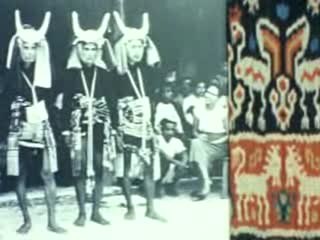
The textiles of Sumba, an island in eastern Indonesia, represent the means by which the present generation passes on its messages to future generations. Sumbanese textiles are deeply personal; they follow a distinct systematic form but also show the individuality of the weavers and the villages where they are produced. Internationally, Sumbanese textiles are collected as examples of textile designs of the highest quality and are found in major museums around the world, as well as in the homes of collectors.
Since the early 1900s, the Dutch were exporting textiles from Sumba. Today, great numbers of textiles are still produced by a relatively small number of women, mainly from the eastern coastal districts of Sumba. These textiles are made not only for export, but also for trade among local people for ritual use, where, by custom, the process of ikat was forbidden.
Since textiles are the products of Sumbanese women, they are viewed as tangible representations of the female element of the bipartite universe. In Sumba, this male-female dynamic is encapsulated in the notion of the Highest Being, who is both the Father Sun and Mother Moon, as well as the Creator or Weaver of human life. The Sumbanese believe individuals are able to acquire the special powers and qualities of certain creatures when textiles displaying such motifs are worn.
Although the appropriate clothes for Sumbanese men and women are different, Sumbanese textiles are seen collectively as a female component of their cosmos. The textiles are both clothing and the currency of traditional ceremonial exchange. Many fine-folded textiles must be presented at each marriage as part of a counter-payment for a bridewealth paid in horses, buffalo, and gold, and at each funeral as a sign of mourning and later also a counter-payment for animals that were contributed for slaughtering. In marriages, the textiles are symbolic and represent dowry from the woman's family, the wife-givers, who are ritually superior on ceremonial occasions. The textiles are a prominent part of reciprocal gift for male dowry, such as metal, buffalo, and ivory from the man's family, whose burden in gift-giving is heavier because of the inferior status of the wife-taker to that of the wife-giver.
The textiles are also traded or given to show that a contract is binding, as a kind of "interest payment" to request for more time to discharge a debt, and as a gesture of gratitude or reciprocation. Within these contexts, the textiles are counted; their collective value is estimated on the basis of materials, workmanship, design, and their relative worth in relation to the livestock traded for it, if any. These estimations value indigo-dyed textiles more than those made with commercial dyes, value hand-spun thread more than store-bought thread, and value labor-intensive techniques of supplementary ikat-dyeing more than simpler and faster designs.
The dominant weaving technique for the hinggi is ikat of the warp, although supplementary weaving of both the warp and weft are sometimes used. For more important textiles, the ends are finished with a tapestry weave.
The process of dyeing the pattern of a particular piece of cloth involves first setting the warp up on a frame, which gives the length of the cloth. In most cases, one end mirrors the other, and the left side of a panel mirrors the right side. Two identical panels are dyed, woven, and then joined. Because the technique is very labor-intensive, the designer, usually the weaver, generally does the setting out and dyeing simultaneously such that two textiles are constructed at the same time.
Women's skirts, the lau, are a plain weave with a variety of decorative techniques added, including embroidery, the application of shells and beads, the supplementary weave of the weft, and, occasionally, ikat.
Hub AI
Textiles of Sumba AI simulator
(@Textiles of Sumba_simulator)
Textiles of Sumba
The textiles of Sumba, an island in eastern Indonesia, represent the means by which the present generation passes on its messages to future generations. Sumbanese textiles are deeply personal; they follow a distinct systematic form but also show the individuality of the weavers and the villages where they are produced. Internationally, Sumbanese textiles are collected as examples of textile designs of the highest quality and are found in major museums around the world, as well as in the homes of collectors.
Since the early 1900s, the Dutch were exporting textiles from Sumba. Today, great numbers of textiles are still produced by a relatively small number of women, mainly from the eastern coastal districts of Sumba. These textiles are made not only for export, but also for trade among local people for ritual use, where, by custom, the process of ikat was forbidden.
Since textiles are the products of Sumbanese women, they are viewed as tangible representations of the female element of the bipartite universe. In Sumba, this male-female dynamic is encapsulated in the notion of the Highest Being, who is both the Father Sun and Mother Moon, as well as the Creator or Weaver of human life. The Sumbanese believe individuals are able to acquire the special powers and qualities of certain creatures when textiles displaying such motifs are worn.
Although the appropriate clothes for Sumbanese men and women are different, Sumbanese textiles are seen collectively as a female component of their cosmos. The textiles are both clothing and the currency of traditional ceremonial exchange. Many fine-folded textiles must be presented at each marriage as part of a counter-payment for a bridewealth paid in horses, buffalo, and gold, and at each funeral as a sign of mourning and later also a counter-payment for animals that were contributed for slaughtering. In marriages, the textiles are symbolic and represent dowry from the woman's family, the wife-givers, who are ritually superior on ceremonial occasions. The textiles are a prominent part of reciprocal gift for male dowry, such as metal, buffalo, and ivory from the man's family, whose burden in gift-giving is heavier because of the inferior status of the wife-taker to that of the wife-giver.
The textiles are also traded or given to show that a contract is binding, as a kind of "interest payment" to request for more time to discharge a debt, and as a gesture of gratitude or reciprocation. Within these contexts, the textiles are counted; their collective value is estimated on the basis of materials, workmanship, design, and their relative worth in relation to the livestock traded for it, if any. These estimations value indigo-dyed textiles more than those made with commercial dyes, value hand-spun thread more than store-bought thread, and value labor-intensive techniques of supplementary ikat-dyeing more than simpler and faster designs.
The dominant weaving technique for the hinggi is ikat of the warp, although supplementary weaving of both the warp and weft are sometimes used. For more important textiles, the ends are finished with a tapestry weave.
The process of dyeing the pattern of a particular piece of cloth involves first setting the warp up on a frame, which gives the length of the cloth. In most cases, one end mirrors the other, and the left side of a panel mirrors the right side. Two identical panels are dyed, woven, and then joined. Because the technique is very labor-intensive, the designer, usually the weaver, generally does the setting out and dyeing simultaneously such that two textiles are constructed at the same time.
Women's skirts, the lau, are a plain weave with a variety of decorative techniques added, including embroidery, the application of shells and beads, the supplementary weave of the weft, and, occasionally, ikat.
Recent media