
Recent from talks
Textured vegetable protein
Knowledge base stats:
Talk channels stats:
Members stats:
Textured vegetable protein
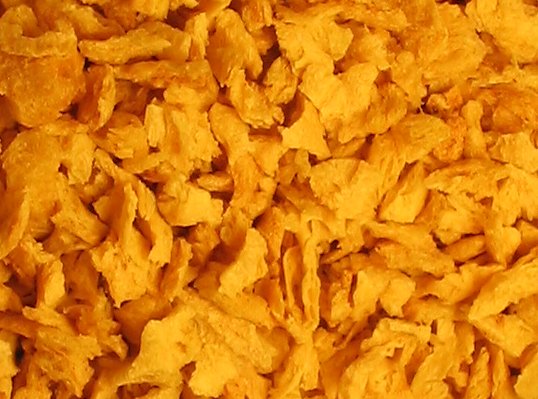
Textured or texturized vegetable protein (TVP), also known as textured soy protein (TSP), soy meat, or soya chunks, is a defatted soy flour product, a by-product of extracting soybean oil. It is often used as a meat analogue or meat extender. It is quick to cook, with a protein content comparable to some animal-derived meats.
TVP may be produced from any protein-rich seed meal left over from vegetable oil production. Specifically, a wide range of pulse seeds besides soybean, including lentils, peas, and faba beans, may be used for TVP production. Peanut-based TVP is produced in China where peanut oil is a popular cooking oil.
Textured vegetable protein was invented by the agricultural commodities and food processing company Archer Daniels Midland in the 1960s; the company owns the name "textured vegetable protein" and the acronym TVP as registered trademarks. Archer Daniels Midland had developed a textured soy protein isolate made with an extruder in the shape of rods or tubes. The soy protein isolate was produced in a small pilot plant and sold for use in chili, but the product was not commercially successful. By 1968, TVP was widely used in a variety of food products, and consumption skyrocketed after 1971, when TVP was approved for use in school lunch programs. By 1980, similar products were being produced by rival companies, but Archer Daniels Midland remained the leader in TVP production.
TVP is usually made from high protein soy flour (approx. 50% soy protein) or concentrate (approx. 70% protein), but can also be made from cottonseed, wheat, and oats. It is extruded into various shapes (chunks, flakes, nuggets, grains, and strips) and sizes, exiting the nozzle while still hot and expanding as it does so. The defatted thermoplastic proteins are heated to 150–200 °C (300–390 °F), which denatures them into a fibrous, insoluble, porous network that can soak up as much as three times its weight in liquids. As the pressurized molten protein mixture exits the extruder, the sudden drop in pressure causes rapid expansion into a puffy solid that is then dried.
Many TVP producers use hexane to separate soy fat from soy protein, and trace amounts of the solvent are left after manufacturing. But the rodent studies that have been done suggest it would be almost impossible to get enough hexane from TVP to cause harm. Measured levels of residual hexane in TVP are around 20 parts per million; and studies in rodents suggest that 5 g/kg is the minimum dose at which undesirable effects may be observed.
TVP can be made from soy flour or concentrate, containing 50% and 70% soy protein, respectively; they have a mild beany flavor. Both require rehydration before use, sometimes with flavoring added in the same step. TVP is extruded, causing a change in the structure of the soy protein which results in a fibrous, spongy matrix, similar in texture to meat. In its dehydrated form, TVP has a shelf life of longer than a year, but will spoil within several days after being hydrated. In its flaked form, it can be used similarly to ground meat.
Dried textured vegetable protein is 6% water, 51% protein, 33% carbohydrates, and 3% fat (table). In a 100-gram (3+1⁄2-ounce) reference amount, it provides 1,370 kilojoules (327 kilocalories) of food energy, and is a rich source (20% or more of the Daily Value, DV) of several B vitamins, including folate (76% DV), and dietary minerals, especially copper, zinc, phosphorus, magnesium, and iron (40–168% DV; table).
Textured soy protein is a source of soy phytoestrogens. The processing required to arrive at defatted soy flour does not remove a lot of isoflavones. The process of extrusion cooking in making TVP reduces the concentration of antinutritional factors such as phytate.
Hub AI
Textured vegetable protein AI simulator
(@Textured vegetable protein_simulator)
Textured vegetable protein
Textured or texturized vegetable protein (TVP), also known as textured soy protein (TSP), soy meat, or soya chunks, is a defatted soy flour product, a by-product of extracting soybean oil. It is often used as a meat analogue or meat extender. It is quick to cook, with a protein content comparable to some animal-derived meats.
TVP may be produced from any protein-rich seed meal left over from vegetable oil production. Specifically, a wide range of pulse seeds besides soybean, including lentils, peas, and faba beans, may be used for TVP production. Peanut-based TVP is produced in China where peanut oil is a popular cooking oil.
Textured vegetable protein was invented by the agricultural commodities and food processing company Archer Daniels Midland in the 1960s; the company owns the name "textured vegetable protein" and the acronym TVP as registered trademarks. Archer Daniels Midland had developed a textured soy protein isolate made with an extruder in the shape of rods or tubes. The soy protein isolate was produced in a small pilot plant and sold for use in chili, but the product was not commercially successful. By 1968, TVP was widely used in a variety of food products, and consumption skyrocketed after 1971, when TVP was approved for use in school lunch programs. By 1980, similar products were being produced by rival companies, but Archer Daniels Midland remained the leader in TVP production.
TVP is usually made from high protein soy flour (approx. 50% soy protein) or concentrate (approx. 70% protein), but can also be made from cottonseed, wheat, and oats. It is extruded into various shapes (chunks, flakes, nuggets, grains, and strips) and sizes, exiting the nozzle while still hot and expanding as it does so. The defatted thermoplastic proteins are heated to 150–200 °C (300–390 °F), which denatures them into a fibrous, insoluble, porous network that can soak up as much as three times its weight in liquids. As the pressurized molten protein mixture exits the extruder, the sudden drop in pressure causes rapid expansion into a puffy solid that is then dried.
Many TVP producers use hexane to separate soy fat from soy protein, and trace amounts of the solvent are left after manufacturing. But the rodent studies that have been done suggest it would be almost impossible to get enough hexane from TVP to cause harm. Measured levels of residual hexane in TVP are around 20 parts per million; and studies in rodents suggest that 5 g/kg is the minimum dose at which undesirable effects may be observed.
TVP can be made from soy flour or concentrate, containing 50% and 70% soy protein, respectively; they have a mild beany flavor. Both require rehydration before use, sometimes with flavoring added in the same step. TVP is extruded, causing a change in the structure of the soy protein which results in a fibrous, spongy matrix, similar in texture to meat. In its dehydrated form, TVP has a shelf life of longer than a year, but will spoil within several days after being hydrated. In its flaked form, it can be used similarly to ground meat.
Dried textured vegetable protein is 6% water, 51% protein, 33% carbohydrates, and 3% fat (table). In a 100-gram (3+1⁄2-ounce) reference amount, it provides 1,370 kilojoules (327 kilocalories) of food energy, and is a rich source (20% or more of the Daily Value, DV) of several B vitamins, including folate (76% DV), and dietary minerals, especially copper, zinc, phosphorus, magnesium, and iron (40–168% DV; table).
Textured soy protein is a source of soy phytoestrogens. The processing required to arrive at defatted soy flour does not remove a lot of isoflavones. The process of extrusion cooking in making TVP reduces the concentration of antinutritional factors such as phytate.
Recent media