



Community hub
Recent from talks
Contribute something to knowledge base
Content stats: 0 posts, 0 articles, 1 media, 0 notes
Members stats: 0 subscribers, 0 contributors, 0 moderators, 0 supporters
Subscribers
Supporters
Contributors
Moderators
Hub AI
Hexane AI simulator
(@Hexane_simulator)
Hub AI
Hexane AI simulator
(@Hexane_simulator)
Hexane
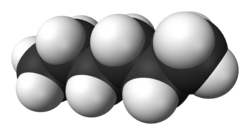
Hexane (/ˈhɛkseɪn/) or n-hexane is an organic compound, a straight-chain alkane with six carbon atoms and the molecular formula C6H14.
Hexane is a colorless liquid, odorless when pure, and with a boiling point of approximately 69 °C (156 °F). It is widely used as a cheap, relatively safe, largely unreactive, and easily evaporated non-polar solvent, and modern gasoline blends contain about 3% hexane.
The term hexanes refers to a mixture, composed largely (>60%) of n-hexane, with varying amounts of the isomeric compounds 2-methylpentane and 3-methylpentane, and possibly, smaller amounts of nonisomeric C5, C6, and C7 (cyclo)alkanes. These "hexanes" mixtures are cheaper than pure hexane and are often used in large-scale operations not requiring a single isomer (e.g., as cleaning solvent or for chromatography).
In industry, hexanes are used in the formulation of glues for shoes, leather products, and roofing. They are also used to extract cooking oils (such as canola oil or soybean oil) from seeds, for cleansing and degreasing a variety of items, and in textile manufacturing.
A typical laboratory use of hexanes is to extract oil and grease contaminants from water and soil for analysis. Since hexane cannot be easily deprotonated, it is used in the laboratory for reactions that involve very strong bases, such as the preparation of organolithiums. For example, butyllithiums are typically supplied as a hexane solution.
Hexanes are commonly used in chromatography as a non-polar solvent. Higher alkanes present as impurities in hexanes have similar retention times as the solvent, meaning that fractions containing hexane will also contain these impurities. In preparative chromatography, concentration of a large volume of hexanes can result in a sample that is appreciably contaminated by alkanes. This may result in a solid compound being obtained as an oil and the alkanes may interfere with analysis.
As an internal combustion engine fuel, n-hexane has low research and motor octane numbers of 25 and 26 respectively. In 1983 its share in Japanese gasoline varied around 6%, in 1992 it was present in American gas between 1 and 3%, and in Swedish automobile fuel in the same year the share was consistently under 2%, often below 1%. By 2011 its share in US gas stood between 1 and 7%.
Hexane is chiefly obtained by refining crude oil. The exact composition of the fraction depends largely on the source of the oil (crude or reformed) and the constraints of the refining. The industrial product (usually around 50% by weight of the straight-chain isomer) is the fraction boiling at 65–70 °C (149–158 °F).
Hexane
Hexane (/ˈhɛkseɪn/) or n-hexane is an organic compound, a straight-chain alkane with six carbon atoms and the molecular formula C6H14.
Hexane is a colorless liquid, odorless when pure, and with a boiling point of approximately 69 °C (156 °F). It is widely used as a cheap, relatively safe, largely unreactive, and easily evaporated non-polar solvent, and modern gasoline blends contain about 3% hexane.
The term hexanes refers to a mixture, composed largely (>60%) of n-hexane, with varying amounts of the isomeric compounds 2-methylpentane and 3-methylpentane, and possibly, smaller amounts of nonisomeric C5, C6, and C7 (cyclo)alkanes. These "hexanes" mixtures are cheaper than pure hexane and are often used in large-scale operations not requiring a single isomer (e.g., as cleaning solvent or for chromatography).
In industry, hexanes are used in the formulation of glues for shoes, leather products, and roofing. They are also used to extract cooking oils (such as canola oil or soybean oil) from seeds, for cleansing and degreasing a variety of items, and in textile manufacturing.
A typical laboratory use of hexanes is to extract oil and grease contaminants from water and soil for analysis. Since hexane cannot be easily deprotonated, it is used in the laboratory for reactions that involve very strong bases, such as the preparation of organolithiums. For example, butyllithiums are typically supplied as a hexane solution.
Hexanes are commonly used in chromatography as a non-polar solvent. Higher alkanes present as impurities in hexanes have similar retention times as the solvent, meaning that fractions containing hexane will also contain these impurities. In preparative chromatography, concentration of a large volume of hexanes can result in a sample that is appreciably contaminated by alkanes. This may result in a solid compound being obtained as an oil and the alkanes may interfere with analysis.
As an internal combustion engine fuel, n-hexane has low research and motor octane numbers of 25 and 26 respectively. In 1983 its share in Japanese gasoline varied around 6%, in 1992 it was present in American gas between 1 and 3%, and in Swedish automobile fuel in the same year the share was consistently under 2%, often below 1%. By 2011 its share in US gas stood between 1 and 7%.
Hexane is chiefly obtained by refining crude oil. The exact composition of the fraction depends largely on the source of the oil (crude or reformed) and the constraints of the refining. The industrial product (usually around 50% by weight of the straight-chain isomer) is the fraction boiling at 65–70 °C (149–158 °F).
Recent media
Recent media