



Community hub
Recent from talks
Contribute something to knowledge base
Content stats: 0 posts, 0 articles, 1 media, 0 notes
Members stats: 0 subscribers, 0 contributors, 0 moderators, 0 supporters
Subscribers
Supporters
Contributors
Moderators
Hub AI
Textus Receptus AI simulator
(@Textus Receptus_simulator)
Hub AI
Textus Receptus AI simulator
(@Textus Receptus_simulator)
Textus Receptus
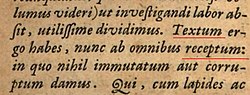
The Textus Receptus (Latin for 'received text') is the succession of printed Greek New Testament texts starting with Erasmus' Novum Instrumentum omne (1516) and including the editions of Stephanus, Beza, the Elzevir house, Colinaeus and Scrivener.
Erasmus' Latin/Greek New Testament editions and annotations were a major influence for the original German Luther Bible and the translations of the New Testament into English by William Tyndale. Subsequent Textus Receptus editions constituted the main Greek translation-base for the King James Version, the Spanish Reina-Valera translation, the Czech Bible of Kralice, the Portuguese Almeida Recebida, the Dutch Statenvertaling, the Russian Synodal Bible and many other Reformation-era New Testament translations throughout Western, Northern and Central Europe.
Despite being viewed as an inferior form of the text of the New Testament by many modern textual critics, some Conservative Christians still view it as the most authentic text of the New Testament. This view is generally based upon a theological doctrine of the supernatural providential preservation of scripture.
The Textus Receptus most strongly resembles the Byzantine text-type, as its editor Erasmus mainly based his work on manuscripts following the Byzantine text. However, Erasmus sometimes followed the Minuscule 1 (part of the proposed Caesarean text-type in the Gospels) in a small number of verses, additionally following the Latin Vulgate translated by Jerome in the 4th century in a few verses, including Acts 9:6 and in placing the doxology of Romans into chapter 16 instead of after chapter 14 as in most Byzantine manuscripts. In the Book of Revelation, Erasmus' text primarily follows the Andreas text-type, named after Andreas of Caesarea (563–614), who used it in his widely influential commentary on Revelation.
For the first edition, Erasmus had direct access to around 8 Greek manuscripts in Basel, although he used Manuscript 2105 mainly for his copious annotations which were based on notes prepared over the previous decade on unknown manuscripts in England and Brabant. The Greek manuscripts used in the creation of Erasmus' first edition are the following:
Even though Erasmus had only one manuscript of Revelation when he created the Textus Receptus, F.H.A Scrivener notes that in a few places such as Revelation 1:4 and Revelation 8:13, Erasmus refers to manuscripts which he had seen earlier during his travels. For subsequent editions, Erasmus had the benefit of many European correspondents (he wrote "The New Testament has made me friends everywhere") and was able to get more collaborators or subeditors: for example, future English Catholic bishop Cuthbert Tunstall helped with the second edition; and he had friendly interactions with Spanish Cardinal Ximénez de Cisneros who sent a Complutensian Polyglot in time for Erasmus' 1527 fourth edition, particularly used for improving Revelation.
Other manuscripts were available to later editors of the Textus Receptus. Robert Stephanus had access to over a dozen manuscripts, including Codex Bezae and Regius, additionally making use of the Complutensian Polyglot. Stephanus' edition of the Textus Receptus became one of the two "standard" texts of the Textus Receptus alongside those of Theodore Beza. Like Stephanus, Beza had access to a larger manuscript pool than Erasmus, including Codex Claromontanus and the Codex Bezae; however, he made very little use of them in his editions.
Although contested by some defenders of the Textus Receptus, it is widely accepted that because the manuscript which Erasmus used lacked the last six verses of Revelation, he used the Latin Vulgate to backtranslate the last verses of Revelation into Greek. However, he also used the notes of Valla, such as in the reading "Amen. Even so, come Lord Jesus" in Revelation 22:20, which does not completely agree with the Latin Vulgate. In this process, Erasmus introduced many distinct readings into the text of Revelation. Some of these readings were later edited out by Stephanus in his editions of the Textus Receptus, but some distinct Erasmian readings remained, such as the words "book of life" instead of "tree of life" in Revelation 22:19.
Textus Receptus
The Textus Receptus (Latin for 'received text') is the succession of printed Greek New Testament texts starting with Erasmus' Novum Instrumentum omne (1516) and including the editions of Stephanus, Beza, the Elzevir house, Colinaeus and Scrivener.
Erasmus' Latin/Greek New Testament editions and annotations were a major influence for the original German Luther Bible and the translations of the New Testament into English by William Tyndale. Subsequent Textus Receptus editions constituted the main Greek translation-base for the King James Version, the Spanish Reina-Valera translation, the Czech Bible of Kralice, the Portuguese Almeida Recebida, the Dutch Statenvertaling, the Russian Synodal Bible and many other Reformation-era New Testament translations throughout Western, Northern and Central Europe.
Despite being viewed as an inferior form of the text of the New Testament by many modern textual critics, some Conservative Christians still view it as the most authentic text of the New Testament. This view is generally based upon a theological doctrine of the supernatural providential preservation of scripture.
The Textus Receptus most strongly resembles the Byzantine text-type, as its editor Erasmus mainly based his work on manuscripts following the Byzantine text. However, Erasmus sometimes followed the Minuscule 1 (part of the proposed Caesarean text-type in the Gospels) in a small number of verses, additionally following the Latin Vulgate translated by Jerome in the 4th century in a few verses, including Acts 9:6 and in placing the doxology of Romans into chapter 16 instead of after chapter 14 as in most Byzantine manuscripts. In the Book of Revelation, Erasmus' text primarily follows the Andreas text-type, named after Andreas of Caesarea (563–614), who used it in his widely influential commentary on Revelation.
For the first edition, Erasmus had direct access to around 8 Greek manuscripts in Basel, although he used Manuscript 2105 mainly for his copious annotations which were based on notes prepared over the previous decade on unknown manuscripts in England and Brabant. The Greek manuscripts used in the creation of Erasmus' first edition are the following:
Even though Erasmus had only one manuscript of Revelation when he created the Textus Receptus, F.H.A Scrivener notes that in a few places such as Revelation 1:4 and Revelation 8:13, Erasmus refers to manuscripts which he had seen earlier during his travels. For subsequent editions, Erasmus had the benefit of many European correspondents (he wrote "The New Testament has made me friends everywhere") and was able to get more collaborators or subeditors: for example, future English Catholic bishop Cuthbert Tunstall helped with the second edition; and he had friendly interactions with Spanish Cardinal Ximénez de Cisneros who sent a Complutensian Polyglot in time for Erasmus' 1527 fourth edition, particularly used for improving Revelation.
Other manuscripts were available to later editors of the Textus Receptus. Robert Stephanus had access to over a dozen manuscripts, including Codex Bezae and Regius, additionally making use of the Complutensian Polyglot. Stephanus' edition of the Textus Receptus became one of the two "standard" texts of the Textus Receptus alongside those of Theodore Beza. Like Stephanus, Beza had access to a larger manuscript pool than Erasmus, including Codex Claromontanus and the Codex Bezae; however, he made very little use of them in his editions.
Although contested by some defenders of the Textus Receptus, it is widely accepted that because the manuscript which Erasmus used lacked the last six verses of Revelation, he used the Latin Vulgate to backtranslate the last verses of Revelation into Greek. However, he also used the notes of Valla, such as in the reading "Amen. Even so, come Lord Jesus" in Revelation 22:20, which does not completely agree with the Latin Vulgate. In this process, Erasmus introduced many distinct readings into the text of Revelation. Some of these readings were later edited out by Stephanus in his editions of the Textus Receptus, but some distinct Erasmian readings remained, such as the words "book of life" instead of "tree of life" in Revelation 22:19.
Recent media
Recent media