
Recent from talks
The Autobiography of Benjamin Franklin
Knowledge base stats:
Talk channels stats:
Members stats:
The Autobiography of Benjamin Franklin
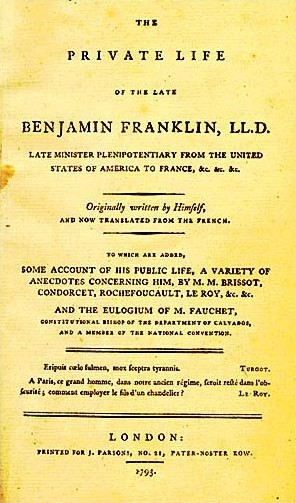
The Autobiography of Benjamin Franklin is the traditional name for the unfinished record of his own life written by Benjamin Franklin from 1771 to 1790; however, Franklin appears to have called the work his Memoirs. Although it had a tortuous publication history after Franklin's death, this work has become one of the most famous and influential examples of an autobiography ever written.
Franklin's account of his life is divided into four parts, reflecting the different periods during which he wrote them. There are actual breaks between the first three parts of the narrative, but Part Three's narrative continues into Part Four without an authorial break. The work ends with events in his life from the year 1758 when he was 52 (Franklin would die in 1790 at age 84).
In the "Introduction" of the 1916 publication of the Autobiography, editor F. W. Pine wrote that Franklin's biography provided the "most remarkable of all the remarkable histories of our self-made men" with Franklin as the greatest exemplar.
Part One of the Autobiography is addressed to Franklin's son William age 41, at that time (1771) Royal Governor of New Jersey. While in England at the estate of the Bishop of St Asaph in Twyford, the 65-year-old Franklin begins by describing his parents and grandparents, recounting his childhood, expressing his fondness for reading, and narrating his apprenticeship to his brother James Franklin, a Boston printer and publisher of the New-England Courant. A fan of the Spectator by Joseph Addison and Sir Richard Steele, Franklin slipped an anonymous paper under the door of his brother's printing house at night. Not knowing its author, James Franklin published it in the Courant, which encouraged Franklin to publish more essays under the pen name Silence Dogood, later collected as the "Silence Dogood" essays. When Franklin finally revealed his authorship, James Franklin was angered, leading to frequent disputes between the two, and causing Franklin to eventually abandon the apprenticeship.
After being jailed by authorities, James Franklin was ordered to cease publication of the Courant, leading him to contrive to have the paper continue under his brother Benjamin's name, but fully under his own control. While signing the discharge of Franklin's apprenticeship, James Franklin attempted to draft new secret indenture papers that would secure Franklin's service for another period of time. But when a fresh disagreement arose between the brothers, Franklin abandoned his brother, correctly judging that he will not produce the secret indenture papers. ("It was not fair in me to take this Advantage", Franklin comments, "and this I therefore reckon one of the first Errata of my life".) James Franklin, however, made it impossible for Franklin to get work anywhere else in Boston. Sneaking onto a ship without his father or brother's knowledge, Franklin headed for New York City, to work with printer William Bradford, but it turned out that Bradford was unable to employ him. However, Franklin was instructed to find Bradford's son Andrew, a Philadelphia printer, who had recently lost an employee.
Arriving in Philadelphia, Franklin finally found work under printer Samuel Keimer. The Governor of Pennsylvania, Sir William Keith, took notice of Franklin and offered to set him up in business for himself. On Keith's recommendation, Franklin traveled to London, but on arrival found that Keith had not written the promised letter of recommendation for him, and that "no one who knew him had the smallest Dependence on him". Franklin found work there until to Philadelphia as an assistant to Thomas Denham, a Quaker merchant, only to return to Keimer's shop after Denham's unexpected death. After quitting over his wages, Franklin left Keimer to begin a printing partnership with Hugh Meredith, a former co-worker. The shop is subsidized by Meredith's father, though most of the work is done by Franklin as Meredith is not much of worker and is given to drinking.
Their first project was to launch a newspaper, but when Keimer hears of this, he rushes out a paper of his own, the Pennsylvania Gazette, a failure, which Franklin buys from Keimer and makes "extremely profitable". (The Saturday Evening Post traces its lineage to Franklin's Pennsylvania Gazette.) The partners also received an appointment as printers for the Pennsylvania assembly. When financial setbacks led to Meredith's father withdrawing his financial support of the paper, friends loan Franklin the money he needs to keep it in operation. The partnership amicably dissolved when Meredith relocated to North Carolina, and Franklin continued the business in his own name. In 1730, Franklin married Deborah Read, and after which, with the help of the Junto, he drafted proposals for Library Company of Philadelphia. Part One ends with a memo from Franklin's noting that "The Affairs of the Revolution occasion'd the Interruption".
The second part begins with two letters Franklin received in the early 1780s while in Paris, encouraging him to continue the Autobiography, of which both correspondents have read Part One. (Although Franklin does not say so, there had been a breach with his son William after the writing of Part One, since the father had sided with the Revolutionaries and the son had remained loyal to the British Crown.) At Passy, a suburb of Paris, Franklin begins Part Two in 1784, giving a more detailed account of his public library plan. He then discusses his "bold and arduous Project of arriving at moral Perfection", listing thirteen virtues he wishes to perfect in himself. He creates a book with columns for each day of the week, marking his offenses against each virtue with black spots. Of these virtues, he notices that Order is the hardest for him to keep. He eventually realizes that perfection is not to be attained, but his attempt makes him feel better and happier.
Hub AI
The Autobiography of Benjamin Franklin AI simulator
(@The Autobiography of Benjamin Franklin_simulator)
The Autobiography of Benjamin Franklin
The Autobiography of Benjamin Franklin is the traditional name for the unfinished record of his own life written by Benjamin Franklin from 1771 to 1790; however, Franklin appears to have called the work his Memoirs. Although it had a tortuous publication history after Franklin's death, this work has become one of the most famous and influential examples of an autobiography ever written.
Franklin's account of his life is divided into four parts, reflecting the different periods during which he wrote them. There are actual breaks between the first three parts of the narrative, but Part Three's narrative continues into Part Four without an authorial break. The work ends with events in his life from the year 1758 when he was 52 (Franklin would die in 1790 at age 84).
In the "Introduction" of the 1916 publication of the Autobiography, editor F. W. Pine wrote that Franklin's biography provided the "most remarkable of all the remarkable histories of our self-made men" with Franklin as the greatest exemplar.
Part One of the Autobiography is addressed to Franklin's son William age 41, at that time (1771) Royal Governor of New Jersey. While in England at the estate of the Bishop of St Asaph in Twyford, the 65-year-old Franklin begins by describing his parents and grandparents, recounting his childhood, expressing his fondness for reading, and narrating his apprenticeship to his brother James Franklin, a Boston printer and publisher of the New-England Courant. A fan of the Spectator by Joseph Addison and Sir Richard Steele, Franklin slipped an anonymous paper under the door of his brother's printing house at night. Not knowing its author, James Franklin published it in the Courant, which encouraged Franklin to publish more essays under the pen name Silence Dogood, later collected as the "Silence Dogood" essays. When Franklin finally revealed his authorship, James Franklin was angered, leading to frequent disputes between the two, and causing Franklin to eventually abandon the apprenticeship.
After being jailed by authorities, James Franklin was ordered to cease publication of the Courant, leading him to contrive to have the paper continue under his brother Benjamin's name, but fully under his own control. While signing the discharge of Franklin's apprenticeship, James Franklin attempted to draft new secret indenture papers that would secure Franklin's service for another period of time. But when a fresh disagreement arose between the brothers, Franklin abandoned his brother, correctly judging that he will not produce the secret indenture papers. ("It was not fair in me to take this Advantage", Franklin comments, "and this I therefore reckon one of the first Errata of my life".) James Franklin, however, made it impossible for Franklin to get work anywhere else in Boston. Sneaking onto a ship without his father or brother's knowledge, Franklin headed for New York City, to work with printer William Bradford, but it turned out that Bradford was unable to employ him. However, Franklin was instructed to find Bradford's son Andrew, a Philadelphia printer, who had recently lost an employee.
Arriving in Philadelphia, Franklin finally found work under printer Samuel Keimer. The Governor of Pennsylvania, Sir William Keith, took notice of Franklin and offered to set him up in business for himself. On Keith's recommendation, Franklin traveled to London, but on arrival found that Keith had not written the promised letter of recommendation for him, and that "no one who knew him had the smallest Dependence on him". Franklin found work there until to Philadelphia as an assistant to Thomas Denham, a Quaker merchant, only to return to Keimer's shop after Denham's unexpected death. After quitting over his wages, Franklin left Keimer to begin a printing partnership with Hugh Meredith, a former co-worker. The shop is subsidized by Meredith's father, though most of the work is done by Franklin as Meredith is not much of worker and is given to drinking.
Their first project was to launch a newspaper, but when Keimer hears of this, he rushes out a paper of his own, the Pennsylvania Gazette, a failure, which Franklin buys from Keimer and makes "extremely profitable". (The Saturday Evening Post traces its lineage to Franklin's Pennsylvania Gazette.) The partners also received an appointment as printers for the Pennsylvania assembly. When financial setbacks led to Meredith's father withdrawing his financial support of the paper, friends loan Franklin the money he needs to keep it in operation. The partnership amicably dissolved when Meredith relocated to North Carolina, and Franklin continued the business in his own name. In 1730, Franklin married Deborah Read, and after which, with the help of the Junto, he drafted proposals for Library Company of Philadelphia. Part One ends with a memo from Franklin's noting that "The Affairs of the Revolution occasion'd the Interruption".
The second part begins with two letters Franklin received in the early 1780s while in Paris, encouraging him to continue the Autobiography, of which both correspondents have read Part One. (Although Franklin does not say so, there had been a breach with his son William after the writing of Part One, since the father had sided with the Revolutionaries and the son had remained loyal to the British Crown.) At Passy, a suburb of Paris, Franklin begins Part Two in 1784, giving a more detailed account of his public library plan. He then discusses his "bold and arduous Project of arriving at moral Perfection", listing thirteen virtues he wishes to perfect in himself. He creates a book with columns for each day of the week, marking his offenses against each virtue with black spots. Of these virtues, he notices that Order is the hardest for him to keep. He eventually realizes that perfection is not to be attained, but his attempt makes him feel better and happier.
Recent media