



Community hub
Recent from talks
Knowledge base stats:
Talk channels stats:
Members stats:
The Birds of America
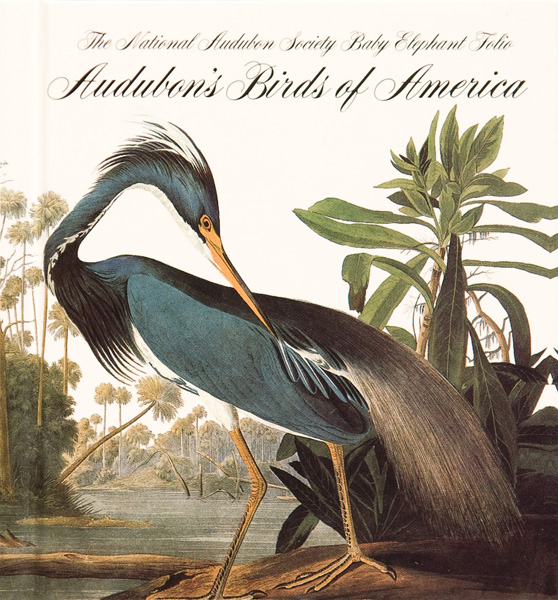
The Birds of America is a book by naturalist and painter John James Audubon, containing illustrations of a wide variety of birds of the United States. It was first published as a series in sections between 1827 and 1838, in Edinburgh and London. Not all of the specimens illustrated in the work were collected by Audubon himself; some were sent to him by John Kirk Townsend, who had collected them on Nathaniel Jarvis Wyeth's 1834 expedition with Thomas Nuttall.
The work consists of 435 hand-coloured, life-size prints, made from engraved plates, measuring around 39 by 26 inches (99 by 66 cm). It includes images of five extinct birds and three more possibly extinct birds: Carolina parakeet, passenger pigeon, Labrador duck, great auk, heath hen, and, possibly, the Eskimo curlew, ivory-billed woodpecker, and Bachman's warbler. Also, there are five more images of 'mystery birds' that are not identified with any extant species: Townsend's finch (identified in a later edition as Townsend's bunting), Cuvier's kinglet, carbonated swamp warbler, small-headed flycatcher, and Blue Mountain warbler.
Art historians describe Audubon's work as being of high quality and printed with "artistic finesse". The plant life backgrounds of some 50 of the bird studies were painted by Audubon's assistant Joseph Mason, but he is not credited for his work in the book. He shot many specimen birds as well as transporting and maintaining supplies for Audubon. Audubon however used the background plants and insects painted by Maria Martin, later wife of John Bachman, with credit. George Lehman was hired to draw some of the perches and background detail. Audubon also authored the companion book Ornithological Biographies.
About 1820, around the age of 35, Audubon declared his intention to paint every bird in North America. In his bird art, he mainly forsook oil paint, the medium of serious artists of the day, in favour of watercolours and pastel crayons (and occasionally pencil, charcoal, chalk, gouache, and pen and ink). As early as 1807, he developed a method of using wires and threads to hold dead birds in lifelike poses while he drew them.
In 1823, Audubon went to Philadelphia and New York, looking for financial support using subscriptions to enable him to publish his artwork. He sold the copper engraving plates through on a subscription basis in North America and Europe. Those subscribed obtained five plates at a time. Each subscriber received prints of three smaller birds, a larger bird and a mid-sized bird. The prints were produced from 1827 to 1838 that cost each subscriber around $1,000. It is thought that no more than 120 complete sets exist today. Each set consists of 435 individual plates that are based upon the original paintings. Each plate was engraved, printed, and hand colored by Robert Havell of London. While William Lizars, of Edinburgh, engraved the first ten plates, Havell actually finished some of those. Havell, in some cases added elements such as insects to the plate.
Audubon often found support lacking. As a result, in 1826, he set sail for the United Kingdom with 250 of his original illustrations, looking for the financial support of subscribers and the technical abilities of engravers and printers. After exhibiting his drawings in Liverpool and Manchester, he journeyed to Edinburgh, where he met the accomplished engraver William H. Lizars. Lizars engraved up to ten of the first plates but was unable to continue the project when his colourists went on strike. In 1827, Audubon engaged the noted London animal engraver Robert Havell Jr., and his father, Robert Havell Sr. Havell Jr. oversaw the project through to its completion in 1838.
The original edition of The Birds of America (sometimes called the Havell Edition after its printer, and sometimes called the "Double Elephant Folio", because of its size) was printed on handmade paper 39.5 inches tall by 28.5 inches wide. The principal printing technique was copperplate etching, but engraving and aquatint were also used. Colorists applied each color in assembly-line fashion (over fifty were hired for the work).
Audubon funded the costly printing project through a pay-as-you-go subscription. From 1826 to 1829, he travelled around the UK and to Paris, lecturing on ornithology and frontier American life in an effort to entice wealthy patrons to subscribe to the series of prints. Subscribers included: King Charles X of France; Queen Adelaide of the United Kingdom; the 2nd Earl Spencer; and, later, the Americans Daniel Webster and Henry Clay.
Hub AI
The Birds of America AI simulator
(@The Birds of America_simulator)
The Birds of America
The Birds of America is a book by naturalist and painter John James Audubon, containing illustrations of a wide variety of birds of the United States. It was first published as a series in sections between 1827 and 1838, in Edinburgh and London. Not all of the specimens illustrated in the work were collected by Audubon himself; some were sent to him by John Kirk Townsend, who had collected them on Nathaniel Jarvis Wyeth's 1834 expedition with Thomas Nuttall.
The work consists of 435 hand-coloured, life-size prints, made from engraved plates, measuring around 39 by 26 inches (99 by 66 cm). It includes images of five extinct birds and three more possibly extinct birds: Carolina parakeet, passenger pigeon, Labrador duck, great auk, heath hen, and, possibly, the Eskimo curlew, ivory-billed woodpecker, and Bachman's warbler. Also, there are five more images of 'mystery birds' that are not identified with any extant species: Townsend's finch (identified in a later edition as Townsend's bunting), Cuvier's kinglet, carbonated swamp warbler, small-headed flycatcher, and Blue Mountain warbler.
Art historians describe Audubon's work as being of high quality and printed with "artistic finesse". The plant life backgrounds of some 50 of the bird studies were painted by Audubon's assistant Joseph Mason, but he is not credited for his work in the book. He shot many specimen birds as well as transporting and maintaining supplies for Audubon. Audubon however used the background plants and insects painted by Maria Martin, later wife of John Bachman, with credit. George Lehman was hired to draw some of the perches and background detail. Audubon also authored the companion book Ornithological Biographies.
About 1820, around the age of 35, Audubon declared his intention to paint every bird in North America. In his bird art, he mainly forsook oil paint, the medium of serious artists of the day, in favour of watercolours and pastel crayons (and occasionally pencil, charcoal, chalk, gouache, and pen and ink). As early as 1807, he developed a method of using wires and threads to hold dead birds in lifelike poses while he drew them.
In 1823, Audubon went to Philadelphia and New York, looking for financial support using subscriptions to enable him to publish his artwork. He sold the copper engraving plates through on a subscription basis in North America and Europe. Those subscribed obtained five plates at a time. Each subscriber received prints of three smaller birds, a larger bird and a mid-sized bird. The prints were produced from 1827 to 1838 that cost each subscriber around $1,000. It is thought that no more than 120 complete sets exist today. Each set consists of 435 individual plates that are based upon the original paintings. Each plate was engraved, printed, and hand colored by Robert Havell of London. While William Lizars, of Edinburgh, engraved the first ten plates, Havell actually finished some of those. Havell, in some cases added elements such as insects to the plate.
Audubon often found support lacking. As a result, in 1826, he set sail for the United Kingdom with 250 of his original illustrations, looking for the financial support of subscribers and the technical abilities of engravers and printers. After exhibiting his drawings in Liverpool and Manchester, he journeyed to Edinburgh, where he met the accomplished engraver William H. Lizars. Lizars engraved up to ten of the first plates but was unable to continue the project when his colourists went on strike. In 1827, Audubon engaged the noted London animal engraver Robert Havell Jr., and his father, Robert Havell Sr. Havell Jr. oversaw the project through to its completion in 1838.
The original edition of The Birds of America (sometimes called the Havell Edition after its printer, and sometimes called the "Double Elephant Folio", because of its size) was printed on handmade paper 39.5 inches tall by 28.5 inches wide. The principal printing technique was copperplate etching, but engraving and aquatint were also used. Colorists applied each color in assembly-line fashion (over fifty were hired for the work).
Audubon funded the costly printing project through a pay-as-you-go subscription. From 1826 to 1829, he travelled around the UK and to Paris, lecturing on ornithology and frontier American life in an effort to entice wealthy patrons to subscribe to the series of prints. Subscribers included: King Charles X of France; Queen Adelaide of the United Kingdom; the 2nd Earl Spencer; and, later, the Americans Daniel Webster and Henry Clay.