Hubbry Logo
BluebookBluebookMain
Open search
Bluebook
Community hub
Bluebook
logo
8 pages, 0 posts
0 subscribers
Be the first to start a discussion here.
Bluebook
Bluebook
from Wikipedia

Key Information

The Bluebook: A Uniform System of Citation is a style guide that prescribes the most widely used legal citation system in the United States. It is taught and used at a majority of law schools in the United States and is also used in a majority of federal courts. Legal publishers also use several "house" citation styles in their works.

The Bluebook is compiled by the Harvard Law Review, Columbia Law Review, Yale Law Journal, and University of Pennsylvania Law Review. Currently, it is in its 22nd edition (published May 2025). Its name was first used for the 6th edition (1939).[1] Opinions have differed regarding its origins at Yale and Harvard Law Schools, with the latter long claiming credit.[2]

The Supreme Court uses its own unique citation style in its opinions, even though most of the justices and their law clerks obtained their legal education at law schools that use The Bluebook.[3] Furthermore, many state courts have their own citation rules that take precedence over the guide for documents filed with those courts. Some of the local rules are simple modifications to The Bluebook system. Delaware's Supreme Court has promulgated rules of citation for unreported cases markedly different from its standards, and custom in that state as to the citation format of the Delaware Uniform Citation code[4] also differs from it.[5] In other states, the local rules differ from The Bluebook in that they use their own style guides. Attorneys in those states must be able to switch seamlessly between citation styles depending upon whether their work product is intended for a federal or state court. California has allowed citations in Bluebook as well as the state's own style manual,[6] but many practitioners and courts continue recommending the California Style Manual.[7]

An online-subscription version of The Bluebook was launched in 2008.[8] A mobile version was launched in 2012 within the Rulebook app, which enables access for legal professionals to federal or state court rules, codes, and style manuals on iPads and other mobile devices.[9]

Elements

[edit]

The 22nd edition of The Bluebook governs the style and formatting of various references and elements of a legal publication, including:

  • Structure and use of citations
  • Typefaces for law reviews
  • Subdivisions
  • Short citation forms (for use when a document makes multiple references to the same case)[10]
  • Quotations
  • Abbreviations, numerals, and symbols
  • Italicization for style and in unique circumstances
  • Capitalization
  • Titles of judges, officials, and terms of court
  • Cases
  • Constitutions
  • Statutes
  • Legislative materials
  • Administrative and executive materials
  • Books, reports, and other nonperiodic materials
  • Periodical materials
  • Unpublished and forthcoming sources
  • Electronic media and other nonprint resources
  • Services
  • Foreign materials
  • International materials

History

[edit]

While the legal citation manuals go as far back as Modus Legendi Abbreviaturas in Utroque Iure published around 1475, there were very few examples prior to the 20th century; law professor Byron D. Cooper mentions only few short articles "Rules for Citation" (The American Law Review, 1896) and "Methods of Citing Statute Law" (Ruppenthal, Law Library Journal, 1919).[11] The Uniform System of Citations thus became a "pioneer" manual.[1]

According to Harvard, the origin of The Bluebook was a pamphlet for proper citation forms for articles in the Harvard Law Review written by its editor, Erwin Griswold.[12] However, according to a 2016 study by two Yale librarians,[2][13] Harvard's claim is incorrect. They trace the origin of The Bluebook to a 1920 publication by Karl Llewellyn at Yale on how to write law journal materials for the Yale Law Journal.[14] The authors point out that some of the material in the 1926 first edition of The Bluebook (as well as that in a 1922 Harvard precursor to it published as Instructions for Editorial Work) duplicate material in the 1920 Llewellen booklet and its 1921 successor, a blue pamphlet that the Yale Law Journal published as Abbreviations and Form of Citation.[15]

For several years before the first edition of The Bluebook appeared, Yale, Columbia, and several other law journals "worked out a tentative citation plan", but Harvard initially opposed it "because of skepticism as to the results to be attained and in part because of a desire not to deviate from our forms especially at the solicitation of other Reviews". Eventually, Harvard "reversed course" and joined the coalition by 1926. According to Judge Henry J. Friendly, "Attorney General [Herbert] Brownell, whom I had known ever since law school—he was Editor-in-Chief of the Yale Law Journal the year I was at the Harvard Law Review and he and I and two others [from Columbia and Pennsylvania] were the authors of the first edition of the Bluebook."[16] Friendly has been considered the creator of The Bluebook.

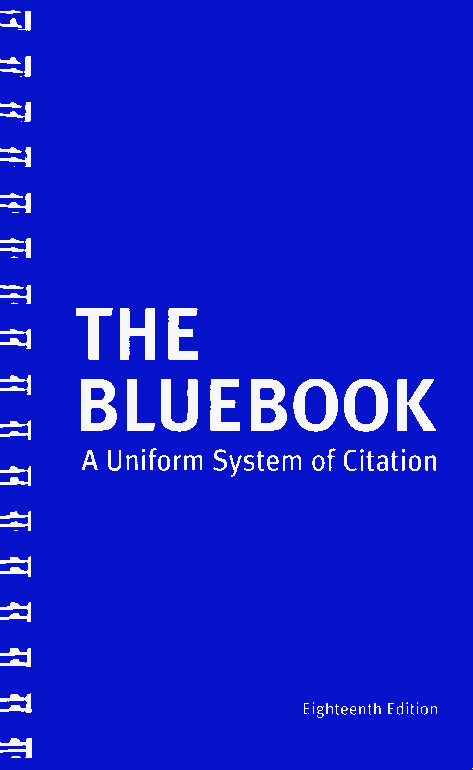
The cover of the 1926 A Uniform System of Citation was green. The color was "brown from the second (1928) edition through the fifth (1936) edition. It was only with the sixth (1939) edition that it became blue."[17] In 1939, the cover of the book was changed from brown to a "more patriotic blue", allegedly to avoid comparison with a color associated with Nazi Germany.[18] The eleventh edition, published in 1967, was actually white with a blue border.[19] The cover color returned to blue in the twelfth edition of 1976.[20]

The full text of the first (1926) through the fifteenth (1991) editions is available on the official website.[21]

The Bluebook uses two different styles. Practitioners use the first in preparing court documents and memoranda, while the second is used primarily in academic settings, such as law reviews and journals.[22] The latter uses specific formatting to identify types of references, such as the use of small caps for books, newspapers, and law reviews.[23] A rule of thumb used by many is to see if the formatting can be reproduced on a typewriter—if so, practitioners use it, if it requires typesetting, it is used for academic articles.[24]

By 2011, The Bluebook was "the main guide and source of authority" on legal references for the past 90 years.[25] It is recognized as the "gold standard" for legal references in the United States, even though it was originally designed only to help teach law students how to cite cases and other legal material.[26] Although other citation systems exist, they have limited acceptance, and in general, The Bluebook is followed in the legal citation as the most widely accepted citation style,[27] called the "Bible", the "final arbiter", even the legal citation "Kama Sutra".[1] Some states have adopted The Bluebook in full, while others have partially adopted The Bluebook.[28] States such as Texas have supplements, such as The Greenbook, that merely address citation issues unique to Texas and otherwise follow The Bluebook.[29]

Variations

[edit]

Federal

[edit]

The Solicitor General issues a style guide that is designed to supplement The Bluebook.[30] This guide focuses on citation for practitioners, such as restraining law reviews to two typefaces: normal and italics.[31] Other changes are similiarly minor, such as moving supra from before the page referenced to after the page number.[32] The guide does state that unless explicitly specified otherwise, The Bluebook rule takes precedence in the event of conflict.[33]

State

[edit]

California used to require use of the California Style Manual.[34] In 2008, the California Supreme Court issued a rule giving an option of using either the California Style Manual or The Bluebook.[35] The two styles are significantly different in citing cases, in use of ibid. or id. (for idem), and in citing books and journals.[36] Michigan uses a separate official citation system issued as an administrative order of the Michigan Supreme Court.[37] The primary difference is that the Michigan system "omits all periods in citations, uses italics somewhat differently, and does not use 'small caps.'"[38] As noted above, Texas merely supplements The Bluebook with items that are unique to Texas courts, such as citing cases when Texas was an independent republic,[39] petition and writ history,[40] and Attorney General Opinions.[41]

Reception

[edit]

Criticism of Bluebook's prolixity

[edit]

At over 500 pages for the 19th edition, The Bluebook is significantly more complicated than the citation systems used by most other fields. Legal scholars have called for its replacement with a simpler system.[42] The University of Chicago uses the simplified "Maroonbook",[43] and even simpler systems are in use by other parties.

During his tenure on the United States Court of Appeals for the Seventh Circuit, Judge Richard Posner repeatedly criticized the Bluebook.[44] In 1986, he wrote the article "Goodbye to the Bluebook," hoping that the Maroonbook would quickly overtake it.[45] In 2011, he wrote the article "The Bluebook Blues," lamenting that the Bluebook remained dominant despite its increasing complexity, while providing the 885-word citation manual used among his law clerks.[46]

[edit]
Cover of BabyBlue
Cover of The Indigo Book

Another dispute is over the copyright status of The Bluebook. Open-source advocates claim that The Bluebook is not protected under copyright because it is a critical piece of legal infrastructure.[47] Lawyers who represent the Bluebook publishing consortium claim that the "carefully curated examples, explanations and other textual materials" are protected by copyright.[48]

A group led by Professor Christopher J. Sprigman at NYU Law School prepared a "public-domain implementation of the Bluebook's Uniform System of Citation," which his group calls BabyBlue. However, in 2015, a law firm (Ropes & Gray) representing the Harvard Law Review Association (HLRA) sent him a letter stating:

[W]e believe that BabyBlue may include content identical or substantially similar to content or other aspects of The Bluebook that constitute original works of authorship protected by copyright, and which are covered by various United States copyright registrations. ...

[M]y client has been and remains concerned that the publication and promotion of such a work may infringe the Reviews' copyright rights in The Bluebook and The Bluebook Online, and may cause substantial, irreparable harm to the Reviews and their rights and interests in those works. ...

[I]t is our client's position that the title BabyBlue, or any title consisting of or comprising the word "Blue", when used on or in connection with your work, would so resemble the BLUEBOOK Marks as to be likely, to cause confusion, mistake, and/or deception…Accordingly, and to avoid any risk of consumer confusion, my client respectfully demands that you agree (i) not to use the title or name BabyBlue, or any other title or name including the word "blue", for your work.[49]

In response to the HLRA letter to Sprigman, over 150 students, faculty, staff, and alumni of Harvard Law School signed a petition supporting BabyBlue. Yale and NYU students added their separate petitions supporting BabyBlue.[50] A posting in the Harvard Law Record commented:

The intellectual property claims that the HLR Association made may or may not be spurious. But independent of that, the tactics employed by the HLR Association's counsel in dealing with Mr. Malamud and Prof. Sprigman are deplorable. The Harvard Law Review claims to be an organization that promotes knowledge and access to legal scholarship. It is a venerated part of the traditions of Harvard Law School. But these actions by the Harvard Law Review speak of competition and not of justice.[50]

The posting also suggested that HLRA should "redirect the money it spends on legal fees ($185,664 in 2013)" to a more worthy purpose.[50] David Post commented: "It's copyright nonsense, and Harvard should be ashamed of itself for loosing its legal hounds to dispense it in order to protect its (apparently fairly lucrative) publication monopoly."[51] On March 31, 2016, it was announced that the project had changed its name to The Indigo Book.[52]

Financial controversy

[edit]

For the first 50 years of the Bluebook's history, the Harvard Law Review kept 100 percent of the revenues.[53] In 1974, the editors of the Columbia and University of Pennsylvania Law Reviews and the Yale Law Journal apparently discovered this due to an indiscretion.[54] They complained that Harvard was illegally keeping all profits from the first eleven editions, estimated to total $20,000 per year.[55] After they threatened to sue, Harvard agreed to split the revenue: 40 percent for Harvard, 20 percent each for Columbia, Pennsylvania, and Yale; Harvard would continue to provide the production and distribution services.[17]

The law reviews have not disclosed the revenues of the Bluebook themselves, but revenues from the sale of the Bluebook have been estimated "in the millions of dollars".[53] A 2022 review of the Harvard Law Review's non-profit disclosures found that the Bluebook had made $1.2 million in profits in 2020, with The Harvard Law Review taking an 8.5% cut of profits for administrative services and the remainder split equally among the four law reviews. Profits from the Bluebook totaled $16 million between 2011 and 2020. Excluding the University of Pennsylvania Law Review, the law review's endowments total $59.4 million.[56]

See also

[edit]

References

[edit]

Sources

[edit]
[edit]
Revisions and contributorsEdit on WikipediaRead on Wikipedia
from Grokipedia
The Bluebook: A Uniform System of Citation is a comprehensive style guide that establishes a standardized format for citing legal authorities, precedents, statutes, and other sources in American legal writing and scholarship. First published in 1926, it serves as the primary reference for law students, attorneys, judges, and academics to ensure precision, consistency, and clarity in citations across legal documents, including briefs, memos, and journal articles. The guide is compiled collaboratively by the editors of four prestigious law reviews: the Columbia Law Review, Harvard Law Review, University of Pennsylvania Law Review, and Yale Law Journal. Widely regarded as the authoritative manual for legal citation in the United States, The Bluebook has evolved through 22 editions, with the most recent—the 22nd edition—released in May 2025 to incorporate updates reflecting modern legal practices, such as expanded guidance on electronic sources and revised rules for practitioner formats. Its structure divides into general rules (covering introductory signals, quotations, and abbreviations), specific citation tables for various source types (like cases, statutes, and periodicals), and appendices for international and state-specific materials. This organization facilitates its use in diverse contexts, from to court filings, though it has faced criticism for its complexity and length, prompting alternatives like the ALWD Citation Manual. The Bluebook's influence extends beyond citation mechanics; it shapes legal communication by promoting uniformity that enhances accessibility and verifiability of sources, thereby supporting the integrity of legal argumentation. Originally a modest compiled by of the , it has grown into an indispensable tool, with both print and online versions available to accommodate digital workflows. Despite ongoing debates about simplification, its dominance in U.S. and practice remains unchallenged.

Publication and Development

Origins and History

The Bluebook originated in the early amid efforts to standardize legal scholarship at elite law schools. Its foundational influences trace back to , where in 1920, professors Karl N. Llewellyn and William Murray Field published "The Writing of a Case Note," a guide for Yale Law Journal contributors that addressed citation inconsistencies in student notes. This evolved into Yale's 1921 pamphlet, "Abbreviations and Form of Citation," which provided uniform rules for abbreviating case names and reporters to streamline editing. By 1926, editors from the , Columbia Law Review, University of Pennsylvania Law Review, and Yale Law Journal collaborated on the first edition of A Uniform System of Citation, a 26-page designed specifically to standardize footnotes in articles and resolve the patchwork of citation practices that had proliferated in legal academia. The impetus for this initial creation stemmed from growing frustrations with the inconsistencies in legal scholarship, where varying citation styles across journals hindered readability and editorial efficiency. Earlier attempts at uniformity, such as house styles at individual law reviews, proved insufficient as the volume of expanded in the post-World War I era. The 1926 pamphlet marked a pivotal step toward a shared standard, initially circulated among the sponsoring journals before wider distribution. By , it had gained traction, with at least 21 reviews adopting its rules, establishing it as the guide for academic . A major historical shift occurred in the mid-20th century, as the guide expanded significantly and transitioned from a niche academic tool to a broader standard in legal practice. The tenth edition in grew to 124 pages, reflecting added complexity in citation forms for emerging legal materials. The twelfth edition, published in 1976 to coincide with the U.S. Bicentennial, marked a substantial expansion to over 200 pages, incorporating more detailed rules for international and administrative sources while reverting to a blue cover—a design choice symbolic of its maturing identity. Post-1950s, adoption accelerated beyond law reviews, with courts and practitioners increasingly relying on it for and opinions due to its perceived and the sponsoring journals' prestige, solidifying its role as the dominant U.S. system. Key events in the late 20th century highlighted ongoing challenges in governance and adaptation. In the 1970s, a revenue-sharing dispute among the sponsoring journals was resolved, with Harvard Law Review assuming a 40% share of profits while the others received 20% each, underscoring the manual's commercial viability amid criticisms of exclusive control by the elite quartet. The 1980s brought scrutiny over this publisher arrangement, raising concerns about monopolistic practices in legal publishing, though no formal antitrust action ensued. By the 1990s, discussions on digital adaptation emerged, with the fourteenth edition (1989) and fifteenth (1991) beginning to address citations for electronic sources like online databases, anticipating the internet's impact on legal research.

Editions and Publishers

The Bluebook has evolved through 22 editions since its inception, with the first edition published in 1926 as a compact 26-page guide and the 22nd edition released in May 2025 exceeding 400 pages, reflecting significant expansion in scope and detail. Initially produced under the auspices of a collaborative effort among leading law reviews, publication transitioned from external printers to direct oversight by the Association starting with the 21st edition in 2020, marking a shift toward that enhanced control over distribution and updates. The 21st edition, released in , represented a major modernization by integrating online components, including the relocation of extensive jurisdictional tables to a digital platform, which reduced the print volume to 365 pages while introducing streamlined rules for authority order, short-form citations, and online source dates. Priced at approximately $30 for the print version, it included options for student access through bundled materials. The 22nd edition introduced substantial rewrites to core rules, expanded guidance on citing digital and electronic sources under Rule 18, and added new formats for AI-generated content citations via Rule 18.3, which specifies treating such outputs as unpublished materials with details on the tool, prompt, and generation date. It also revised Tables T1 and T2 to incorporate updated formats for foreign jurisdictions and introduced Rule 22 for tribal sources, alongside Rule 23 for archival materials, enhancing coverage of diverse legal traditions. The print edition retails for $49, with student discounts available through online subscriptions starting at $39 for one year or reduced rates for multi-year plans via the official platform.

Citation Framework

Core Elements

The core elements of a Bluebook citation form the foundational building blocks for referencing legal authorities, ensuring precision and uniformity in legal writing. These elements adapt based on the type of source but generally encompass identifiers for the author or parties involved, the title or name of the work, publication or reporting details, specific location references (pinpoints), and supplementary information in parentheticals. This structure facilitates quick retrieval of sources while conveying essential context, such as jurisdiction and temporal relevance. Primary elements include author names, which for secondary sources like books and articles are rendered in ordinary type as they appear on the publication, typically providing the full name for the first author and initials for subsequent authors in multi-author works. Titles follow specific conventions: case names and titles are presented in italics or depending on the context ( for case names in academic footnotes), while article titles are italicized. Publication details comprise volume numbers, reporter or container names (abbreviated per relevant tables), and initial page numbers, providing the location within the source material. Pinpoint citations specify exact pages, paragraphs, or sections for the referenced material, inserted after the initial page to direct readers precisely. Parentheticals supply additional details, such as the and court for cases, the year of decision or , and subsequent (e.g., "aff'd" or "rev'd") to indicate the authority's status. Different types of sources incorporate these elements variably. For cases, the core components are the abbreviated party names (following Table T6 guidelines, omitting initials and using "v." for versus), volume, reporter abbreviation (per Table T1 for U.S. jurisdictions), first page, and a parenthetical with and year; for example, a U.S. Supreme Court case might appear as Brown v. Bd. of Educ., 347 U.S. 483 (1954). Statutes require the title number, code abbreviation (e.g., U.S.C. per Table T1), section symbol and number, and year in parentheses, such as 42 U.S.C. § 1983 (2018). Secondary sources adapt the elements accordingly: books include author, title in italics, edition (if not first), publisher, and year (per Rule 15 and Table T13), while articles feature author, italicized title, volume, periodical name in small caps (abbreviated per Table T13), first page, and pinpoint (per Rule 16). Signals and explanatory phrases introduce citations to indicate their relationship to the proposition, such as "see" for direct support, "cf." for analogous comparison (often requiring an explanatory parenthetical to clarify relevance), "see also" for additional support, "contra" for contrary authority, and the new "Contrast" signal for opposing authorities; these are italicized and grouped by strength in citation sentences or footnotes. Footnotes serve as the primary vehicle for citations in academic legal writing, with internal cross-references using "supra," "infra," or "id." for repeated authorities. Typeface conventions emphasize clarity: in academic formats, case names and periodical titles use small caps, while italics denote titles of books, articles, signals, and procedural phrases in cases (e.g., ex rel.). The 22nd edition, released in May 2025, introduced updates to accommodate online-only sources by requiring permanent archiving (e.g., via Perma.cc links or "PDF on file with author") in addition to traditional elements, including URLs or database identifiers where applicable, and access dates only if the content is likely to change; DOIs are omitted unless specifically required by the publisher. These changes ensure citability of digital materials without altering the core structure for print sources, emphasizing reader accessibility to verifiable versions.

Rules and Formatting

The Bluebook distinguishes between citation sentences, which stand alone as complete sentences introducing authorities, and citation clauses, which are integrated into the text without introductory words like "see" or "e.g.". Citation sentences begin with a capital letter and end with a period, while clauses use lowercase and integrate seamlessly. For short forms, "Id." is used to refer to the immediately preceding citation, with variations like "Id. at 45" for pinpoint references or "Id." in string citations to refer back to the first source in the sequence.. String citations compile multiple authorities supporting a single proposition, separated by semicolons, and ordered logically within signals like "see" or "cf.". Formatting in the Bluebook emphasizes consistency through abbreviations, typeface conventions, and hierarchical ordering. Abbreviations follow jurisdiction-specific tables, such as "U.S." for in Table T10, which lists and reporter abbreviations.. Case names are abbreviated per Table T6 (e.g., "Co." for ), periodical titles per Table T13, and jurisdictional formats per Table T1, ensuring brevity without ambiguity.. Italics are preferred for case names, book titles, and signals in (Whitepages), while underlining is reserved for practitioner contexts (Bluepages) or when italics are unavailable.. Authorities in string citations or footnotes are ordered by type—constitutional provisions first, followed by statutes, then cases—and secondarily by , , and chronology.. The Bluebook's tables provide essential reference for uniform application: Table T1 outlines citation formats for U.S. jurisdictions, including state codes and reporters; Table T6 standardizes abbreviations in case names to reduce redundancy; Table T10 details abbreviations for courts and geographical terms; and Table T13 governs periodical abbreviations, prioritizing common legal journals.. These tables ensure citations are concise yet precise, with updates in the 22nd edition streamlining entries for digital and international sources. The 22nd edition, released in May 2025, introduced revisions to adapt to evolving legal practice. Rule 18.3 provides the first standardized format for citing generative AI outputs, requiring identification of the of the prompt, the model (e.g., " 4o"), the exact prompt, a , and a preserved PDF or screenshot archived via tools like perma.cc.. Parallel citations were simplified, particularly for tribal sources under new Rule 22, prioritizing tribal reporters before commercial databases like .. Guidance on author names emphasizes inclusive practices, such as retaining full designations (e.g., "Jr." or nonbinary markers) as they appear in publications to promote .. In the Bluebook 22nd edition (2025), there is no dedicated rule exclusively for government agency press releases. They are typically cited as press releases under Rule 17 (unpublished materials) or Rule 18 (internet sources), consistent with guidance from legal journals and law library resources. The standard format is: Press Release, [Abbreviated Agency Name], [Title of Press Release] ([Month Day, Year]), [URL or archived link (required for online sources per Rule 18.2.1(d), such as Perma.cc or on file)]. Example: Press Release, U.S. Dep't of Just., Justice Department Charges [Title] (Jan. 1, 2026), https://www.justice.gov/opa/pr/... (archived at [Perma link]). No major changes to this format from prior editions are noted in 22nd edition updates, though online citations now strictly require permanent archiving per Rule 18.2.1(d) to ensure accessibility and verifiability.. Common pitfalls in Bluebook application include over-abbreviation, which can obscure meaning (e.g., excessively shortening case names beyond Table T6 guidelines), and incorrect ordering of authorities, such as placing statutes before constitutions in a string citation.. Relying on automated tools like for citations often leads to errors, as they may not conform to Bluebook or abbreviation rules..

Variations in Application

Federal Citations

Federal case citations in the Bluebook follow standardized formats tailored to the level of the federal , emphasizing official reporters where available. For Supreme Court decisions, the preferred citation is to the , formatted as Case Name, Volume U.S. Page (Year), such as , 5 U.S. 137 (1803). Parallel citations to unofficial reporters like the Reporter (S. Ct.) or United States Supreme Court Reports, Lawyers' Edition (L. Ed. 2d) are permitted but not required under general Bluebook rules. Citations to decisions from the use the Federal Reporter series, structured as Case Name, Volume F.3d Page (Circuit Abbreviation Year), for example, United States v. Lopez, 2 F.3d 1342 (5th Cir. 1993). No official reporter exists for these courts, so the Federal Reporter (published by West) serves as the , with parallel citations to unofficial sources like or Lexis generally optional unless specified by local rules. District court opinions are cited similarly to the Federal Supplement, as in Case Name, Volume F. Supp. 3d Page (District Abbreviation Year). Statutory citations prioritize the United States Code (U.S.C.) for codified s, formatted as Title U.S.C. § Section (Year if needed), such as 42 U.S.C. § 1983. The year is omitted for stable federal code sections unless citing a specific historical version or digital database supplement. For uncodified or recently enacted s, session laws are used, exemplified by Pub. L. No. 101-336, 104 Stat. 327 (1990), referencing the Americans with Disabilities Act. Administrative materials, governed by Rule 14 and Table T1, cite the (C.F.R.) as Title C.F.R. § Section (Year), for instance, 40 C.F.R. § 50.1 (2024). The Bluebook addresses treaties and international sources under Rule 21, which provides formats for multilateral agreements, bilateral treaties, and documents from organizations like the . For U.S.-ratified treaties, citations often reference the Treaties and Other International Agreements (U.S.T.) or Statutes at Large, such as Convention on the Rights of the Child, Nov. 20, 1989, 1577 U.N.T.S. 3. UN documents, covered in Rule 21.7, follow a structure including the document symbol, session, and year, e.g., G.A. Res. 217A (III), U.N. Doc. A/810 (Dec. 10, ). Table T4 lists preferred sources for international materials. The 22nd edition introduces enhanced handling of federal digital archives, mandating permanent archival links for online sources under Rule 18.2.1(d) to ensure accessibility and verifiability. This includes tools like Perma.cc for creating stable URLs to federal government websites or databases, such as archived versions of regulations on the Government Publishing Office site, formatted with the archival identifier appended to the URL. Such updates reflect the growing reliance on digital federal materials while maintaining citation integrity.

State and Local Citations

State case citations in The Bluebook follow Rule 10 and Table T1, which provide jurisdiction-specific abbreviations for official and unofficial reporters. For instance, decisions from the California Supreme Court are typically cited using the official California Reports, such as People v. Anderson, 123 Cal. 456 (1897), or parallel citations to regional reporters like the Pacific Reporter, e.g., 70 P. 177 (Cal. 1902). Regional reporters, such as the Atlantic Reporter (A.2d or A.3d), are used for many states lacking official reporters, with abbreviations tailored to each jurisdiction per Table T1; for example, a Delaware case might appear as State v. Smith, 123 A.2d 456 (Del. 1956). These formats ensure precision in identifying the court and publication source, though parallel citations are often required in practice to reference both official and unofficial versions. Citations to state statutes are governed by Rule 12 and Table T1, emphasizing the official state code with jurisdiction-specific abbreviations and section symbols. A common format is the abbreviated code title followed by the section, publisher, and year, such as Cal. Civ. Code § 51 (West 2023) for California's . Session laws, which are uncodified legislative acts, are cited chronologically under Rule 12.3.1, for example, 2023 Cal. Sess. Laws ch. 123 (A.B. 456), while state constitutions use Rule 11, as in Cal. Const. art. I, § 7. These structures accommodate variations in how states organize and publish their laws, prioritizing the most authoritative source available. Local variations extend The Bluebook's framework to sub-state entities, including tribal nations, municipal ordinances, and limited international contexts. The 22nd edition introduces Table T1.5, an online-only resource listing all 574 federally recognized tribal nations with standardized abbreviations for citing tribal court decisions and codes, such as Navajo Nation v. Brown, 25 Navajo Rep. 123 ( Sup. Ct. 2020), to promote consistency in indigenous law citations. Municipal ordinances are addressed under Rule 12.9.2, cited analogously to statutes with the full locality name, code abbreviation, section, publisher, and year, for example, Chi., Ill., Municipal Code ch. 7-12, § 7-12-010 (2023). Rule 21 briefly accommodates international comparisons for state or local materials involving foreign , such as citing a municipal ordinance referencing a under foreign tables in Table T2. Following the release of the 22nd edition in May 2025, the amended its Style Sheet effective September 1, 2025, to make parallel citations to multiple reporters for Supreme Court decisions optional, eliminating the prior requirement for three parallel reporters (U.S., S. Ct., and L. Ed.). Despite The Bluebook's standardization efforts, challenges arise from inconsistencies across the 50 states, where local court rules or alternative style manuals often hybridize or supplant full adoption. For example, courts permit either The Bluebook or the California Style Manual for citations, leading to format variations like differing abbreviation preferences. In contrast, New York relies on its own New York Official Reports Style Manual for state-specific conventions, diverging from Bluebook norms in reporter citations and punctuation. These jurisdictional differences necessitate consulting Table T1 alongside local rules to avoid errors in practice.

Reception and Criticisms

Complexity and Usability Issues

The Bluebook has faced significant criticism for its prolixity, having expanded from 124 pages in its 10th edition (1958) to 560 pages in the 20th edition (2015), a growth attributed to an accumulation of increasingly granular rules rather than essential updates. This expansion, often termed "Bluebook bloat," has been linked to the addition of detailed provisions for niche scenarios, including extensive abbreviation guidelines in Tables T6 through T16, which span hundreds of pages and dictate precise shortenings for case names, court designations, and institutional authors. For instance, these tables require abbreviating words like "Coalition" to "Coal." or "Community" to "Cmty.," even in complex party names, leading to convoluted citations such as Alt. Coal. Constr. P'ship v. Ne. S.S. Twp. Cmty. Bhd.. Critics argue this level of detail serves more to manipulate word counts in briefs—by squeezing abbreviations into tighter spaces—than to enhance clarity, prompting the creation of supplementary guides like Understanding and Mastering the Bluebook (a 200-page resource) to navigate the rules. Usability challenges further compound these issues, with the Bluebook's steep imposing a heavy burden on law students and practitioners alike. Legal writing expert Bryan Garner has highlighted how the system's "rules, exceptions to rules, and exceptions to exceptions" demand rote memorization of minutiae, such as which punctuation marks require italics, turning citation into a time-consuming ritual that detracts from substantive analysis. For practitioners, this translates to hours spent reformatting documents to comply, a process Garner and others deem inefficient compared to simpler alternatives like the University of Chicago's Maroonbook, which relies on broader principles rather than exhaustive prescriptions. Garner has advocated for reforms to streamline these elements, arguing that the Bluebook's rigidity stifles accessible and encourages overly formalistic habits among young lawyers. The Bluebook's reception diverges sharply between academia and legal practice, underscoring its usability gaps. In law reviews, adherence remains strict, with student editors enforcing its conventions as a , yet this fidelity is often at odds with practical needs. Courts frequently deviate, prioritizing over Bluebook precision—such as omitting parallel citations or using plain-language formats—since judges and clerks view the manual's 500+ pages as impractical for opinion drafting, where a two-page internal guide suffices. Practitioners echo this sentiment, with widespread critiques labeling the system outdated for the digital age, as its rules lag behind online sourcing and fail to fully accommodate ephemeral web content without additional archiving steps. Scholars like have called for its abolition in favor of concise systems used in other disciplines, noting that no links Bluebook compliance to improved scholarship or practice efficiency. The 21st edition (2020), at 365 pages, reduced the length from the previous edition. The 22nd edition (2025), at approximately 400 pages, attempted to address some concerns through targeted streamlining, such as mandating archived links (e.g., via perma.cc) for all citations to better integrate digital sources and reducing reliance on optional parentheticals for modified quotations by introducing "(citation modified)." It also updated terminology for typographical elements, like replacing "large and small capitals" with "small capitals," to simplify instructions. However, complaints persist regarding incomplete digital adaptation, as the edition retains voluminous abbreviation tables and does not broadly eliminate parallel citations, leaving practitioners to contend with ongoing inconsistencies between academic rigor and real-world application. The Bluebook has faced significant controversies over its copyright enforcement and accessibility, particularly regarding efforts to create free digital alternatives. In late 2015, Carl Malamud and Christopher Sprigman released Baby Blue, an open-source HTML version of legal citation rules compatible with The Bluebook, aimed at providing free public access to what its creators argued were uncopyrightable legal standards. The Harvard Law Review Association (HLRA), along with other publishers, responded with cease-and-desist letters alleging copyright infringement in the expression of rules and examples, as well as trademark confusion from the "Baby Blue" name. This led to a temporary delay in full publication, but Baby Blue was ultimately released on February 5, 2016, after the HLRA withdrew its objections on February 11, agreeing to make certain widely used Bluebook content publicly available in limited form to resolve the dispute. Broader accessibility challenges stem from The Bluebook's high costs and proprietary nature, which have long excluded non-law students, self-represented litigants, and international users without institutional access. Priced at around $49 for the print edition, it imposes a financial barrier that critics argue undermines the in uniform , especially since no fully open-source alternatives existed until partial efforts like . Legal scholars have highlighted how this monopoly-like control by a of law reviews creates an "immoral and nonsensical" barrier to essential legal tools, exacerbating inequities in access to . The absence of free, comprehensive digital options persisted until the 22nd edition introduced partial online tools, though these remain behind a . Legal disputes over The Bluebook's copyright have extended into debates about in citation software and digital adaptations. The Baby Blue case underscored arguments that citation rules themselves are not copyrightable as functional legal standards, but specific expressions and examples are protected, influencing subsequent . In the 2020s, discussions intensified around whether automated citation tools, such as those integrating generative AI, can fairly use Bluebook formats without infringement, with critics questioning the enforceability of copyrights on evolving digital applications. The 22nd edition's launch in May 2025 included a subscription-based digital platform at legalbluebook.com, costing $42 annually for full access, which has drawn for failing to provide truly open resources despite promises of improved online tools. This model continues to fuel calls for greater transparency and reduced barriers in standards.

Financial and Organizational Debates

The Bluebook generates substantial revenue primarily through sales of its print and digital editions, which are essential tools for legal professionals, students, and academics. Additional income streams include sales of supplementary materials, such as the Interactive Citation Workbook designed for student practice, and licensing fees for online access and integration into legal software platforms. Financial disclosures from the Association, the entity responsible for publication and distribution, indicate total organizational revenue exceeding $4 million annually in recent years, with The Bluebook serving as the flagship product driving these figures. Profits from The Bluebook have sparked significant controversy over their distribution among the four sponsoring law reviews—Harvard Law Review, Columbia Law Review, University of Pennsylvania Law Review, and Yale Law Journal. For the first half-century of its existence, Harvard retained 100% of the revenues, leading to a revolt by the other three journals in the 1970s over the lack of . This culminated in a 1976 restructuring agreement that allocated 40% of net profits to Harvard and 20% to each of the others, an arrangement criticized for perpetuating Harvard's dominance despite the collaborative nature of the project. Critics have also accused the system of exploiting unpaid student labor, as the intensive editing and compilation work is performed by volunteer student editors from the four schools, generating profits estimated at around $1.5 million annually without compensating contributors. Organizationally, The Bluebook's governance by rotating student editors from the sponsoring law reviews has created tensions between the academic focus of law journal production and the practical needs of legal practitioners, who often find the manual's evolution disconnected from real-world citation demands. As a nonprofit entity under the Harvard Law Review Association, it faces ongoing scrutiny for operating like a commercial enterprise, particularly with rising edition prices—such as the 22nd edition released in May 2025—and limited transparency in financial operations. These issues have fueled debates about whether its nonprofit status aligns with its revenue-driven model, especially as costs for the latest editions approach $50 for print copies and require annual subscriptions for digital updates. While Bluebook profits have historically funded operations and stipends for the sponsoring reviews, detractors argue that the emphasis on revenue generation stifles innovation in citation standards, prioritizing market dominance over user-friendly reforms. This has contributed to the rise of alternatives like the ALWD Citation Manual, developed by the Association of Directors in 2003 as a more accessible and consistent option for instruction.

References

Add your contribution
Related Hubs
User Avatar
No comments yet.