



Community hub
Recent from talks
Knowledge base stats:
Talk channels stats:
Members stats:
The Great Gatsby
The Great Gatsby (/ɡætsbiː/ ⓘ) is a 1925 tragedy novel by American writer F. Scott Fitzgerald. Set in the Jazz Age on Long Island, near New York City, the novel depicts first-person narrator Nick Carraway's interactions with Jay Gatsby, a mysterious millionaire obsessed with reuniting with his former lover, Daisy Buchanan.
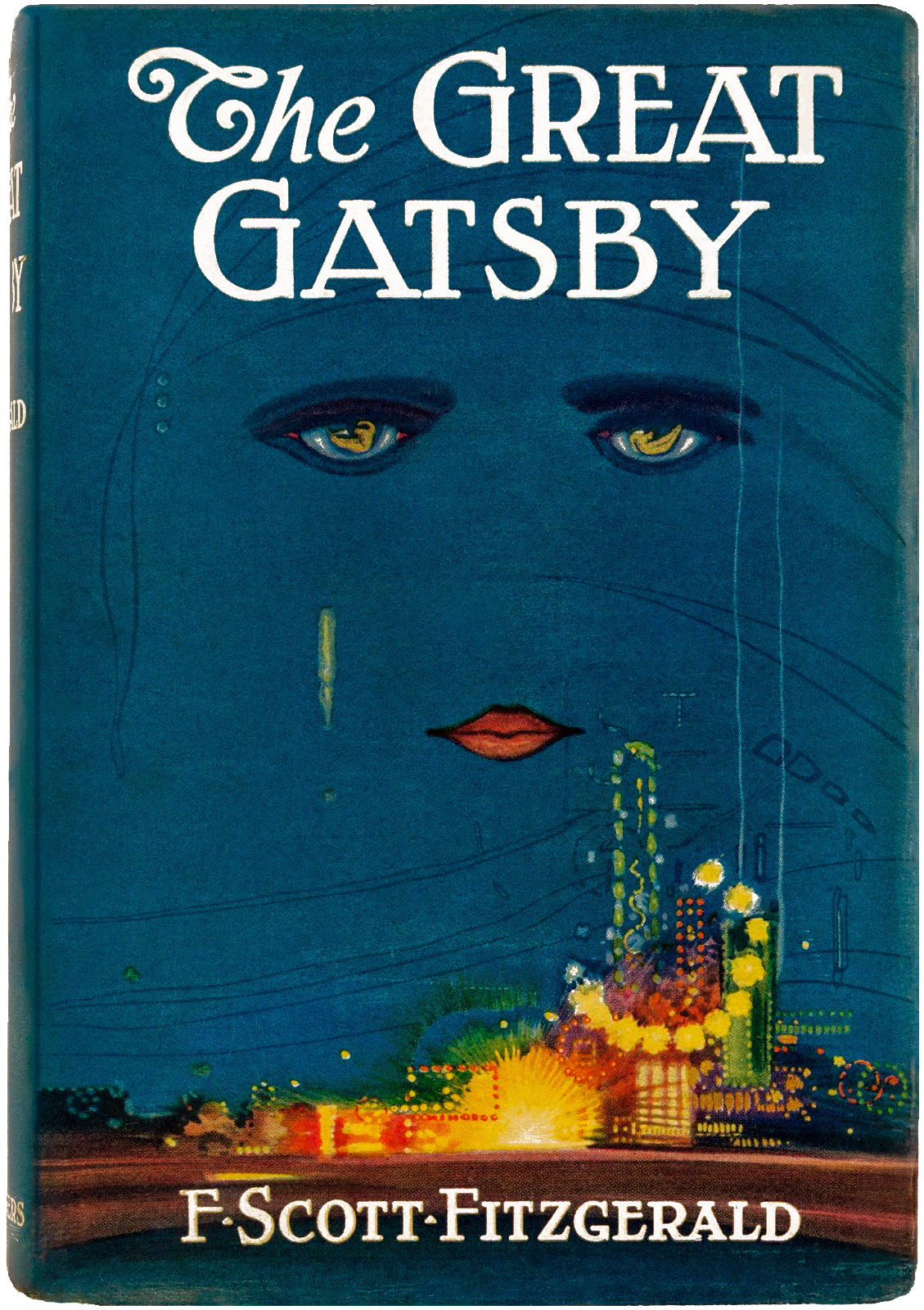
The novel was inspired by a youthful romance Fitzgerald had with socialite Ginevra King and the riotous parties he attended on Long Island's North Shore in 1922. Following a move to the French Riviera, Fitzgerald completed a rough draft of the novel in 1924. He submitted it to editor Maxwell Perkins, who persuaded Fitzgerald to revise the work over the following winter. After making revisions, Fitzgerald was satisfied with the text but remained ambivalent about the book's title and considered several alternatives. Painter Francis Cugat's dust jacket art, named Celestial Eyes, greatly impressed Fitzgerald, and he incorporated its imagery into the novel.
After its publication by Scribner's in April 1925, The Great Gatsby received generally favorable reviews, though some literary critics believed it did not equal Fitzgerald's previous efforts. Compared to his earlier novels, This Side of Paradise (1920) and The Beautiful and Damned (1922), the novel was a commercial disappointment. It sold fewer than 20,000 copies by October, and Fitzgerald's hopes of a monetary windfall from the novel were unrealized. When Fitzgerald died in 1940, he believed himself to be a failure and his work forgotten.
During World War II, the novel experienced an abrupt surge in popularity when the Council on Books in Wartime distributed free copies to American soldiers serving overseas. This new-found popularity launched a critical and scholarly re-examination, and the work soon became a core part of most American high school curricula and a part of American popular culture. Numerous stage and film adaptations followed in the subsequent decades.
Gatsby continues to attract popular and scholarly attention. Scholars emphasize the novel's treatment of social class, inherited versus self-made wealth, gender, race, and environmentalism, as well as its cynical attitude towards the American Dream. The Great Gatsby is widely considered to be a literary masterpiece and a contender for the title of the Great American Novel.
Set on the prosperous Long Island of 1922, The Great Gatsby provides a critical social history of Prohibition-era America during the Jazz Age. F. Scott Fitzgerald's fictional narrative fully renders that period—known for its jazz music, economic prosperity, flapper culture, libertine mores, rebellious youth, and ubiquitous speakeasies. Fitzgerald uses many of these 1920s societal developments to tell his story, from simple details like petting in automobiles to broader themes such as bootlegging as the illicit source of Gatsby's fortune.
Fitzgerald conveys the hedonism of Jazz Age society by following a down-to-earth narrator as a spectator of the flashiest and most raucous era in American history. In Fitzgerald's eyes, the era represented a morally permissive time when Americans of all ages became disillusioned with prevailing social norms and obsessed with pleasure-seeking. Fitzgerald himself had a certain ambivalence towards the Jazz Age, an era whose themes he would later regard as reflective of events in his own life.
The Great Gatsby reflects various events in Fitzgerald's youth. He was a young Midwesterner from Minnesota. Like the novel's narrator who went to Yale, he was educated at an Ivy League school, Princeton. There the 18-year-old Fitzgerald met Ginevra King, a 16-year-old socialite with whom he fell deeply in love. Although Ginevra was madly in love with him, her upper-class family openly discouraged his courtship of their daughter because of his lower-class status, and her father purportedly told him that "poor boys shouldn't think of marrying rich girls".
Hub AI
The Great Gatsby AI simulator
(@The Great Gatsby_simulator)
The Great Gatsby
The Great Gatsby (/ɡætsbiː/ ⓘ) is a 1925 tragedy novel by American writer F. Scott Fitzgerald. Set in the Jazz Age on Long Island, near New York City, the novel depicts first-person narrator Nick Carraway's interactions with Jay Gatsby, a mysterious millionaire obsessed with reuniting with his former lover, Daisy Buchanan.
The novel was inspired by a youthful romance Fitzgerald had with socialite Ginevra King and the riotous parties he attended on Long Island's North Shore in 1922. Following a move to the French Riviera, Fitzgerald completed a rough draft of the novel in 1924. He submitted it to editor Maxwell Perkins, who persuaded Fitzgerald to revise the work over the following winter. After making revisions, Fitzgerald was satisfied with the text but remained ambivalent about the book's title and considered several alternatives. Painter Francis Cugat's dust jacket art, named Celestial Eyes, greatly impressed Fitzgerald, and he incorporated its imagery into the novel.
After its publication by Scribner's in April 1925, The Great Gatsby received generally favorable reviews, though some literary critics believed it did not equal Fitzgerald's previous efforts. Compared to his earlier novels, This Side of Paradise (1920) and The Beautiful and Damned (1922), the novel was a commercial disappointment. It sold fewer than 20,000 copies by October, and Fitzgerald's hopes of a monetary windfall from the novel were unrealized. When Fitzgerald died in 1940, he believed himself to be a failure and his work forgotten.
During World War II, the novel experienced an abrupt surge in popularity when the Council on Books in Wartime distributed free copies to American soldiers serving overseas. This new-found popularity launched a critical and scholarly re-examination, and the work soon became a core part of most American high school curricula and a part of American popular culture. Numerous stage and film adaptations followed in the subsequent decades.
Gatsby continues to attract popular and scholarly attention. Scholars emphasize the novel's treatment of social class, inherited versus self-made wealth, gender, race, and environmentalism, as well as its cynical attitude towards the American Dream. The Great Gatsby is widely considered to be a literary masterpiece and a contender for the title of the Great American Novel.
Set on the prosperous Long Island of 1922, The Great Gatsby provides a critical social history of Prohibition-era America during the Jazz Age. F. Scott Fitzgerald's fictional narrative fully renders that period—known for its jazz music, economic prosperity, flapper culture, libertine mores, rebellious youth, and ubiquitous speakeasies. Fitzgerald uses many of these 1920s societal developments to tell his story, from simple details like petting in automobiles to broader themes such as bootlegging as the illicit source of Gatsby's fortune.
Fitzgerald conveys the hedonism of Jazz Age society by following a down-to-earth narrator as a spectator of the flashiest and most raucous era in American history. In Fitzgerald's eyes, the era represented a morally permissive time when Americans of all ages became disillusioned with prevailing social norms and obsessed with pleasure-seeking. Fitzgerald himself had a certain ambivalence towards the Jazz Age, an era whose themes he would later regard as reflective of events in his own life.
The Great Gatsby reflects various events in Fitzgerald's youth. He was a young Midwesterner from Minnesota. Like the novel's narrator who went to Yale, he was educated at an Ivy League school, Princeton. There the 18-year-old Fitzgerald met Ginevra King, a 16-year-old socialite with whom he fell deeply in love. Although Ginevra was madly in love with him, her upper-class family openly discouraged his courtship of their daughter because of his lower-class status, and her father purportedly told him that "poor boys shouldn't think of marrying rich girls".