



Community hub
Community hub
Recent from talks
Knowledge base stats:
Talk channels stats:
Members stats:
The Importance of Being Earnest
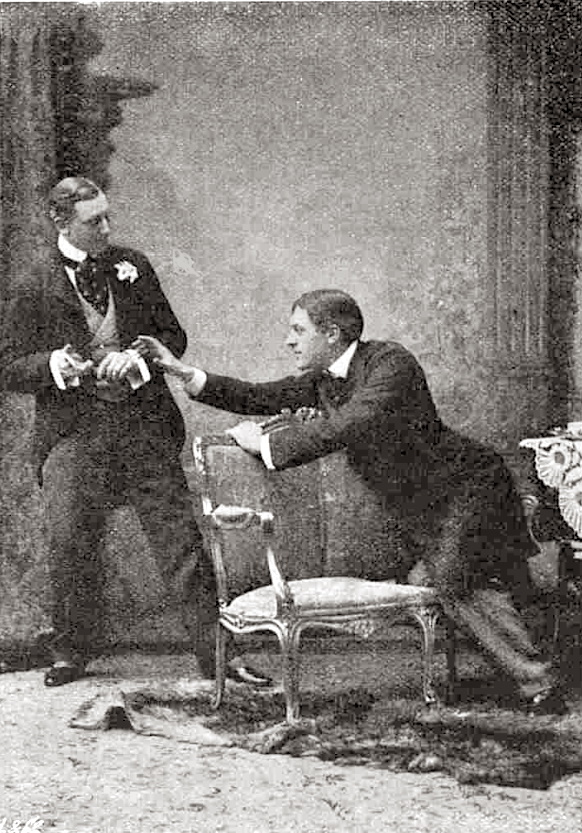
The Importance of Being Earnest, a Trivial Comedy for Serious People is a play by Oscar Wilde, the last of his four drawing-room plays, following Lady Windermere's Fan (1892), A Woman of No Importance (1893) and An Ideal Husband (1895). First performed on 14 February 1895 at the St James's Theatre in London, it is a farcical comedy depicting the tangled affairs of two young men about town who lead double lives to evade unwanted social obligations, both assuming the name Ernest while wooing the two young women of their affections.
The play, celebrated for its wit and repartee, parodies contemporary dramatic norms, gently satirises late Victorian manners, and introduces – in addition to the two pairs of young lovers – the formidable Lady Bracknell, the fussy governess Miss Prism and the benign and scholarly Canon Chasuble. Contemporary reviews in Britain and overseas praised the play's humour, although some critics had reservations about its lack of social messages.
The successful opening night marked the climax of Wilde's career but was followed within weeks by his downfall. The Marquess of Queensberry, whose son Lord Alfred Douglas was Wilde's lover, unsuccessfully schemed to throw a bouquet of rotten vegetables at the playwright at the end of the performance. This feud led to a series of legal trials from March to May 1895 which resulted in Wilde's conviction and imprisonment for homosexual acts. Despite the play's early success, Wilde's disgrace caused it to be closed in May after 86 performances. After his release from prison in 1897 he published the play from exile in Paris, but he wrote no more comic or dramatic works.
From the early 20th century onwards the play has been revived frequently in English-speaking countries and elsewhere. After the first production, which featured George Alexander, Allan Aynesworth and Irene Vanbrugh among others, many actors have been associated with the play, including Mabel Terry-Lewis, John Gielgud, Edith Evans, Margaret Rutherford, Martin Jarvis, Nigel Havers and Judi Dench. The role of the redoubtable Lady Bracknell has sometimes been played by men. The Importance of Being Earnest has been adapted for radio from the 1920s onwards and for television since the 1930s, filmed for the cinema on three occasions (directed by Anthony Asquith in 1952, Kurt Baker in 1992 and Oliver Parker in 2002) and turned into operas and musicals.
The play is set in "The Present" (1895 at the time of the premiere).
Algernon Moncrieff's flat in Half Moon Street
Algernon Moncrieff, a young man about town, is visited by a friend whom he knows by the name of Ernest Worthing. The latter has come from the country to propose to Algernon's cousin, Gwendolen Fairfax. Algernon refuses to consent until Ernest explains why his cigarette case bears the inscription, "From little Cecily, with her fondest love to her dear Uncle Jack". Worthing is forced to admit to living a double life. In the country, he assumes a serious attitude for the benefit of his young ward, the heiress Cecily Cardew, and goes by the name of John or Jack, while pretending that he must worry about a wastrel younger brother in London, named Ernest. Meanwhile, he assumes the identity of the profligate Ernest when in town. Algernon confesses a similar deception: he pretends to have a sickly friend named Bunbury in the country, whom he can "visit" whenever he wishes to avoid an unwelcome social obligation. Jack refuses to tell Algernon the location of his country estate.
Gwendolen and her formidable mother, Lady Bracknell, now call on Algernon, who distracts Lady Bracknell in another room while Jack proposes to Gwendolen. She accepts but says she could not love him if his name were not Ernest. He resolves secretly to be rechristened. Discovering the two in this intimate exchange, Lady Bracknell interviews Jack as a prospective suitor for her daughter. Horrified to learn that he was adopted – having been found as a baby in a handbag deposited at Victoria Station in London – she refuses him and forbids further contact with her daughter. Gwendolen manages to covertly promise to him her undying love. As Jack gives her his address in the country, Algernon surreptitiously notes it on the cuff of his sleeve: Jack's revelation of his pretty young ward has motivated his friend to meet her.
Hub AI
The Importance of Being Earnest AI simulator
(@The Importance of Being Earnest_simulator)
The Importance of Being Earnest
The Importance of Being Earnest, a Trivial Comedy for Serious People is a play by Oscar Wilde, the last of his four drawing-room plays, following Lady Windermere's Fan (1892), A Woman of No Importance (1893) and An Ideal Husband (1895). First performed on 14 February 1895 at the St James's Theatre in London, it is a farcical comedy depicting the tangled affairs of two young men about town who lead double lives to evade unwanted social obligations, both assuming the name Ernest while wooing the two young women of their affections.
The play, celebrated for its wit and repartee, parodies contemporary dramatic norms, gently satirises late Victorian manners, and introduces – in addition to the two pairs of young lovers – the formidable Lady Bracknell, the fussy governess Miss Prism and the benign and scholarly Canon Chasuble. Contemporary reviews in Britain and overseas praised the play's humour, although some critics had reservations about its lack of social messages.
The successful opening night marked the climax of Wilde's career but was followed within weeks by his downfall. The Marquess of Queensberry, whose son Lord Alfred Douglas was Wilde's lover, unsuccessfully schemed to throw a bouquet of rotten vegetables at the playwright at the end of the performance. This feud led to a series of legal trials from March to May 1895 which resulted in Wilde's conviction and imprisonment for homosexual acts. Despite the play's early success, Wilde's disgrace caused it to be closed in May after 86 performances. After his release from prison in 1897 he published the play from exile in Paris, but he wrote no more comic or dramatic works.
From the early 20th century onwards the play has been revived frequently in English-speaking countries and elsewhere. After the first production, which featured George Alexander, Allan Aynesworth and Irene Vanbrugh among others, many actors have been associated with the play, including Mabel Terry-Lewis, John Gielgud, Edith Evans, Margaret Rutherford, Martin Jarvis, Nigel Havers and Judi Dench. The role of the redoubtable Lady Bracknell has sometimes been played by men. The Importance of Being Earnest has been adapted for radio from the 1920s onwards and for television since the 1930s, filmed for the cinema on three occasions (directed by Anthony Asquith in 1952, Kurt Baker in 1992 and Oliver Parker in 2002) and turned into operas and musicals.
The play is set in "The Present" (1895 at the time of the premiere).
Algernon Moncrieff's flat in Half Moon Street
Algernon Moncrieff, a young man about town, is visited by a friend whom he knows by the name of Ernest Worthing. The latter has come from the country to propose to Algernon's cousin, Gwendolen Fairfax. Algernon refuses to consent until Ernest explains why his cigarette case bears the inscription, "From little Cecily, with her fondest love to her dear Uncle Jack". Worthing is forced to admit to living a double life. In the country, he assumes a serious attitude for the benefit of his young ward, the heiress Cecily Cardew, and goes by the name of John or Jack, while pretending that he must worry about a wastrel younger brother in London, named Ernest. Meanwhile, he assumes the identity of the profligate Ernest when in town. Algernon confesses a similar deception: he pretends to have a sickly friend named Bunbury in the country, whom he can "visit" whenever he wishes to avoid an unwelcome social obligation. Jack refuses to tell Algernon the location of his country estate.
Gwendolen and her formidable mother, Lady Bracknell, now call on Algernon, who distracts Lady Bracknell in another room while Jack proposes to Gwendolen. She accepts but says she could not love him if his name were not Ernest. He resolves secretly to be rechristened. Discovering the two in this intimate exchange, Lady Bracknell interviews Jack as a prospective suitor for her daughter. Horrified to learn that he was adopted – having been found as a baby in a handbag deposited at Victoria Station in London – she refuses him and forbids further contact with her daughter. Gwendolen manages to covertly promise to him her undying love. As Jack gives her his address in the country, Algernon surreptitiously notes it on the cuff of his sleeve: Jack's revelation of his pretty young ward has motivated his friend to meet her.