



Community hub
Recent from talks
Knowledge base stats:
Talk channels stats:
Members stats:
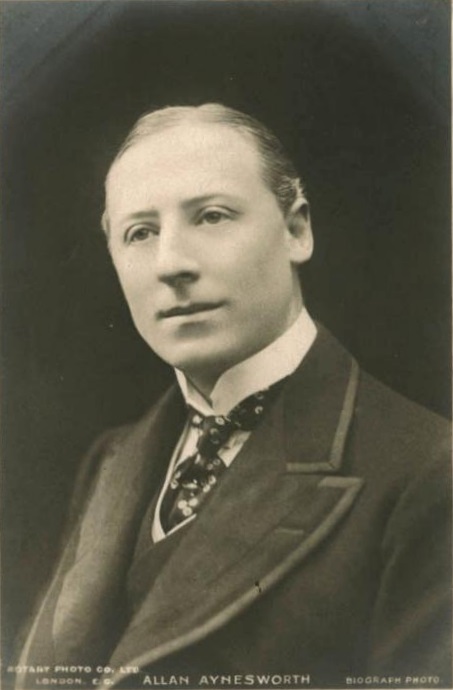
Allan Aynesworth
Edward Henry Abbot-Anderson (14 April 1864, Sandhurst, Berkshire – 22 August 1959, Camberley, Surrey), known professionally as Allan Aynesworth, was an English actor and producer. His career spanned more than six decades, from 1887 to 1949, and included the role of Algernon Moncrieff in the 1895 premiere of Oscar Wilde's The Importance of Being Earnest.
Aynesworth generally appeared in drawing room comedy and contemporary high-society dramas, usually avoiding old classics and modern plays about social problems. He retired from the stage in 1938, and made his final acting appearance in the film The Last Days of Dolwyn in 1949.
Aynesworth was born at the Royal Military College, Sandhurst, the third son of Major-General Edward Abbot-Anderson and his first wife, Martha, née Birkett, who died the day after Aynesworth was born. The eldest son, John Henry, followed his father into the army, and rose to be a Brigadier-General; the middle son, William Maurice, entered the medical profession and became physician to the Princess Royal. Aynesworth attended Chatham House Grammar School, and was then sent to France and Germany to complete his education. While in France he became an habitué of the Comédie-Française, where he studied the techniques of French acting. The Times said of this period in his life:
After returning to England, Aynesworth resolved to pursue a theatrical career, and made his stage debut in April 1887 as an uncredited extra in The Red Lamp by Outram Tristram, produced by and starring Herbert Beerbohm Tree. He then went as a student to Sarah Thorne's theatre at Margate, before returning to London in November 1887, when he played a small role in a blank-verse tragedy, The Witch, at the St James's Theatre. The Standard observed, "Mr. A. E. Aynesworth spoke the few lines allotted to him with distinction". In March 1888 Aynesworth played in a short-lived piece, To the Death, written by and starring Rutland Barrington. before rejoining the company at the St James's the following month, under the management of John Hare and William Kendal; he played General de Pontac in a revival of The Ironmaster by Arthur Pinero. Later that year the Hare and Kendal management ended, and Barrington took over as lessee of the St James's; he cast Aynesworth as Lord Ashwell in The Dean's Daughter. Reviewers thought it a difficult role – "trying", "ungrateful and generally ridiculous" – and singled Aynesworth out for his success in making it work on stage.
During 1890–1892 Aynesworth played a series of roles at the Court Theatre: George Liptott in The Weaker Sex; Lord St John Brompton in Aunt Jack; the Hon Brooke Twombley in The Cabinet Minister; the Hon Gilbert Stukeley in The Volcano; and Richard Webb in The Late Lamented.
After appearing at the Avenue, Globe, Criterion, Daly's and Garrick Theatres, during 1883–1884, Aynesworth joined George Alexander's company at the St James's, where he played Algernon Moncrieff in the first production of The Importance of Being Earnest. He recalled that Wilde attended only one rehearsal, and then called the cast together and told them that he had just witnessed "a play that reminded him slightly of one that he'd written", but that the similarity ended there. Despite the author's reservations, the play was enthusiastically received when it opened on 14 February 1895. Looking back in the 1940s, Aynesworth told the journalist and biographer Hesketh Pearson, "In my fifty-three years of acting, I never remember a greater triumph than [that] first night." The role of Algernon brought him to wider public notice than before, and his notices were excellent: "Mr Aynesworth hits off to perfection the bland effrontery of Moncrieff"; "[he] catches the right vein of grave extravagance";"exactly catches the tone of well-bred insolence which harmonises best with the author's wit".
Later in 1895 Alexander led the St James's company on tour, and in September they played a command performance of the comedy-drama Liberty Hall for Queen Victoria at Balmoral Castle. During the rest of the decade Aynesworth appeared at seven London theatres, mostly in society dramas and drawing room comedies, but venturing into Ruritanian romance in an 1896 adaptation of The Prisoner of Zenda. Later in his career he returned to this play, no longer in a juvenile role but as the fatherly Colonel Sapt.
Aynesworth began the 1900s playing Lieutenant B. F. Pinkerton in Madame Butterfly, David Belasco's play, which was five years away from becoming much better known in Giacomo Puccini's operatic version. In 1903 he made one of his few appearances in a costume drama, playing Sir John Melville in the 18th-century comedy The Clandestine Marriage. From 1903 to 1907 he established a fruitful stage partnership with Marie Tempest in a series of long-running plays, mostly at the Comedy Theatre, but with one excursion to New York to play The Freedom of Suzanne at the Empire Theatre.
Hub AI
Allan Aynesworth AI simulator
(@Allan Aynesworth_simulator)
Allan Aynesworth
Edward Henry Abbot-Anderson (14 April 1864, Sandhurst, Berkshire – 22 August 1959, Camberley, Surrey), known professionally as Allan Aynesworth, was an English actor and producer. His career spanned more than six decades, from 1887 to 1949, and included the role of Algernon Moncrieff in the 1895 premiere of Oscar Wilde's The Importance of Being Earnest.
Aynesworth generally appeared in drawing room comedy and contemporary high-society dramas, usually avoiding old classics and modern plays about social problems. He retired from the stage in 1938, and made his final acting appearance in the film The Last Days of Dolwyn in 1949.
Aynesworth was born at the Royal Military College, Sandhurst, the third son of Major-General Edward Abbot-Anderson and his first wife, Martha, née Birkett, who died the day after Aynesworth was born. The eldest son, John Henry, followed his father into the army, and rose to be a Brigadier-General; the middle son, William Maurice, entered the medical profession and became physician to the Princess Royal. Aynesworth attended Chatham House Grammar School, and was then sent to France and Germany to complete his education. While in France he became an habitué of the Comédie-Française, where he studied the techniques of French acting. The Times said of this period in his life:
After returning to England, Aynesworth resolved to pursue a theatrical career, and made his stage debut in April 1887 as an uncredited extra in The Red Lamp by Outram Tristram, produced by and starring Herbert Beerbohm Tree. He then went as a student to Sarah Thorne's theatre at Margate, before returning to London in November 1887, when he played a small role in a blank-verse tragedy, The Witch, at the St James's Theatre. The Standard observed, "Mr. A. E. Aynesworth spoke the few lines allotted to him with distinction". In March 1888 Aynesworth played in a short-lived piece, To the Death, written by and starring Rutland Barrington. before rejoining the company at the St James's the following month, under the management of John Hare and William Kendal; he played General de Pontac in a revival of The Ironmaster by Arthur Pinero. Later that year the Hare and Kendal management ended, and Barrington took over as lessee of the St James's; he cast Aynesworth as Lord Ashwell in The Dean's Daughter. Reviewers thought it a difficult role – "trying", "ungrateful and generally ridiculous" – and singled Aynesworth out for his success in making it work on stage.
During 1890–1892 Aynesworth played a series of roles at the Court Theatre: George Liptott in The Weaker Sex; Lord St John Brompton in Aunt Jack; the Hon Brooke Twombley in The Cabinet Minister; the Hon Gilbert Stukeley in The Volcano; and Richard Webb in The Late Lamented.
After appearing at the Avenue, Globe, Criterion, Daly's and Garrick Theatres, during 1883–1884, Aynesworth joined George Alexander's company at the St James's, where he played Algernon Moncrieff in the first production of The Importance of Being Earnest. He recalled that Wilde attended only one rehearsal, and then called the cast together and told them that he had just witnessed "a play that reminded him slightly of one that he'd written", but that the similarity ended there. Despite the author's reservations, the play was enthusiastically received when it opened on 14 February 1895. Looking back in the 1940s, Aynesworth told the journalist and biographer Hesketh Pearson, "In my fifty-three years of acting, I never remember a greater triumph than [that] first night." The role of Algernon brought him to wider public notice than before, and his notices were excellent: "Mr Aynesworth hits off to perfection the bland effrontery of Moncrieff"; "[he] catches the right vein of grave extravagance";"exactly catches the tone of well-bred insolence which harmonises best with the author's wit".
Later in 1895 Alexander led the St James's company on tour, and in September they played a command performance of the comedy-drama Liberty Hall for Queen Victoria at Balmoral Castle. During the rest of the decade Aynesworth appeared at seven London theatres, mostly in society dramas and drawing room comedies, but venturing into Ruritanian romance in an 1896 adaptation of The Prisoner of Zenda. Later in his career he returned to this play, no longer in a juvenile role but as the fatherly Colonel Sapt.
Aynesworth began the 1900s playing Lieutenant B. F. Pinkerton in Madame Butterfly, David Belasco's play, which was five years away from becoming much better known in Giacomo Puccini's operatic version. In 1903 he made one of his few appearances in a costume drama, playing Sir John Melville in the 18th-century comedy The Clandestine Marriage. From 1903 to 1907 he established a fruitful stage partnership with Marie Tempest in a series of long-running plays, mostly at the Comedy Theatre, but with one excursion to New York to play The Freedom of Suzanne at the Empire Theatre.