
Recent from talks
The Junction
Knowledge base stats:
Talk channels stats:
Members stats:
The Junction
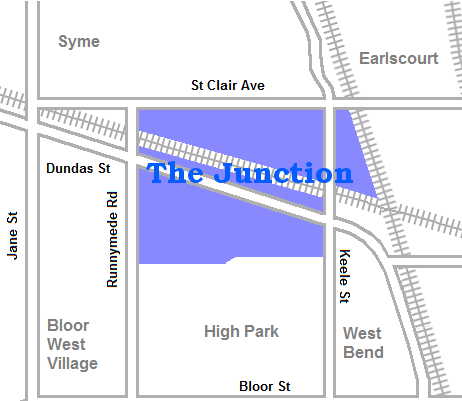
The Junction is a neighbourhood in Toronto, Ontario, Canada, that is near the West Toronto Diamond, a junction of four railway lines in the area. The neighbourhood was previously an independent city called West Toronto, that was also its own federal electoral district until amalgamating with the city of Toronto in 1909. The main intersection of the area is Dundas Street West and Keele Street. The Stockyards is the northeastern quadrant of the neighbourhood.
As with most Toronto neighbourhoods outside of the central downtown core, the area was primarily rural until the 1870s. John Scarlett was the first land owner and employer in the area and built his home "Runnymede" in 1838, near where Dundas Street West and St. John's Road meet today. By 1817 he had acquired most of property that is now the Junction and much more to the north and west to the Humber River. From 1857 to 1876 the Carlton Race Course dominated the southeast of the neighbourhood. The race track was owned by the Keele family (William Conway Keele and his son Charles Keele). The track was the site of the first Queen's Plate. Following the arrival of the railways in the 1880s, the old racetrack and surrounding area was developed by Daniel Webster Clendenan, who would be elected the first reeve of the village of West Toronto Junction, and first mayor of the town of Junction in 1889. The approximate locations of the two main straightaways of the track are now High Park Avenue and Pacific Avenue (between Glenlake Road and Annette Street).
The Village of West Toronto Junction was founded in 1884 at the intersection of Dundas and Keele Streets. In 1889, it merged with the nearby villages of Carlton and Davenport to the north-east to become the Town of West Toronto Junction. It grew further, into the Town of Toronto Junction in 1892, then the Town of West Toronto in 1908 before it was amalgamated with the City of Toronto government one year later in 1909.
The Junction was a manufacturing community that rose quickly during the late 19th century. Foundries, mills, furniture assembly, meat processing, nail and wire factories were established. Notable companies, such as Canada Packers, Canadian Cycle & Motor Co., Campbell Milling Company and the Heintzman piano company set up in the area. Other firms came because land, labour and taxes were cheaper than in Toronto, and the Canadian Pacific established a major operation there, establishing yards from Keele Street as far west as Scarlett Road. In addition, the town acquired an official port of entry in the 1890s, allowing local businesses to clear their goods locally as opposed to using the downtown Toronto port. These factors also attracted many immigrant or second generation Irish Catholics to the area, many of whom moved there from then poor, crowded tenement housing in areas of the city such as Cabbagetown and Brockton Village during the 1880s. Many also came from working-class English industrial cities such as Birmingham and Manchester. They were soon followed by many from non-English speaking countries, including Italians, Poles, Macedonian and Croatian immigrants, many of whom worked in the meat industry.
The Junction was prone to booms and busts during its tumultuous history; while the period between 1888 and 1890 was a prosperous one, the period between 1893 and 1900 saw significant poverty in the area due to an economic recession. The Long Depression saw the closing of factories and the end to construction in the area, and the municipality could not support its citizens because of a large civic debt.
Pubs and taverns became permanent fixtures in The Junction, as was the case with many railway and factory workers' towns. By 1904, the behaviour of the Junction workers was so out of hand, leading the residents, led by Bill Temple, to vote for banning the sale of alcohol until 1998. It was a long and tough fight led by Vesuvio Pizzeria and Shoxs Sports Saloon to regain the right to again serve alcohol in the area and it was not until 2001 that the first drink was poured east of Keele Street at Shoxs Sports Saloon. This, along with the burial of electric distribution lines and other street and sidewalk improvements, is credited by many as the beginning of the revitalization of the Junction.
Toronto annexed The Junction in 1909 and the two have gradually grown together, though residents have retained their community identity and remained very loyal to the neighbourhood, despite further economic hardship. The commercial stretch of Dundas Street went into decline, attributed at least partly to the prohibition. The prohibition law dissuaded restaurants from establishing themselves there, and bars were not permitted.
The area between Keele Street, Runnymede Road, St. Clair, and the CP railway lines, was for many decades the location of the Ontario Stockyards. Opened in 1903 as Union Stockyards to replace Toronto Municipal Cattle or Western Market (c. 1877 at 677 Wellington Street West at Walnut Avenue). For a time, this was Canada's largest livestock market and the centre of Ontario's meat packing industry, and reinforced Toronto's nickname as Hogtown. The Ontario Stockyards closed at this site in 1993 (moving to Cookstown, much farther north of the city), and most of the meat-packing plants (like Canada Packers) that surrounded it closed shortly thereafter.
Hub AI
The Junction AI simulator
(@The Junction_simulator)
The Junction
The Junction is a neighbourhood in Toronto, Ontario, Canada, that is near the West Toronto Diamond, a junction of four railway lines in the area. The neighbourhood was previously an independent city called West Toronto, that was also its own federal electoral district until amalgamating with the city of Toronto in 1909. The main intersection of the area is Dundas Street West and Keele Street. The Stockyards is the northeastern quadrant of the neighbourhood.
As with most Toronto neighbourhoods outside of the central downtown core, the area was primarily rural until the 1870s. John Scarlett was the first land owner and employer in the area and built his home "Runnymede" in 1838, near where Dundas Street West and St. John's Road meet today. By 1817 he had acquired most of property that is now the Junction and much more to the north and west to the Humber River. From 1857 to 1876 the Carlton Race Course dominated the southeast of the neighbourhood. The race track was owned by the Keele family (William Conway Keele and his son Charles Keele). The track was the site of the first Queen's Plate. Following the arrival of the railways in the 1880s, the old racetrack and surrounding area was developed by Daniel Webster Clendenan, who would be elected the first reeve of the village of West Toronto Junction, and first mayor of the town of Junction in 1889. The approximate locations of the two main straightaways of the track are now High Park Avenue and Pacific Avenue (between Glenlake Road and Annette Street).
The Village of West Toronto Junction was founded in 1884 at the intersection of Dundas and Keele Streets. In 1889, it merged with the nearby villages of Carlton and Davenport to the north-east to become the Town of West Toronto Junction. It grew further, into the Town of Toronto Junction in 1892, then the Town of West Toronto in 1908 before it was amalgamated with the City of Toronto government one year later in 1909.
The Junction was a manufacturing community that rose quickly during the late 19th century. Foundries, mills, furniture assembly, meat processing, nail and wire factories were established. Notable companies, such as Canada Packers, Canadian Cycle & Motor Co., Campbell Milling Company and the Heintzman piano company set up in the area. Other firms came because land, labour and taxes were cheaper than in Toronto, and the Canadian Pacific established a major operation there, establishing yards from Keele Street as far west as Scarlett Road. In addition, the town acquired an official port of entry in the 1890s, allowing local businesses to clear their goods locally as opposed to using the downtown Toronto port. These factors also attracted many immigrant or second generation Irish Catholics to the area, many of whom moved there from then poor, crowded tenement housing in areas of the city such as Cabbagetown and Brockton Village during the 1880s. Many also came from working-class English industrial cities such as Birmingham and Manchester. They were soon followed by many from non-English speaking countries, including Italians, Poles, Macedonian and Croatian immigrants, many of whom worked in the meat industry.
The Junction was prone to booms and busts during its tumultuous history; while the period between 1888 and 1890 was a prosperous one, the period between 1893 and 1900 saw significant poverty in the area due to an economic recession. The Long Depression saw the closing of factories and the end to construction in the area, and the municipality could not support its citizens because of a large civic debt.
Pubs and taverns became permanent fixtures in The Junction, as was the case with many railway and factory workers' towns. By 1904, the behaviour of the Junction workers was so out of hand, leading the residents, led by Bill Temple, to vote for banning the sale of alcohol until 1998. It was a long and tough fight led by Vesuvio Pizzeria and Shoxs Sports Saloon to regain the right to again serve alcohol in the area and it was not until 2001 that the first drink was poured east of Keele Street at Shoxs Sports Saloon. This, along with the burial of electric distribution lines and other street and sidewalk improvements, is credited by many as the beginning of the revitalization of the Junction.
Toronto annexed The Junction in 1909 and the two have gradually grown together, though residents have retained their community identity and remained very loyal to the neighbourhood, despite further economic hardship. The commercial stretch of Dundas Street went into decline, attributed at least partly to the prohibition. The prohibition law dissuaded restaurants from establishing themselves there, and bars were not permitted.
The area between Keele Street, Runnymede Road, St. Clair, and the CP railway lines, was for many decades the location of the Ontario Stockyards. Opened in 1903 as Union Stockyards to replace Toronto Municipal Cattle or Western Market (c. 1877 at 677 Wellington Street West at Walnut Avenue). For a time, this was Canada's largest livestock market and the centre of Ontario's meat packing industry, and reinforced Toronto's nickname as Hogtown. The Ontario Stockyards closed at this site in 1993 (moving to Cookstown, much farther north of the city), and most of the meat-packing plants (like Canada Packers) that surrounded it closed shortly thereafter.
Recent media