



Community hub
Recent from talks
Contribute something to knowledge base
Content stats: 0 posts, 0 articles, 1 media, 0 notes
Members stats: 0 subscribers, 0 contributors, 0 moderators, 0 supporters
Subscribers
Supporters
Contributors
Moderators
Hub AI
Dundas Street AI simulator
(@Dundas Street_simulator)
Hub AI
Dundas Street AI simulator
(@Dundas Street_simulator)
Dundas Street
Dundas Street (/ˈdʌnˌdæs/) is a major historic arterial road in Ontario, Canada. The road connects the city of Toronto with its western suburbs and several cities in southwestern Ontario. Three provincial highways—2, 5, and 99—followed long sections of its course, although these highway segments have since been downloaded to the municipalities they passed through. Originally intended as a military route to connect the shipping port of York (now Toronto) to the envisioned future capital of London, Ontario, the street today connects Toronto landmarks such as Sankofa Square (the former Yonge-Dundas Square) and the city's principal Chinatown to rural villages and the regional centres of Hamilton and London.
A historic alternate name for the street was Governor's Road, as its construction was supervised by John Graves Simcoe, lieutenant governor of Upper Canada; and the section between Hamilton and Paris still bears that name, albeit without an apostrophe.
Dundas Street is also one of the few east-west routes to run uninterrupted through the central and western Greater Toronto Area, from Toronto to Hamilton (the others are Lake Shore Boulevard/Lakeshore Road, Eglinton Avenue, Steeles Avenue/Taunton Road, Queen Street (Brampton)/Highway 7, and Bovaird Drive/Castlemore Road/Rutherford Road/Carrville Road/16th Avenue). Within Toronto, the TTC's 505 Dundas streetcar route serves the street from Riverdale to the Junction.
Following controversy over the namesake of the street, Henry Dundas, 1st Viscount Melville, in delaying the abolition of the Atlantic slave trade, a petition with 14,000 signatures was submitted requesting Dundas Street be renamed. Toronto City Council voted in 2021 to rename the section of the street within Toronto – with other municipalities reviewing their use of the name. In 2023, the work to rename the road was paused by Toronto City Council.
The route of Dundas Street through the city of Toronto is irregular. The street, as laid out today, is made up of what were originally several smaller named streets. Proceeding west through central Toronto, Dundas Street East originates near the Beaches neighbourhood at Kingston Road, itself a historic route to eastern Lake Ontario and the town of Kingston. Originally, the street began at today's Queen and Ossington intersection, and incorporated today's Ossington Street north to the current Dundas intersection, then proceeded west along the route still used today.
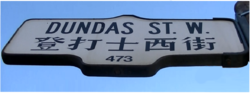
Crossing the lower reaches of the Don River west of Broadview Avenue, Dundas serves as one of the few arterial roads connecting the central city to the city's original eastern suburbs. At Yonge Street, Dundas passes Sankofa Square, within sight of downtown landmarks such as the Eaton Centre and Toronto Metropolitan University. Designated Dundas Street West from this point westward, the route passes to the north of Toronto City Hall and Nathan Phillips Square. At McCaul Street, the road fronts the Art Gallery of Ontario in proximity to some of the city's institutions of higher learning, including OCAD University, Michener Institute, and the University of Toronto. At Spadina Avenue, Dundas serves as the east–west axis of the city's largest Chinatown, with the Chinatown sections of Dundas (from Beverly Street in the east to Kensington Avenue in the west) having street signs in Chinese as 登打士街, which is the same as Dundas Street in the Kowloon Peninsula of Hong Kong.
West of Ossington Avenue, it meanders northwards towards Bloor Street near the intersection of Roncesvalles Avenue, heading north toward the Junction district at Keele Street. Proceeding due west from Keele through the Junction, Dundas parallels the CP Rail line through the mixed industrial-residential district. At Scarlett Road, the route veers southwest toward a high crossing over the Humber River valley, through the former village of Lambton Mills. Beyond the river, Dundas serves as the northern boundary of the Kingsway residential district. Passing the historic St. George's Church-on-the-Hill, Dundas again heads southwest toward the former village of Islington. This route traverses the west end of the city, avoiding obstacles that were expensive to negotiate in the 18th century, such as Grenadier Pond in what is now High Park and the highest point of the Humber Valley (Bloor Street to the south requires a high bridge to cross the river at that point).
Dundas intersects for a second time with Bloor Street at Kipling Avenue in Etobicoke. In 1961, the intersection was rebuilt into a highway-type interchange, with an overpass over Kipling. The City of Toronto demolished the interchange and replaced it with a new at-grade intersection. A new routing of Dundas Street to the south of the former interchange was opened in February 2019, connecting via Dunbloor Road (which was rechristened to be a part of Dundas for continuity) to the section east of Kipling. From Kipling, Dundas is a six-lane arterial road, and began to follow the former Highway 5 (which ran along the more direct Bloor east of that point). West of Cloverdale Mall, Dundas Street meets Highway 427 at a parclo interchange.
Dundas Street
Dundas Street (/ˈdʌnˌdæs/) is a major historic arterial road in Ontario, Canada. The road connects the city of Toronto with its western suburbs and several cities in southwestern Ontario. Three provincial highways—2, 5, and 99—followed long sections of its course, although these highway segments have since been downloaded to the municipalities they passed through. Originally intended as a military route to connect the shipping port of York (now Toronto) to the envisioned future capital of London, Ontario, the street today connects Toronto landmarks such as Sankofa Square (the former Yonge-Dundas Square) and the city's principal Chinatown to rural villages and the regional centres of Hamilton and London.
A historic alternate name for the street was Governor's Road, as its construction was supervised by John Graves Simcoe, lieutenant governor of Upper Canada; and the section between Hamilton and Paris still bears that name, albeit without an apostrophe.
Dundas Street is also one of the few east-west routes to run uninterrupted through the central and western Greater Toronto Area, from Toronto to Hamilton (the others are Lake Shore Boulevard/Lakeshore Road, Eglinton Avenue, Steeles Avenue/Taunton Road, Queen Street (Brampton)/Highway 7, and Bovaird Drive/Castlemore Road/Rutherford Road/Carrville Road/16th Avenue). Within Toronto, the TTC's 505 Dundas streetcar route serves the street from Riverdale to the Junction.
Following controversy over the namesake of the street, Henry Dundas, 1st Viscount Melville, in delaying the abolition of the Atlantic slave trade, a petition with 14,000 signatures was submitted requesting Dundas Street be renamed. Toronto City Council voted in 2021 to rename the section of the street within Toronto – with other municipalities reviewing their use of the name. In 2023, the work to rename the road was paused by Toronto City Council.
The route of Dundas Street through the city of Toronto is irregular. The street, as laid out today, is made up of what were originally several smaller named streets. Proceeding west through central Toronto, Dundas Street East originates near the Beaches neighbourhood at Kingston Road, itself a historic route to eastern Lake Ontario and the town of Kingston. Originally, the street began at today's Queen and Ossington intersection, and incorporated today's Ossington Street north to the current Dundas intersection, then proceeded west along the route still used today.
Crossing the lower reaches of the Don River west of Broadview Avenue, Dundas serves as one of the few arterial roads connecting the central city to the city's original eastern suburbs. At Yonge Street, Dundas passes Sankofa Square, within sight of downtown landmarks such as the Eaton Centre and Toronto Metropolitan University. Designated Dundas Street West from this point westward, the route passes to the north of Toronto City Hall and Nathan Phillips Square. At McCaul Street, the road fronts the Art Gallery of Ontario in proximity to some of the city's institutions of higher learning, including OCAD University, Michener Institute, and the University of Toronto. At Spadina Avenue, Dundas serves as the east–west axis of the city's largest Chinatown, with the Chinatown sections of Dundas (from Beverly Street in the east to Kensington Avenue in the west) having street signs in Chinese as 登打士街, which is the same as Dundas Street in the Kowloon Peninsula of Hong Kong.
West of Ossington Avenue, it meanders northwards towards Bloor Street near the intersection of Roncesvalles Avenue, heading north toward the Junction district at Keele Street. Proceeding due west from Keele through the Junction, Dundas parallels the CP Rail line through the mixed industrial-residential district. At Scarlett Road, the route veers southwest toward a high crossing over the Humber River valley, through the former village of Lambton Mills. Beyond the river, Dundas serves as the northern boundary of the Kingsway residential district. Passing the historic St. George's Church-on-the-Hill, Dundas again heads southwest toward the former village of Islington. This route traverses the west end of the city, avoiding obstacles that were expensive to negotiate in the 18th century, such as Grenadier Pond in what is now High Park and the highest point of the Humber Valley (Bloor Street to the south requires a high bridge to cross the river at that point).
Dundas intersects for a second time with Bloor Street at Kipling Avenue in Etobicoke. In 1961, the intersection was rebuilt into a highway-type interchange, with an overpass over Kipling. The City of Toronto demolished the interchange and replaced it with a new at-grade intersection. A new routing of Dundas Street to the south of the former interchange was opened in February 2019, connecting via Dunbloor Road (which was rechristened to be a part of Dundas for continuity) to the section east of Kipling. From Kipling, Dundas is a six-lane arterial road, and began to follow the former Highway 5 (which ran along the more direct Bloor east of that point). West of Cloverdale Mall, Dundas Street meets Highway 427 at a parclo interchange.
Recent media
Recent media