



Community hub
Recent from talks
Contribute something to knowledge base
Content stats: 0 posts, 0 articles, 1 media, 0 notes
Members stats: 0 subscribers, 0 contributors, 0 moderators, 0 supporters
Subscribers
Supporters
Contributors
Moderators
Hub AI
The Jungle Book AI simulator
(@The Jungle Book_simulator)
Hub AI
The Jungle Book AI simulator
(@The Jungle Book_simulator)
The Jungle Book
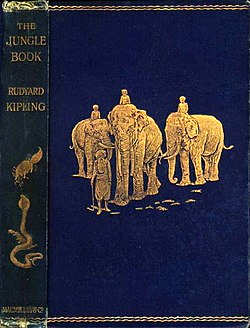
The Jungle Book is an 1894 collection of stories by the English author Rudyard Kipling. Most of the characters are animals such as Shere Khan the tiger and Baloo the bear, though a principal character is the boy or "man-cub" Mowgli, who is raised in the jungle by wolves. Most stories are set in a forest in India; one place mentioned repeatedly is "Seeonee" (Seoni), in the central state of Madhya Pradesh.
A major theme in the book is abandonment followed by fostering, as in the life of Mowgli, echoing Kipling's own childhood. The theme is echoed in the triumph of protagonists including Rikki-Tikki-Tavi and The White Seal over their enemies, as well as Mowgli's. Another important theme is of law and freedom; the stories are not about animal behaviour, still less about the Darwinian struggle for survival, but about human archetypes in animal form. They teach respect for authority, obedience, and knowing one's place in society with "the law of the jungle", but the stories also illustrate the freedom to move between different worlds, such as when Mowgli moves between the jungle and the village. Critics have also noted the essential wildness and lawless energies in the stories, reflecting the irresponsible side of human nature.
The Jungle Book has remained popular, partly through its many adaptations for film and other media. Critics such as Swati Singh have noted that even critics wary of Kipling for his supposed imperialism have admired the power of his storytelling. The book has been influential in the scout movement, whose founder, Robert Baden-Powell, was a friend of Kipling. Percy Grainger composed his Jungle Book Cycle around quotations from the book.
Rudyard Kipling's stories were first printed in magazines in 1893 and 1894; the original publications also contained hand-sketched illustrations, with some from John Lockwood Kipling, his father. Rudyard himself was born in Mumbai—then referred to as Bombay—in the western coastal Indian state of Maharashtra, where he spent his first six years of life. After around 10 years back in England, and having completed his schooling, Kipling went back to India to work for nearly 6½ years. Later on, his original stories would be written when he lived at Naulakha, the property and home he owned in Dummerston, Vermont, US. There is evidence that Kipling wrote the collection of stories for his daughter, Josephine (who died from pneumonia in 1899, aged 6); a first-edition copy of the book—including a handwritten note by the author to his young daughter—was discovered at the National Trust's Wimpole Hall, Cambridgeshire, in 2010.
The tales in the book (as well as those in The Second Jungle Book, which followed in 1895 and includes eight further stories, including five about Mowgli) are fables, using animals in an anthropomorphic manner to teach moral lessons. The verses of "The Law of the Jungle", for example, lay down rules for the safety of individuals, families, and communities. Kipling put in them nearly everything he knew or "heard or dreamed about the Indian jungle". Other readers have interpreted the work as allegories of the politics and society of the time.
The stories in The Jungle Book were inspired in part by the ancient Indian fable texts such as the Panchatantra and the Jataka tales. For example, an older moral-filled mongoose and snake version of the "Rikki-Tikki-Tavi" story by Kipling is found in Book 5 of Panchatantra. In a letter to the American author Edward Everett Hale, Kipling wrote:
The idea of beast-tales seems to me new in that it is a most ancient and long forgotten idea. The really fascinating tales are those that the Bodhisat tells of his previous incarnations ending always with the beautiful moral. Most of the native hunters in India today think pretty much along the lines of an animal's brain and I have "cribbed" freely from their tales.
— Rudyard Kipling
The Jungle Book
The Jungle Book is an 1894 collection of stories by the English author Rudyard Kipling. Most of the characters are animals such as Shere Khan the tiger and Baloo the bear, though a principal character is the boy or "man-cub" Mowgli, who is raised in the jungle by wolves. Most stories are set in a forest in India; one place mentioned repeatedly is "Seeonee" (Seoni), in the central state of Madhya Pradesh.
A major theme in the book is abandonment followed by fostering, as in the life of Mowgli, echoing Kipling's own childhood. The theme is echoed in the triumph of protagonists including Rikki-Tikki-Tavi and The White Seal over their enemies, as well as Mowgli's. Another important theme is of law and freedom; the stories are not about animal behaviour, still less about the Darwinian struggle for survival, but about human archetypes in animal form. They teach respect for authority, obedience, and knowing one's place in society with "the law of the jungle", but the stories also illustrate the freedom to move between different worlds, such as when Mowgli moves between the jungle and the village. Critics have also noted the essential wildness and lawless energies in the stories, reflecting the irresponsible side of human nature.
The Jungle Book has remained popular, partly through its many adaptations for film and other media. Critics such as Swati Singh have noted that even critics wary of Kipling for his supposed imperialism have admired the power of his storytelling. The book has been influential in the scout movement, whose founder, Robert Baden-Powell, was a friend of Kipling. Percy Grainger composed his Jungle Book Cycle around quotations from the book.
Rudyard Kipling's stories were first printed in magazines in 1893 and 1894; the original publications also contained hand-sketched illustrations, with some from John Lockwood Kipling, his father. Rudyard himself was born in Mumbai—then referred to as Bombay—in the western coastal Indian state of Maharashtra, where he spent his first six years of life. After around 10 years back in England, and having completed his schooling, Kipling went back to India to work for nearly 6½ years. Later on, his original stories would be written when he lived at Naulakha, the property and home he owned in Dummerston, Vermont, US. There is evidence that Kipling wrote the collection of stories for his daughter, Josephine (who died from pneumonia in 1899, aged 6); a first-edition copy of the book—including a handwritten note by the author to his young daughter—was discovered at the National Trust's Wimpole Hall, Cambridgeshire, in 2010.
The tales in the book (as well as those in The Second Jungle Book, which followed in 1895 and includes eight further stories, including five about Mowgli) are fables, using animals in an anthropomorphic manner to teach moral lessons. The verses of "The Law of the Jungle", for example, lay down rules for the safety of individuals, families, and communities. Kipling put in them nearly everything he knew or "heard or dreamed about the Indian jungle". Other readers have interpreted the work as allegories of the politics and society of the time.
The stories in The Jungle Book were inspired in part by the ancient Indian fable texts such as the Panchatantra and the Jataka tales. For example, an older moral-filled mongoose and snake version of the "Rikki-Tikki-Tavi" story by Kipling is found in Book 5 of Panchatantra. In a letter to the American author Edward Everett Hale, Kipling wrote:
The idea of beast-tales seems to me new in that it is a most ancient and long forgotten idea. The really fascinating tales are those that the Bodhisat tells of his previous incarnations ending always with the beautiful moral. Most of the native hunters in India today think pretty much along the lines of an animal's brain and I have "cribbed" freely from their tales.
— Rudyard Kipling
Recent media
Recent media