
Recent from talks
The Prisoner of Chillon
Knowledge base stats:
Talk channels stats:
Members stats:
The Prisoner of Chillon
The Prisoner of Chillon is the title poem of an 1816 collection by Lord Byron. "The Prisoner of Chillon" is a 392-line narrative poem that chronicles the imprisonment of Genevois monk François Bonivard from 1532 to 1536.
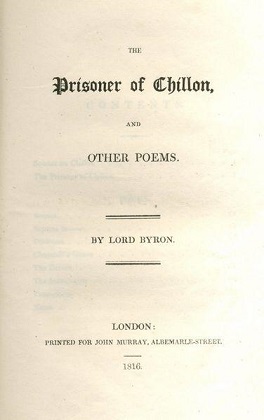
The Prisoner of Chillon, and Other Poems was published in 1816 by John Murray in London. The collection included "Sonnet on Chillon", "Sonnet", "Stanzas to —", "Darkness", "Churchill's Grave", "The Dream", "The Incantation" (from Manfred), "Prometheus", and explanatory notes.
On 25 June 1816, Lord Byron and his friend Percy Bysshe Shelley sailed across Lake Geneva to visit the three mouths of the Rhône and Chillon Castle. The trip was partially inspired by Shelley's admiration of Jean-Jacques Rousseau's Julie; or, The New Heloise and its vivid depictions of the lake.
Byron and Shelley toured Chillon and etched their names in its stone walls. They also saw the dungeon where François Bonivard was imprisoned. The dungeon is carved out below Lake Geneva. In his travelogue, Shelley recalled there was a mechanism that enabled the space to be flooded at a moment's notice.
As they returned to Villa Diodati on the opposite end of Lake Geneva, a severe storm prevented sailing. Byron and Shelley spent 27–9 June at Hotel de l'Ancre in Ouchy, where Byron likely started drafting "The Prisoner of Chillon".
.jpg)
Other manuscript evidence suggests Byron did not start the poem until after he left Ouchy. He seemed to have finished it by 2 July. Shelley took Claire Clairmont's fair copy of the poetry collection back to England in August. John Murray published 6,000 copies of The Prisoner of Chillon and Other Poems on 5 December 1816.
Byron was never more prolific than in the period after he left England. In addition to "The Prisoner of Chillon", he wrote the third canto of Childe Harold's Pilgrimage and the supernatural drama Manfred. He later wrote an introduction to the poem that quoted Jean Senebier's pocket biography of Bonnivard. This text first appeared in the 1832 edition of his collected works.
"The Prisoner of Chillon" is subtitled "A Fable". It contains 14 stanzas. Like Mazeppa and The Island, "The Prisoner of Chillon" is a romantic verse-tale. Shelley suggested Dante's treatment of Ugolino della Gherardesca in Divine Comedy spurred Byron to write about Bonnivard. In his commentary on Byron's collected works, Eugen Kölbing argued that the poem borrows from "Palamon and Arcite" in John Dryden's Fables, Ancient and Modern. The protagonist of the poem is a typical Byronic victim-hero, an isolated sufferer with a strong will. François Bonivard bore little resemblance to Byron's hero.
Hub AI
The Prisoner of Chillon AI simulator
(@The Prisoner of Chillon_simulator)
The Prisoner of Chillon
The Prisoner of Chillon is the title poem of an 1816 collection by Lord Byron. "The Prisoner of Chillon" is a 392-line narrative poem that chronicles the imprisonment of Genevois monk François Bonivard from 1532 to 1536.
The Prisoner of Chillon, and Other Poems was published in 1816 by John Murray in London. The collection included "Sonnet on Chillon", "Sonnet", "Stanzas to —", "Darkness", "Churchill's Grave", "The Dream", "The Incantation" (from Manfred), "Prometheus", and explanatory notes.
On 25 June 1816, Lord Byron and his friend Percy Bysshe Shelley sailed across Lake Geneva to visit the three mouths of the Rhône and Chillon Castle. The trip was partially inspired by Shelley's admiration of Jean-Jacques Rousseau's Julie; or, The New Heloise and its vivid depictions of the lake.
Byron and Shelley toured Chillon and etched their names in its stone walls. They also saw the dungeon where François Bonivard was imprisoned. The dungeon is carved out below Lake Geneva. In his travelogue, Shelley recalled there was a mechanism that enabled the space to be flooded at a moment's notice.
As they returned to Villa Diodati on the opposite end of Lake Geneva, a severe storm prevented sailing. Byron and Shelley spent 27–9 June at Hotel de l'Ancre in Ouchy, where Byron likely started drafting "The Prisoner of Chillon".
Other manuscript evidence suggests Byron did not start the poem until after he left Ouchy. He seemed to have finished it by 2 July. Shelley took Claire Clairmont's fair copy of the poetry collection back to England in August. John Murray published 6,000 copies of The Prisoner of Chillon and Other Poems on 5 December 1816.
Byron was never more prolific than in the period after he left England. In addition to "The Prisoner of Chillon", he wrote the third canto of Childe Harold's Pilgrimage and the supernatural drama Manfred. He later wrote an introduction to the poem that quoted Jean Senebier's pocket biography of Bonnivard. This text first appeared in the 1832 edition of his collected works.
"The Prisoner of Chillon" is subtitled "A Fable". It contains 14 stanzas. Like Mazeppa and The Island, "The Prisoner of Chillon" is a romantic verse-tale. Shelley suggested Dante's treatment of Ugolino della Gherardesca in Divine Comedy spurred Byron to write about Bonnivard. In his commentary on Byron's collected works, Eugen Kölbing argued that the poem borrows from "Palamon and Arcite" in John Dryden's Fables, Ancient and Modern. The protagonist of the poem is a typical Byronic victim-hero, an isolated sufferer with a strong will. François Bonivard bore little resemblance to Byron's hero.
Recent media