


Community hub
Recent from talks
Contribute something to knowledge base
Content stats: 0 posts, 0 articles, 1 media, 0 notes
Members stats: 0 subscribers, 0 contributors, 0 moderators, 0 supporters
Subscribers
Supporters
Contributors
Moderators
The Rooks Have Returned
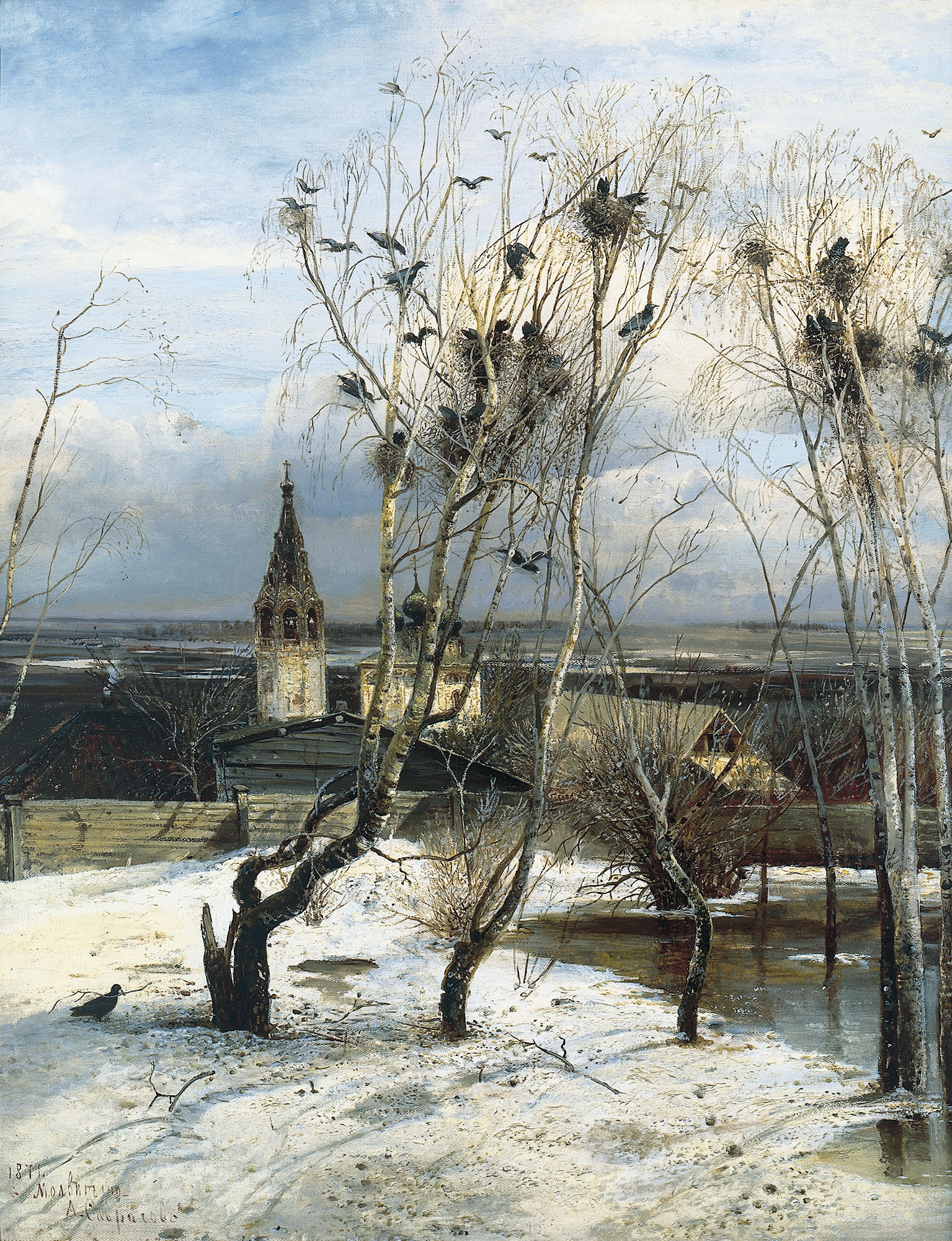
The Rooks Have Returned (Russian: Грачи прилетели, lit. 'The rooks have flown in') is a widely known landscape painting by Russian painter Alexei Savrasov (1830–1897). It was created in 1871 and is kept in the State Tretyakov Gallery (inv. 828). The size of the painting is 62 × 48.5 cm. The painting is considered Savrasov's most famous work, and its appearance is regarded as "an important stage in the development of Russian landscape painting."
Savrasov began working on The Rooks in March 1871. The studies for the future painting were done by the artist during his trip to the Kostroma Governorate, when he was in the village of Molvitino (now the village of Susanino, Kostroma Oblast). The prototype of the church depicted in the painting is the Church of the Resurrection, built in the late 17th century. The place where the artist worked is confirmed by his inscription made in the lower left corner of the canvas: "1871. S. Molvitino. A. Savrasov." Some researchers of Savrasov's work believe that the very first drawings and studies for the painting could have been performed by the artist in Yaroslavl or its environs, shortly before his trip to the Kostroma Governorate. After returning from Molvitino, Savrasov worked on the painting in Yaroslavl and then completed it in Moscow, where he returned in early May. The painting was named by the artist Here Come the Rooks. In the summer of 1871, the painting was purchased from Savrasov by Pavel Tretyakov.
The painting was exhibited at the Moscow Society of Art Lovers in autumn 1871. Later that year, it was presented at the 1st exhibition of the Society for Travelling Art Exhibitions (opened on 28 November in Saint Petersburg) under its current name (listed with an exclamation mark in the catalogue). The Rooks received good reviews: artist Ivan Kramskoi wrote that at the exhibition, this landscape "is the best, and it is truly beautiful," and art critic Vladimir Stasov noted that it is "probably the best and most original painting by Mr. Savrasov."
Painter Isaac Levitan considered The Rooks Have Returned to be one of Savrasov's best paintings. Noting the apparent uncomplicatedness of the plot, he wrote that "behind this simplicity, you feel the soft, good soul of the artist, to whom all this is dear and close to his heart..." Art historian Alexei Fedorov-Davydov called the painting an outstanding work of art and noted that "it has not only artistic, but also general cultural significance." Critic and musicologist Boris Asafiev wrote that the painting became "a symbol of the artistic renewal of the sphere of the Russian landscape for 'far ahead'", and that with this work Savrasov discovered "a new sense of spring and springiness."
In late 1870, Alexei Savrasov, who was then a professor at the Moscow School of Painting, Sculpture and Architecture, took a five-month leave of absence to travel to Yaroslavl with his family, including his wife Sophia Karlovna and children. While on the Volga, he painted several works, such as View of the Volga near Yuryevets and The Spill of the Volga near Yaroslavl. In a letter to Pavel Tretyakov dated 31 December 1870, Savrasov wrote: "The quiet life in Yaroslavl allows me to concentrate on art", and in his New Year's greetings to his brother-in-law Karl Hertz, the artist reported: "After all the troubles, I am just beginning to work and am very satisfied with the studio and the apartment in general." In a correspondence with Tretyakov on 13 February, Savrasov reported that his pregnant wife was seriously ill. On 18 February, he wrote that his wife had given birth prematurely, and although she was recovering, the child was very weak. A few days later, the newborn girl died. The artist was deeply affected by the loss of his child, as evidenced by several paintings of his daughter's grave in the Yaroslavl cemetery.
Some researchers believe that it was the artist's depressed state following the tragedy that led to his vivid creative response to the phenomena heralding the arrival of spring. According to art historian Faina Maltseva, "the idea of a new painting, prompted by an encounter with an early spring landscape, can be confidently associated with Savrasov's stay in Yaroslavl". Art historian Vladimir Petrov also believes that the artist's first drawings and sketches for the planned painting were made in Yaroslavl, "under the influence of helpful in overcoming suffering 'healing vastness', the beauty of eternally renewed, resurrecting nature".
In March 1871, Savrasov visited the provincial centre of Kostroma Governorate. It appears that the artist travelled between Yaroslavl and Kostroma, which were 70 versts apart and not connected by railway, by sledge via the so-called 'highland road' (Russian: «нагорный тракт») that ran along the right bank of the Volga. The dates of this journey are uncertain, and determining them is complicated by the lack of detailed information about Savrasov's trip to Moscow in March of the same year. In a letter to Pavel Tretyakov dated 27 February, Savrasov reported that he planned to leave for Moscow around 2-5 March. If this was the case, it is clear that the artist could have only travelled to Kostroma province after returning from Moscow to Yaroslavl. However, it is known that Savrasov decided to exhibit his painting View of the Volga near Yuryevets at the Moscow Society of Art Lovers exhibition, which opened on 21 March. If he had planned to attend the beginning of the exhibition, he could have delayed his trip to Moscow and visited Kostroma Governorate beforehand.
Savrasov travelled to Molvitino from Kostroma, which was then part of the Molvitino parish in the Buysky Uyezd of Kostroma Governorate (now Susanino, the administrative centre of Susaninsky district in Kostroma Oblast), where he painted the sketches for his future canvas The Rooks Have Returned. In an 1871 pamphlet on the Kostroma Governorate, these places were described as follows: "The location of Molvitin is beautiful. It is situated at the end of a high mountain, protruding into the valley in the form of a promontory, between two rivers, which under Molvitin join each other." The Resurrection Church, which still stands today, served as the prototype for the temple depicted in the painting. Construction of this stone church began in the early 1680s and was completed in 1690, likely by an artel of Yaroslavl masters. Only the bell tower has remained unchanged since the end of the 17th century. The temple itself has undergone several reconstructions, with the last significant changes dating back to 1855–1857, before it was depicted in Savrasov's painting. The church now serves as the Ivan Susanin Museum.
The Rooks Have Returned
The Rooks Have Returned (Russian: Грачи прилетели, lit. 'The rooks have flown in') is a widely known landscape painting by Russian painter Alexei Savrasov (1830–1897). It was created in 1871 and is kept in the State Tretyakov Gallery (inv. 828). The size of the painting is 62 × 48.5 cm. The painting is considered Savrasov's most famous work, and its appearance is regarded as "an important stage in the development of Russian landscape painting."
Savrasov began working on The Rooks in March 1871. The studies for the future painting were done by the artist during his trip to the Kostroma Governorate, when he was in the village of Molvitino (now the village of Susanino, Kostroma Oblast). The prototype of the church depicted in the painting is the Church of the Resurrection, built in the late 17th century. The place where the artist worked is confirmed by his inscription made in the lower left corner of the canvas: "1871. S. Molvitino. A. Savrasov." Some researchers of Savrasov's work believe that the very first drawings and studies for the painting could have been performed by the artist in Yaroslavl or its environs, shortly before his trip to the Kostroma Governorate. After returning from Molvitino, Savrasov worked on the painting in Yaroslavl and then completed it in Moscow, where he returned in early May. The painting was named by the artist Here Come the Rooks. In the summer of 1871, the painting was purchased from Savrasov by Pavel Tretyakov.
The painting was exhibited at the Moscow Society of Art Lovers in autumn 1871. Later that year, it was presented at the 1st exhibition of the Society for Travelling Art Exhibitions (opened on 28 November in Saint Petersburg) under its current name (listed with an exclamation mark in the catalogue). The Rooks received good reviews: artist Ivan Kramskoi wrote that at the exhibition, this landscape "is the best, and it is truly beautiful," and art critic Vladimir Stasov noted that it is "probably the best and most original painting by Mr. Savrasov."
Painter Isaac Levitan considered The Rooks Have Returned to be one of Savrasov's best paintings. Noting the apparent uncomplicatedness of the plot, he wrote that "behind this simplicity, you feel the soft, good soul of the artist, to whom all this is dear and close to his heart..." Art historian Alexei Fedorov-Davydov called the painting an outstanding work of art and noted that "it has not only artistic, but also general cultural significance." Critic and musicologist Boris Asafiev wrote that the painting became "a symbol of the artistic renewal of the sphere of the Russian landscape for 'far ahead'", and that with this work Savrasov discovered "a new sense of spring and springiness."
In late 1870, Alexei Savrasov, who was then a professor at the Moscow School of Painting, Sculpture and Architecture, took a five-month leave of absence to travel to Yaroslavl with his family, including his wife Sophia Karlovna and children. While on the Volga, he painted several works, such as View of the Volga near Yuryevets and The Spill of the Volga near Yaroslavl. In a letter to Pavel Tretyakov dated 31 December 1870, Savrasov wrote: "The quiet life in Yaroslavl allows me to concentrate on art", and in his New Year's greetings to his brother-in-law Karl Hertz, the artist reported: "After all the troubles, I am just beginning to work and am very satisfied with the studio and the apartment in general." In a correspondence with Tretyakov on 13 February, Savrasov reported that his pregnant wife was seriously ill. On 18 February, he wrote that his wife had given birth prematurely, and although she was recovering, the child was very weak. A few days later, the newborn girl died. The artist was deeply affected by the loss of his child, as evidenced by several paintings of his daughter's grave in the Yaroslavl cemetery.
Some researchers believe that it was the artist's depressed state following the tragedy that led to his vivid creative response to the phenomena heralding the arrival of spring. According to art historian Faina Maltseva, "the idea of a new painting, prompted by an encounter with an early spring landscape, can be confidently associated with Savrasov's stay in Yaroslavl". Art historian Vladimir Petrov also believes that the artist's first drawings and sketches for the planned painting were made in Yaroslavl, "under the influence of helpful in overcoming suffering 'healing vastness', the beauty of eternally renewed, resurrecting nature".
In March 1871, Savrasov visited the provincial centre of Kostroma Governorate. It appears that the artist travelled between Yaroslavl and Kostroma, which were 70 versts apart and not connected by railway, by sledge via the so-called 'highland road' (Russian: «нагорный тракт») that ran along the right bank of the Volga. The dates of this journey are uncertain, and determining them is complicated by the lack of detailed information about Savrasov's trip to Moscow in March of the same year. In a letter to Pavel Tretyakov dated 27 February, Savrasov reported that he planned to leave for Moscow around 2-5 March. If this was the case, it is clear that the artist could have only travelled to Kostroma province after returning from Moscow to Yaroslavl. However, it is known that Savrasov decided to exhibit his painting View of the Volga near Yuryevets at the Moscow Society of Art Lovers exhibition, which opened on 21 March. If he had planned to attend the beginning of the exhibition, he could have delayed his trip to Moscow and visited Kostroma Governorate beforehand.
Savrasov travelled to Molvitino from Kostroma, which was then part of the Molvitino parish in the Buysky Uyezd of Kostroma Governorate (now Susanino, the administrative centre of Susaninsky district in Kostroma Oblast), where he painted the sketches for his future canvas The Rooks Have Returned. In an 1871 pamphlet on the Kostroma Governorate, these places were described as follows: "The location of Molvitin is beautiful. It is situated at the end of a high mountain, protruding into the valley in the form of a promontory, between two rivers, which under Molvitin join each other." The Resurrection Church, which still stands today, served as the prototype for the temple depicted in the painting. Construction of this stone church began in the early 1680s and was completed in 1690, likely by an artel of Yaroslavl masters. Only the bell tower has remained unchanged since the end of the 17th century. The temple itself has undergone several reconstructions, with the last significant changes dating back to 1855–1857, before it was depicted in Savrasov's painting. The church now serves as the Ivan Susanin Museum.
Recent media
Recent media