



Community hub
Recent from talks
Knowledge base stats:
Talk channels stats:
Members stats:
The Solar Project
34°52′19″N 116°50′03″W / 34.87187°N 116.83419°W
The SOLAR Project consists of the Solar One, Solar Two and Solar Tres solar thermal power plants based in the Mojave Desert, United States and Andalucía, Spain. The US Department of Energy (DOE) and a consortium of US utilities built the country's first two large-scale, demonstration solar power towers in the desert near Barstow, California.
Solar One/Solar Two have been scrapped since 2009. Solar Tres (later renamed Gemasolar), the first commercial plant of the project, was opened in Spain in 2011.
Solar One was a pilot solar-thermal project built in the Mojave Desert just east of Barstow, CA, USA. It was the first test of a large-scale thermal solar power tower plant. Solar One was designed by the Department of Energy (DOE) (led by Sandia National Laboratories in Livermore, California), Southern California Edison, LA Dept of Water and Power, and California Energy Commission. It was located in Daggett, CA, about 10 miles (16 km) east of Barstow.
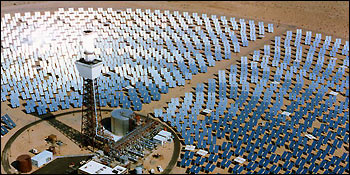
Solar One's method of collecting energy was based on concentrating the sun's energy onto a common focal point to produce heat to run a steam turbine generator. It had hundreds of large mirror assemblies, or heliostats, that track the sun, reflecting the solar energy onto a 328 ft (100 m) tall tower where a black receiver absorbed the heat. High-temperature heat transfer fluid was used to carry the energy to a boiler on the ground where the steam was used to spin a series of turbines, much like a traditional power plant.
In the late 1970s, a competition was held by the DOE to obtain the best heliostat design for the project. Several promising designs were selected and prototypes were built and shipped to the area for testing. Trade-offs involved simplicity of construction to minimize costs for high-volume manufacturing versus the need for a reliable, two-axis tracking system that could maintain focus on the tower. Rigidity of the structure was a major concern in terms of wind load resistance and durability, but shading of the mirrors by support structures was to be avoided.
The project produced 7 MW of electricity using 1,818 heliostats of 40 m2 (430 ft2) reflective surface area each, with a total area of 72,650 m2 (782,000 ft2). Solar One was completed in 1981 and was operational from 1982 to 1986. Later redesigned and renamed Solar Two, it could be seen from Interstate 40 where it covered a 51 hectare (126 acre) site, not including the administration building or rail yard facilities shared with a neighboring plant. Solar One/Two and other nearby solar projects are plainly visible via satellite imaging software at 34°52′18″N 116°50′03″W / 34.87167°N 116.83417°W.
During times of high winds, blowing dust is sometimes illuminated by the reflected sunbeams to create an unusual atmospheric phenomenon in the vicinity of the power tower. These beams of light were depicted in several scenes, and a painting, in the 1987 movie Bagdad Cafe, which was filmed nearby.
Hub AI
The Solar Project AI simulator
(@The Solar Project_simulator)
The Solar Project
34°52′19″N 116°50′03″W / 34.87187°N 116.83419°W
The SOLAR Project consists of the Solar One, Solar Two and Solar Tres solar thermal power plants based in the Mojave Desert, United States and Andalucía, Spain. The US Department of Energy (DOE) and a consortium of US utilities built the country's first two large-scale, demonstration solar power towers in the desert near Barstow, California.
Solar One/Solar Two have been scrapped since 2009. Solar Tres (later renamed Gemasolar), the first commercial plant of the project, was opened in Spain in 2011.
Solar One was a pilot solar-thermal project built in the Mojave Desert just east of Barstow, CA, USA. It was the first test of a large-scale thermal solar power tower plant. Solar One was designed by the Department of Energy (DOE) (led by Sandia National Laboratories in Livermore, California), Southern California Edison, LA Dept of Water and Power, and California Energy Commission. It was located in Daggett, CA, about 10 miles (16 km) east of Barstow.
Solar One's method of collecting energy was based on concentrating the sun's energy onto a common focal point to produce heat to run a steam turbine generator. It had hundreds of large mirror assemblies, or heliostats, that track the sun, reflecting the solar energy onto a 328 ft (100 m) tall tower where a black receiver absorbed the heat. High-temperature heat transfer fluid was used to carry the energy to a boiler on the ground where the steam was used to spin a series of turbines, much like a traditional power plant.
In the late 1970s, a competition was held by the DOE to obtain the best heliostat design for the project. Several promising designs were selected and prototypes were built and shipped to the area for testing. Trade-offs involved simplicity of construction to minimize costs for high-volume manufacturing versus the need for a reliable, two-axis tracking system that could maintain focus on the tower. Rigidity of the structure was a major concern in terms of wind load resistance and durability, but shading of the mirrors by support structures was to be avoided.
The project produced 7 MW of electricity using 1,818 heliostats of 40 m2 (430 ft2) reflective surface area each, with a total area of 72,650 m2 (782,000 ft2). Solar One was completed in 1981 and was operational from 1982 to 1986. Later redesigned and renamed Solar Two, it could be seen from Interstate 40 where it covered a 51 hectare (126 acre) site, not including the administration building or rail yard facilities shared with a neighboring plant. Solar One/Two and other nearby solar projects are plainly visible via satellite imaging software at 34°52′18″N 116°50′03″W / 34.87167°N 116.83417°W.
During times of high winds, blowing dust is sometimes illuminated by the reflected sunbeams to create an unusual atmospheric phenomenon in the vicinity of the power tower. These beams of light were depicted in several scenes, and a painting, in the 1987 movie Bagdad Cafe, which was filmed nearby.