
Recent from talks
The Sun (New York City)
Knowledge base stats:
Talk channels stats:
Members stats:
The Sun (New York City)
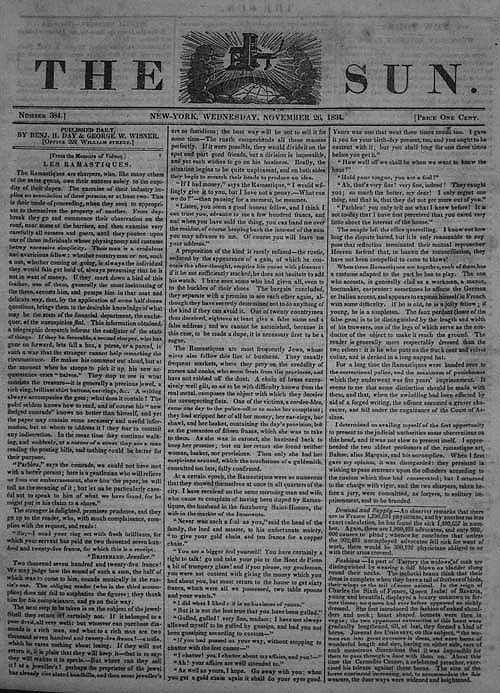
The Sun was a New York newspaper published from 1833 until 1950. It was considered a serious paper, like the city's two more successful broadsheets, The New York Times and the New York Herald Tribune. The Sun was the first successful penny daily newspaper in the United States, and was for a time the most successful newspaper in America.
The paper had a central focus on crime news, in which it was a pioneer, and was the first journal to hire a police reporter. Its audience was primarily working class readers.
The Sun is well-known for publishing the Great Moon Hoax of 1835, as well as Francis Pharcellus Church's 1897 editorial containing the line "Yes, Virginia, there is a Santa Claus".
It merged with the New York World-Telegram in 1950.
The Sun began publication in New York on September 3, 1833, as a morning newspaper edited by Benjamin Day (1810–1889), with the slogan "It Shines for All". It cost only one penny (equivalent to 33¢ in 2024), was easy to carry, and had illustrations and crime reporting popular with working-class readers.
It inspired a new genre across the nation, known as the penny press, which made the news more accessible to low-income readers at a time when most papers cost five cents. The Sun was also the first newspaper to hire newspaper hawkers to sell it on the street, developing the trade of newsboys shouting headlines.
The Sun was the first newspaper to report crimes and personal events such as suicides, deaths, and divorces. The paper had a focus on police reports and human-interest stories for the masses, which consisted of short descriptions of arrests, thefts, and violence. With their competitor the New York Herald, founded by James Gordon Bennett, they covered murder cases such as Helen Jewett's murder, the murder of John C. Colt, Samuel Colt's brother, and Mary Rogers's case near Sybil's Cave. The Sun and The Herald took sides in these cases, championing working class people over the traditional landed and mercantile elites which, during this era, held disproportionate power over the nation's politics and economy.
Benjamin Day's brother-in-law, Moses Yale Beach, joined the venture in 1834, became co-owner in 1835, and a few years later, became sole proprietor, bringing a number of innovations to the industry. It became the largest among the Gotham papers for 20 years, sometimes eclipsed by the New-York Tribune or the New York Herald.
Hub AI
The Sun (New York City) AI simulator
(@The Sun (New York City)_simulator)
The Sun (New York City)
The Sun was a New York newspaper published from 1833 until 1950. It was considered a serious paper, like the city's two more successful broadsheets, The New York Times and the New York Herald Tribune. The Sun was the first successful penny daily newspaper in the United States, and was for a time the most successful newspaper in America.
The paper had a central focus on crime news, in which it was a pioneer, and was the first journal to hire a police reporter. Its audience was primarily working class readers.
The Sun is well-known for publishing the Great Moon Hoax of 1835, as well as Francis Pharcellus Church's 1897 editorial containing the line "Yes, Virginia, there is a Santa Claus".
It merged with the New York World-Telegram in 1950.
The Sun began publication in New York on September 3, 1833, as a morning newspaper edited by Benjamin Day (1810–1889), with the slogan "It Shines for All". It cost only one penny (equivalent to 33¢ in 2024), was easy to carry, and had illustrations and crime reporting popular with working-class readers.
It inspired a new genre across the nation, known as the penny press, which made the news more accessible to low-income readers at a time when most papers cost five cents. The Sun was also the first newspaper to hire newspaper hawkers to sell it on the street, developing the trade of newsboys shouting headlines.
The Sun was the first newspaper to report crimes and personal events such as suicides, deaths, and divorces. The paper had a focus on police reports and human-interest stories for the masses, which consisted of short descriptions of arrests, thefts, and violence. With their competitor the New York Herald, founded by James Gordon Bennett, they covered murder cases such as Helen Jewett's murder, the murder of John C. Colt, Samuel Colt's brother, and Mary Rogers's case near Sybil's Cave. The Sun and The Herald took sides in these cases, championing working class people over the traditional landed and mercantile elites which, during this era, held disproportionate power over the nation's politics and economy.
Benjamin Day's brother-in-law, Moses Yale Beach, joined the venture in 1834, became co-owner in 1835, and a few years later, became sole proprietor, bringing a number of innovations to the industry. It became the largest among the Gotham papers for 20 years, sometimes eclipsed by the New-York Tribune or the New York Herald.
Recent media