Recent from talks
Nothing was collected or created yet.
The Weather Girls
View on Wikipedia
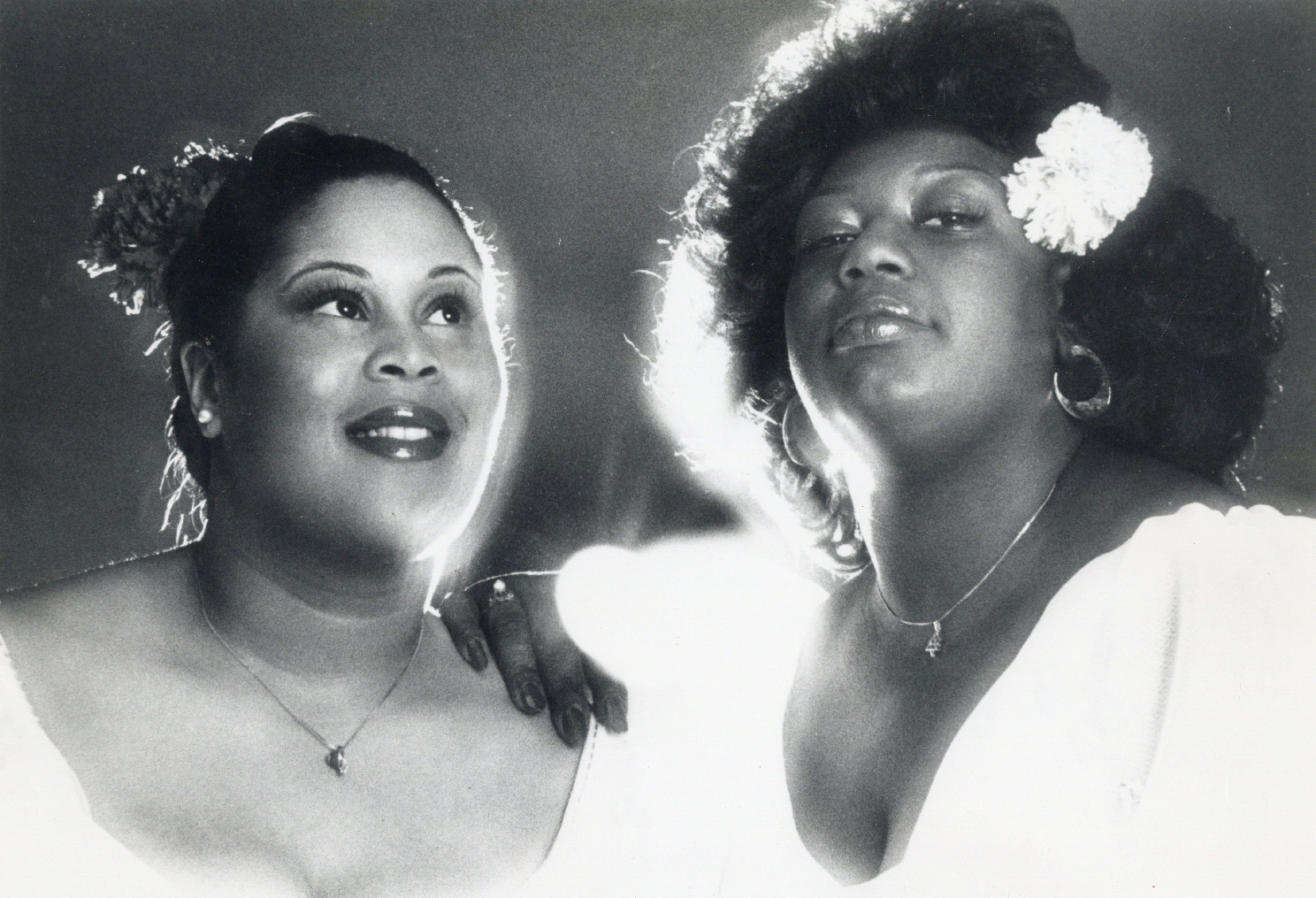
The Weather Girls are an American female duo whose best-known line-up comprised Martha Wash and Izora Armstead. Formed in 1976 in San Francisco, California, Wash and Armstead began their musical careers as Two Tons O' Fun, the female backup duo for disco singer Sylvester. After several years of singing background for Sylvester, the duo was signed in 1979 to Fantasy Records as Two Tons O' Fun. The duo changed their name to The Weather Girls and were launched into somewhat more mainstream recognition following the release of the single, "It's Raining Men" (1982), which became their first number-one song on the US Dance Chart and their biggest hit. Despite having several hit songs on the Dance Chart as Two Tons O' Fun and The Weather Girls, the duo never achieved a top 40 hit on the main US Hot 100 and ultimately disbanded in 1988 after the release of their self-titled fifth album The Weather Girls.
Key Information
In 1991, Armstead reformed the duo with her daughter Dynelle Rhodes. Over the course of a decade, the Armstead and Rhodes released three albums: Double Tons of Fun (1993), Think Big!, and Puttin' On the Hits (1999). In 2004, Armstead died due to heart failure and was replaced with singer Ingrid Arthur. Following the release of two albums Totally Wild! (2004) and The Woman I Am (2009), Arthur left the group and was replaced with singer Dorrey Lin Lyles in 2012. April 11, 2025 Darnita Williams join the group.
As the Weather Girls with Martha Wash and Izora Armstead, the duo received a Grammy Award nomination for Best R&B Performance by a Duo or Group with Vocal in 1984.[4]
History
[edit]1970–1975: Formation and early years
[edit]Izora Rhodes and Martha Wash met at a young age.[5] Wash attended Church of God in Christ, which was an alley away from the Baptist church Rhodes was attending.[5] Rhodes was the lead vocalist and pianist of the San Francisco Inspirational Choir.[5] Wash and Rhodes eventually landed in a gospel group called N.O.W. (News of the World).[5][6] While performing part-time in the group, Wash worked as a secretary for UC Hospital while Rhodes worked as a bartender and a nurse assistant.[5] Rhodes also worked as a piano and vocal teacher.[5]
1976–1979: Sylvester and the Two Tons o' Fun
[edit]In February 1976, Wash auditioned as a backup singer before American singer-songwriter Sylvester and his manager Brent Thomson. Impressed with her vocal performance, Sylvester inquired if she had another large black friend who could sing, after which she introduced him to Izora Rhodes. Although he referred to them simply as "the girls", Wash and Rhodes formed a musical duo called Two Tons O' Fun.[7][8] Two Tons O' Fun debuted as Sylvester's backing vocalists on his self-titled third album Sylvester, released in 1977. The duo sang backup vocals on the album's singles "Down, Down, Down" and "Over and Over"; the former charted at number eighteen on the Billboard Dance chart.[9]
In 1978, Sylvester released his fourth album Step II, in which The Two Tons also contributed background vocals throughout the album. They performed backing vocals on the singles "Dance (Disco Heat)" and "You Make Me Feel (Mighty Real)" which both peaked at number one on Billboard's Dance chart.[9] In 1979, the duo secured their own record deal with Fantasy Records. That same year, Two Tons O' Fun sang background on Sylvester's live album Living Proof, one of their final performances together. As they began to work on their own album, the duo appeared in fewer shows with Sylvester.
1980–1981: Debut album and Backatcha
[edit]On January 24, 1980, the duo released their debut self-titled album Two Tons o' Fun. The album spawned two top-five dance singles: "Earth Can Be Just Like Heaven" and "I Got the Feeling".[10] Shortly after the release of the album, they changed their name to The Two Tons after being informed that an Oklahoma gospel act had already registered the group name "Two Tons o Fun" with ASCAP since 1958.[5] Their second album Backatcha was released later that year. The album spawned a single "I Depend On You" that peaked at number seventy-two on the Dance chart.[10] The follow-up single "Never Like This" peaked at number fifty-five on the R&B chart.
1982–1988: The Weather Girls and breakthrough
[edit]In September 1982, the duo released their single "It's Raining Men", and changed their duo title to The Weather Girls, a name chosen as a pun on the song's subject. The song became their biggest hit to date, peaking at number one on the Dance chart and number forty-six on Billboard's Hot 100 chart.[11] The song also peaked at number two on the UK Singles Chart,[12] and became certified Silver-status for sales exceeding 200,000 copies in the United Kingdom.[13] "It's Raining Men" received a nomination at the 26th Annual Grammy Awards (1983) for Best R&B Performance By A Duo Or Group With Vocal. On January 22, 1983, they released their third album Success.[11] Despite the overall success of the album's lead single, the album experienced mild success.[14] The album's title-track "Success" was released as the second single and peaked at number eighty-nine on the R&B chart.[11] Two additional singles, "I'm Gonna Wash That Man Right Outa My Hair" and "Dear Santa (Bring Me a Man This Christmas)", were also released but failed to chart.
In 1984, The Weather Girls performed backing vocals on the million-selling single "Centipede" by Rebbie Jackson.[15] The song was written, arranged, and produced by Michael Jackson, who also sang background vocals on the song.[15] It reached number 4 on the Black Singles Chart and was certified gold by the Recording Industry Association of America. In 1985, The Weather Girls released their fourth album Big Girls Don't Cry. The album's singles "Well-A-Wiggy" and "No One Can Love You More Than Me" experienced moderate success and had poor promotion. In 1988, The Weather Girls released their self-titled fifth album The Weather Girls, party produced by Full Force and Reggie Lucas, which was ultimately seen as a commercial failure by their record label. Shortly after the album, The Weather Girls disbanded and Wash took up a solo career and also began working as a session vocalist.[16]
1991–2003: Reformation
[edit]After a three-year hiatus and Wash pursuing her solo career, Armstead reformed The Weather Girls with her daughter Dynelle Rhodes and relocated to Germany in 1991. Their first album together Double Tons of Fun was released in 1993. The album's lead single "Can You Feel It" peaked at number two on Billboard's Dance chart. The song also peaked at number 75 on Germany's music chart, their second single to enter that chart since "It's Raining Men". While touring the club circuit, the album's third single "We Shall All Be Free" peaked at number 80 on Germany's music chart. Their follow-up album Think Big! was released in December 1995. The album saw Armstead's contribution as a songwriter and penning several songs, including the album's third single "The Sound of Sex (Ooh Gitchie O-La-La-Ay)", which was written with her daughter. The album also contained a cover version of Sylvester's 1979 disco hit "Stars", recorded as a duet with Scottish pop singer Jimmy Somerville.
In 1999, The Weather Girls released their eighth studio album Puttin' On The Hits, which contained a collection of covered disco songs. The non-album track "Big Brown Girl" was released as a single in 1999. In 2002, they joined the Disco Brothers for participation in the German National Final for the Eurovision Song Contest with their song "Get Up". In the end, the group only managed a 13th place out of 15.
2004–2012: Lineup change
[edit]On September 16, 2004, Izora Armstead died of heart failure at age 62. Prior to Armstead's passing, new member Ingrid Arthur joined The Weather Girls in 2004. Following Armstead's passing, they released the album Totally Wild which spawned the single "Wild Thang" in 2004. In 2006, Joan Faulkner began performing with Rhodes and often substituting for Arthur. In 2008, the Weather Girls released a single "Break You", which topped the Dance chart.[11] In 2009, the duo released a new studio album titled The Woman I Am. In 2012, The Weather Girls released "It's Raining Men 2K12", a newly recorded version of their 1982 hit, produced by Sebo Reed.[17] In the same year, Arthur departed from The Weather Girls to focus on her solo career. Dorrey Lin Lyles, a singer who had worked with the duo in the past, was added to the duo in mid-2012.
2013–present: Recent activity
[edit]The Weather Girls began touring internationally in 2013. In 2018, they released a new single "We Need Love", produced by Torsten Abrolat, Terri B! and featuring, Jason Anousheh.[18]
Legacy
[edit]Widely associated with their biggest song "It's Raining Men", VH1 ranked the song at thirty-five on their list of the 100 Greatest Dance Songs in 2000,[19] and also at thirty-five in their 100 Greatest One-Hit Wonders of the 1980s in 2009.[20] Paste Magazine ranked the song twelve in their list of The 60 Best Dancefloor Classics in February 2017.[21]
"It's Raining Men" has often been perceived as a gay anthem.[22] A campaign in Facebook was launched on January 19, 2014, to get the song to UK number one in response to a UKIP councillor blaming recent UK floods and adverse weather on divine retribution for the British government's introduction of gay marriage.[23] The campaign was reported widely and The Weather Girls' version reached number 21 on the first day of the chart week.[24] The song re-entered the UK Singles Chart in 2014 at number 31.[25] In 2017, Rolling Stone included the song on their 25 Essential LGBTQ Pride Songs list.[26] In 2018, Billboard ranked the song at number forty-seven on their The 50 Best Gay Anthems Of All Time list.[27] The Gay UK ranked the song at number two on their Top 40 Gay Anthems for Pride list.[28]
To date, The Weather Girls have accumulated an overall total of four number-one dance singles.[11] Dynelle Rhodes holds the rights to the Weather Girls name and performs across Europe.
Members
[edit]
Current members[edit]
Touring members[edit]
|
Former members[edit]
|
Faulkner often substitutes for and performs as the second member.
Discography
[edit]Albums
[edit]| Title | Album details | Peak chart positions | ||
|---|---|---|---|---|
| US [29] |
US R&B [29] | |||
| Two Tons o' Fun | 91 | 28 | ||
| Backatcha |
|
— | — | |
| Success | — | — | ||
| Big Girls Don't Cry |
|
— | — | |
| Weather Girls |
|
— | — | |
| Double Tons of Fun |
|
— | — | |
| Think Big! |
|
— | — | |
| Puttin' on the Hits |
|
— | — | |
| Totally Wild |
|
— | — | |
| The Woman I Am |
|
— | — | |
| Carry On: The Deluxe Collection 1982–1992 |
|
— | — | |
Singles
[edit]| Title | Year | Peak chart positions | Certifications | Album | |||||||||||||
|---|---|---|---|---|---|---|---|---|---|---|---|---|---|---|---|---|---|
| US [30] |
US Dance [30] |
US R&B [30] |
AUS [31] |
GER [32] |
NL [33] |
NOR [34] |
NZ [35] |
SWI [36] |
UK [37] | ||||||||
| "Earth Can Be Just Like Heaven" | 1980 | — | 2 | — | — | — | — | — | — | — | — | Two Tons o' Fun | |||||
| "I Got the Feeling" | — | 2 | 29 | — | — | — | — | — | — | — | |||||||
| "Just Us" | — | — | 52 | — | — | — | — | — | — | — | |||||||
| "Taking Away Your Space" | — | — | 53 | — | — | — | — | — | — | — | |||||||
| "I Depend on You" | 1981 | — | 72 | — | — | — | — | — | — | — | — | Backatcha | |||||
| "Never Like This" | — | — | 55 | — | — | — | — | — | — | — | |||||||
| "It's Raining Men" | 1982 | 46 | 1 | 34 | 16 | 43 | 46 | 8 | 13 | 95 | 2 | Success | |||||
| "Success" | 1983 | — | — | 89 | — | — | — | — | — | — | 95 | ||||||
| "I'm Gonna Wash That Man Right Outta My Hair" | — | — | — | — | — | — | — | — | — | — | |||||||
| "Dear Santa (Bring Me a Man This Christmas)" | — | — | — | — | — | — | — | — | — | — | |||||||
| "Well-a-Wiggy" | 1985 | 107 | — | 76 | — | — | — | — | — | — | — | Big Girls Don't Cry | |||||
| "No One Can Love You More Than Me" | — | 26 | — | — | — | — | — | — | — | — | |||||||
| "Big Girls Don't Cry" | — | — | — | — | — | — | — | — | — | — | |||||||
| "Love You Like a Train" | 1988 | — | — | — | — | — | — | — | — | — | — | The Weather Girls | |||||
| "Land of the Believer" | — | — | — | — | — | — | — | — | — | — | |||||||
| "Can You Feel It" | 1993 | — | 2 | — | — | 75 | — | — | — | — | — | Double Tons of Fun | |||||
| "We're Gonna Party" | — | — | — | — | — | — | — | — | — | — | |||||||
| "We Shall All Be Free" | 1994 | — | — | — | — | 80 | — | — | — | — | — | ||||||
| "Oh, What a Night" | 1995 | — | — | — | — | — | — | — | — | — | — | Think Big! | |||||
| "Star" (featuring Jimmy Somerville) |
— | — | — | — | — | — | — | — | — | — | |||||||
| "The Sound of Sex (Ooh Gitchie O-La-La-Ay)" | 1996 | — | — | — | — | 89 | — | — | — | — | — | ||||||
| "Don't Look Any Further" (with Dennis Edwards) |
1998 | — | — | — | — | — | — | — | — | — | — | Puttin' On The Hits | |||||
| "I'm So Excited" | — | — | — | — | — | — | — | — | — | — | |||||||
| "Get Up" (Disco Brothers featuring The Weather Girls) |
2002 | — | — | — | — | — | — | — | — | — | — | Non-album single | |||||
| "Wild Thang" | 2004 | — | — | — | — | — | — | — | — | — | — | Totally Wild | |||||
| "Break You" (Ralph Falcon featuring The Weather Girls) |
2008 | — | 1 | — | — | — | — | — | — | — | — | Non-album single | |||||
| "We Need Love" (featuring Jason Anousheh) |
2018 | — | — | — | — | — | — | — | — | — | — | ||||||
| "Cheek to Cheek" | 2019 | — | 32 | — | — | — | — | — | — | — | — | ||||||
| "Stand Up" | 2020 | — | — | — | — | — | — | — | — | — | — | ||||||
| "—" denotes a recording that did not chart or was not released in that territory. | |||||||||||||||||
See also
[edit]References
[edit]- ^ Perrone, Pierre (September 27, 2004). "Izora Rhodes-Armstead". The Independent. Archived from the original on June 20, 2022. Retrieved August 8, 2016.
- ^ Sisario, Ben (September 28, 2004). "Izora Armstead, a Singer in the Weather Girls Duo, Dies". The New York Times. Retrieved August 8, 2016.
- ^ Wynn, Ron. "The Weather Girls - Big Girls Don't Cry". AllMusic. Retrieved August 8, 2016.
- ^ Weather Girls | Artist. Grammy Awards. Retrieved on February 5, 2019
- ^ a b c d e f g Gamson, Joshua (March 10, 2005). The Fabulous Sylvester: The Legend, the Music, the Seventies in San Francisco. Macmillan. ISBN 9780805072501 – via Google Books.
- ^ Martha Wash Cover Story. America's AIDS Magazine. Retrieved on January 28, 2019
- ^ Gamson 2005, pp. 115–118.
- ^ Davis, Sharon (2015). Mighty Real: Sharon Davis Remembers Sylvester. New Romney: Bank House Books. pp. 10–11. ISBN 978-0-9573058-9-2.
- ^ a b Sylvester | Billboard Chart History. Billboard. Retrieved on February 1, 2019
- ^ a b Two Tons of Fun | Billboard Chart History. Billboard. Retrieved on February 1, 2019
- ^ a b c d e The Weather Girls | Billboard Chart History. Billboard. Retrieved on February 1, 2019
- ^ Weather Girls | full Official Charty History | Official Charts Company. Official Charts. Retrieved on February 5, 2019
- ^ Weather Girls - "It's Raining Men". BPI. Retrieved on June 21, 2021
- ^ Success - The Weather Girls (All Music). AllMusic. Retrieved on March 29, 2019
- ^ a b Collier, Aldore (May 27, 1985). "Rebbie, oldest sister, latest bloomer, in the Jackson family". Jet. 68 (11). Johnson Publishing Company. Retrieved October 11, 2009.
- ^ The Weather Girls | Biography & History | AllMusic. AllMusic. Retrieved on March 30, 2019
- ^ It's Raining Men 2K12 (Sebo Reed Meets Weather Girls) [Remixes] - EP by Sebo Reed & The Weather Girls on Apple Music. iTunes. Retrieved on February 5, 2019
- ^ We Need Love (Remixes) by Terri B! & The Weather Girls on Apple Music. iTunes. Retrieved on March 30, 2019
- ^ "Rock on the Net: VH1: 100 Greatest Dance Songs". Rock on the Net. Retrieved on February 5, 2019
- ^ Ali, Rahsheeda (May 2, 2013). "100 Greatest One Hit Wonders of the 80s". VH1. Archived from the original on June 28, 2022. Retrieved October 8, 2018.
- ^ "The 60 Best Dancefloor Classics". pastemagazine.com. February 27, 2017. Retrieved August 25, 2017.
- ^ "The pink hit parade: Sing if you're glad to be gay". The Independent. London. November 1, 2006. Retrieved April 26, 2009.
- ^ It's Raining Men set to make a splash in Top 40 on this week's Officia. [sic] Official Charts. Retrieved on February 17, 2019
- ^ Morse, Felicity (January 21, 2014). "Facebook campaign launched to get 'It's Raining Men' to number 1 after Ukip councillor blames floods on gay marriage". The Independent. Archived from the original on June 20, 2022. Retrieved January 29, 2014.
- ^ "NEWS: It's Raining Men Enters Into Official UK Single's Chart". Thegayuk.com. February 2, 2014. Archived from the original on February 19, 2014. Retrieved April 1, 2014.
- ^ 25 Essential LGBTQ Pride Songs. Rolling Stone Magazine. Retrieved on February 5, 2019
- ^ 50 Top LGBTQ Anthems: Critic's Picks (Updated 2018). Billboard. Retrieved on February 5, 2019
- ^ 40 top gay anthems for Pride. The Gay UK. Retrieved on February 5, 2019
- ^ a b
- Two Tons o Fun: Two Tons o Fun Billboard Chart History
- The Weather Girls: The Weather Girls Billboard Chart History. Billboard. Retrieved on February 10, 2019
- ^ a b c "The Weather Girls". Billboard. Prometheus Global Media.
- ^ Kent, David (1993). Australian Chart Book 1970–1992 (illustrated ed.). St Ives, N.S.W.: Australian Chart Book. p. 334. ISBN 0-646-11917-6.
- ^ Hung, Steffen. "Discographie The Weather Girls". German Charts Portal. Hung Medien (Steffen Hung).
{{cite web}}: CS1 maint: deprecated archival service (link) - ^ Hung, Steffen. "Discografie The Weather Girls". Dutch Charts Portal. Hung Medien (Steffen Hung).
- ^ Hung, Steffen. "Discography The Weather Girls". Norwegian Charts Portal. Hung Medien (Steffen Hung).
- ^ Hung, Steffen. "Discography The Weather Girls". New Zealand Charts Portal. Hung Medien (Steffen Hung).
- ^ Hung, Steffen. "Discographie The Weather Girls". Swiss Charts Portal. Hung Medien (Steffen Hung).
- ^ "UK Charts > The Weather Girls". Official Charts Company.
- ^ "British single certifications – Weather Girls – It's Raining Men". British Phonographic Industry. Retrieved November 13, 2022. Select singles in the Formats field. Type It's Raining Men Weather Girls in the "Search:" field.
- ^ "British single certifications – Weather Girls – It's Raining Men". British Phonographic Industry. Retrieved September 24, 2023. Select singles in the Formats field. Type It's Raining Men Weather Girls in the "Search:" field.
- ^ "Gold-/Platin-Datenbank (The Weather Girls)" (in German). Bundesverband Musikindustrie. Retrieved December 22, 2022.
- ^ "New Zealand single certifications – The Weather Girls – It's Raining Men". Radioscope. Retrieved January 19, 2025. Type It's Raining Men in the "Search:" field and press Enter.
External links
[edit]The Weather Girls
View on GrokipediaHistory
1970–1975: Formation and Early Gospel Roots
Izora Rhodes Armstead, born in Galveston, Texas, on July 6, 1942, relocated to San Francisco as a child and immersed herself in the local gospel music scene from an early age.[6] She studied piano starting at age four and later attended the San Francisco Conservatory of Music, where she earned a teaching credential, while drawing inspiration from gospel icons such as Mahalia Jackson and Clara Ward.[7] Armstead's early performances occurred primarily in church settings, where she cultivated her distinctive alto voice through rigorous gospel traditions emphasizing emotional depth and vocal power.[8] Martha Wash, born December 28, 1953, in San Francisco as the youngest of nine children, began singing gospel at age three, influenced by her mother's records of artists like the Staple Singers.[9] She honed her skills in local church choirs and school ensembles, graduating from San Francisco Polytechnic High School around 1971 after participating in the choir there.[10] Wash's contralto range, characterized by its forceful projection, developed through these formative church experiences, which provided a foundation in call-and-response dynamics and sustained phrasing typical of Bay Area gospel practices.[11] In the early to mid-1970s, Armstead and Wash converged in San Francisco's vibrant gospel community, both joining the group NOW (News of the World), a local ensemble focused on traditional spirituals and contemporary gospel arrangements.[5] Their collaboration within NOW marked the initial pairing of their resonant voices, which complemented each other in harmonized leads during church and community performances across the city.[6] These appearances, often in venues like neighborhood sanctuaries, showcased their emerging synergy and laid the groundwork for broader musical explorations beyond strictly religious contexts.[12]1976–1979: Backup Vocals for Sylvester and Emergence as Two Tons o' Fun
In February 1976, Martha Wash auditioned successfully as a backup singer for Sylvester James, leading to the recruitment of both her and Izora Armstead (later Izora Rhodes Armstead) into his performing ensemble. Their gospel-honed vocal strengths provided robust support for Sylvester's falsetto-led disco performances during live shows and recordings.[5] The duo contributed prominently to Sylvester's 1978 album Step II, released on Fantasy Records, delivering layered harmonies on key tracks including "You Make Me Feel (Mighty Real)" and "Dance (Disco Heat)". These songs exemplified the era's hi-NRG disco production, where Wash's soprano and Armstead's alto created a powerful contrapuntal effect against synthesizer-driven beats and James Wirrick's guitar arrangements.[13][11] By 1979, after establishing their onstage presence alongside Sylvester, Wash and Armstead signed a recording contract with Fantasy Records' Honey imprint as Two Tons o' Fun, transitioning from backup roles to lead artists. This deal facilitated their initial studio sessions, producing material that showcased their unaccompanied vocal range and rhythmic phrasing suited to disco's emphatic structures.[14][15]1980–1982: Rebranding to The Weather Girls and Debut Breakthrough
In 1980, Martha Wash and Izora Armstead, performing as Two Tons o' Fun, released their second album Backatcha! on Fantasy Records, featuring tracks like "Never Like This" that continued their disco-oriented sound but failed to achieve significant commercial breakthrough.[16] The album included eight songs produced in a post-disco style, emphasizing their robust vocal harmonies, yet it did not chart prominently on major Billboard lists.[17] By 1982, the duo signed with Columbia Records and rebranded as The Weather Girls to align with the thematic elements of their upcoming single, marking a strategic shift aimed at broadening their market appeal beyond niche disco audiences.[18] This name change coincided with the recording of "It's Raining Men," written by Paul Jabara and Paul Shaffer specifically to energize gay club scenes with its exuberant, weather-themed lyrics and hi-NRG production.[19] Produced by Jabara and Bob Esty, the track featured synthesized hooks, a driving beat at around 132 BPM, and the duo's powerful, call-and-response vocals, which propelled its initial traction in dance clubs.[20] Released on September 10, 1982, as the lead single from their third album Success, "It's Raining Men" debuted on the Billboard Hot Dance/Club Play Songs chart and eventually crossed over to pop radio, peaking at number 46 on the Billboard Hot 100 in March 1983 after 11 weeks.[21] Its chart performance stemmed from the infectious energy of the production and vocal delivery rather than broader cultural narratives, as evidenced by strong dance chart success contrasting limited mainstream pop penetration; in the UK, it initially underperformed upon release but later reached number 2 in 1984 following sustained US momentum.[22] This breakthrough established The Weather Girls' signature sound, setting the stage for international recognition through verifiable airplay and sales data rather than contrived thematic appeals.1983–1990: Follow-Up Efforts and Initial Decline
Following the breakthrough success of "It's Raining Men" in 1982, The Weather Girls released their third studio album, Success, on Columbia Records in 1983. The album featured the prior hit alongside new tracks such as the title song "Success" and "Dear Santa (Bring Me a Man This Christmas)", but neither achieved comparable commercial impact, with no entries on the Billboard Hot 100 and limited airplay amid the music industry's transition away from disco toward emerging genres like house and hip-hop.[23][24] This shift reduced demand for the duo's high-energy, disco-rooted sound, contributing to sales that fell short of their 1980–1982 peak without significant label promotion to adapt their style.[24] In 1985, The Weather Girls issued Big Girls Don't Cry, their fourth album, which included singles like "No One Can Love You More Than Me" but similarly underperformed, registering no Billboard Hot 100 placements and receiving tepid critical reception for failing to innovate beyond prior formulas.[25][26] The release reflected eroding label support, as Columbia prioritized rising acts in rap and electronic music, leaving the duo without the marketing resources that had propelled their earlier work; album sales data indicate units moved in the low tens of thousands, a stark decline from "It's Raining Men"'s certified gold status.[26] By the late 1980s, persistent commercial stagnation led to the duo's disbandment in 1988, with Martha Wash departing to pursue session vocals and eventual solo projects, while Izora Armstead initially stepped back from major releases.[27] This split stemmed primarily from unsustainable career momentum rather than documented artistic rifts, as both members shifted to independent endeavors amid a market unsupportive of their established act; Wash's subsequent ghost vocals on hits like C+C Music Factory's "Gonna Make You Sweat" (1990) underscored her individual vocal prowess but highlighted the group's inability to sustain duo viability.[27] No further group recordings emerged until the 1990s reformation with new members.1991–2004: Reformation and European Touring Focus
In 1991, Izora Armstead reformed The Weather Girls by partnering with her daughter Dynelle Rhodes as the second member, redirecting efforts toward European audiences where enduring popularity of "It's Raining Men" from the early 1980s supported live bookings.[2] The duo relocated to Germany to capitalize on this regional demand, prioritizing touring over U.S. markets that showed minimal renewed interest in new material.[28] This reformation emphasized family integration and niche nostalgia-driven performances, with live vocal energy—rooted in their gospel-influenced style—serving as the primary draw for sustained income rather than chart placements. Their collaborative output included the 1993 album Double Tons of Fun, released via EastWest Records in Germany, featuring euro house and disco tracks like "We're Gonna Party" aimed at club and party circuits but achieving no major commercial breakthroughs.[29] Additional releases followed, such as Think Big! and Puttin' On the Hits, though these remained confined to limited European distribution without replicating prior success. Performances at events like the 1998 Gay Games opening ceremony in Amsterdam highlighted their appeal in LGBTQ+ gatherings, where "It's Raining Men" functioned as a staple anthem, underscoring reliance on established hits amid absent new singles.[30] The era concluded tragically on September 16, 2004, when Armstead died of heart failure in San Leandro, California, at age 62, ending the mother-daughter configuration after over a decade of Europe-centric touring that demonstrated viability through consistent but modest live engagements rather than recording revenue.[5][31] This phase reflected pragmatic adaptation to available markets, with empirical evidence from tour bookings affirming vocal prowess as a key asset despite broader industry disinterest.2005–Present: Lineup Evolutions and Sustained Performances
Following Izora Armstead's death from heart failure on September 16, 2004, her daughter Dynelle Rhodes assumed primary continuity for the group, partnering with vocalist Ingrid Arthur starting in 2005 to maintain performances under the Weather Girls name.[32][33] This lineup recorded the album Totally Wild! in 2004 and focused on live touring, particularly in Europe, without original member Martha Wash, who pursued solo endeavors.[34] Subsequent rotations included shifts to other vocalists, with Dorrey Lynn Lyles joining Dynelle Rhodes as the current pairing by the mid-2010s, enabling ongoing festival and open-air appearances amid no new major studio releases since the early 2000s.[35] The group's endurance has relied on high-energy live renditions of signature tracks like "It's Raining Men," sustaining appeal in niche dance and club circuits without Billboard chart resurgences. In 2023, they performed at the Berliner Rundfunk 91.4 Open Air, delivering sets featuring "It's Raining Men," "I'm So Excited," and covers such as "Hit the Road Jack."[36] This pattern continued into 2024 with a show at Essen.Original in Germany, emphasizing crowd-energizing performances over original material.[37] By 2025, the Weather Girls maintained activity through European festival bookings, including the Kilworth Festival appearance and a return to Berliner Rundfunk Open Air on May 7, reflecting persistent demand for their nostalgic, interactive stage presence despite lineup fluidity and absence of new recordings.[38][39] These events underscore viability through fan loyalty in event-driven venues, with setlists prioritizing remixed classics to capitalize on live atmosphere rather than studio innovation.[36]Musical Style and Contributions
Vocal Techniques and Genre Influences
Martha Wash and Izora Armstead utilized contralto and alto vocal registers, respectively, marked by forceful belting and resonant chest voice projection honed through gospel choir experience in San Francisco churches. Wash's range extended to low chest notes around F2, while Armstead's deeper timbre provided a bass-like growl, creating a layered sonic foundation capable of cutting through dense hi-NRG productions. Their technique emphasized diaphragmatic support for sustained power, avoiding oversinging to maintain clarity in high-decibel club environments.[40] Call-and-response harmonies, inherited from African American gospel traditions, formed a core element of their interplay, adapted to disco and hi-NRG by synchronizing with four-on-the-floor beats and synthesized basslines. This gospel-derived responsiveness contrasted sharply with Sylvester's falsetto leads, whom they backed as Two Tons o' Fun, allowing their grounded timbres to anchor ethereal disco arrangements.[41][42] The integration preserved acoustic intensity, enabling empirical vocal endurance in extended mixes and live sets spanning decades.[43] Unlike polished pop contemporaries reliant on multi-tracked autotuned layers, the duo's raw, unadorned power—rooted in unamplified church shouting—facilitated causal adaptability to remix formats, where their belts retained punch amid varied electronic manipulations. This unrefined approach, prioritizing timbre over precision, sustained appeal in underground dance circuits over mainstream refinement.[44][45]Songwriting, Production, and Key Collaborations
The Weather Girls, initially recording as Two Tons o' Fun, relied heavily on external producers and songwriters for their early material, with Harvey Fuqua handling production on their 1979 self-titled debut album, which featured compositions largely sourced from outside contributors rather than the duo themselves.[46] This approach continued into their rebranding, where their breakthrough single "It's Raining Men," released in 1982, was penned by Paul Jabara and Paul Shaffer, highlighting a pattern of depending on established hitmakers for core creative input.[19] Fuqua's involvement stemmed from the duo's prior backing vocal work with Sylvester, providing foundational exposure but limited innovation in song construction, as their contributions remained primarily performative. The 1983 album Success, their first under the Weather Girls moniker, was produced by Paul Jabara alongside assistant Jerry Solomon, incorporating Hi-NRG arrangements with prominent synthesizers tailored for dance club environments, though the tracklist again drew from external writers, including Jabara's own hand in several cuts.[16] Bob Esty co-produced the title track "It's Raining Men," emphasizing layered electronic production to amplify the duo's powerhouse vocals over straightforward, anthem-like lyrics that prioritized catchiness over depth.[47] Later efforts, such as the 1985 album Big Girls Don't Cry and the 1988 self-titled release produced by Full Force and Reggie Lucas, showed sporadic internal songwriting attempts, particularly from Izora Armstead, but outputs post-1982 underscored compositional constraints, with diminished commercial resonance suggesting the duo's strengths lay in vocal execution elevating serviceable rather than pioneering material.[24] Key collaborations reinforced this dynamic: Fuqua's Motown-honed oversight bridged their gospel roots to disco, while Jabara's involvement—extending to joint projects like Paul Jabara and Friends (1983)—provided polished, market-oriented frameworks that the duo's raw energy transformed into enduring dance staples, though without originating the melodic or lyrical innovations themselves.[48] This external reliance, evident in credits across their discography, positioned The Weather Girls as interpreters of high-caliber provided songs, where production choices favored synth-driven propulsion suited to 1980s club circuits over self-generated authorship breakthroughs.[49]Commercial Performance
Chart Achievements and Sales Data
"It's Raining Men," released in 1982, marked the duo's commercial pinnacle, peaking at number 46 on the Billboard Hot 100 chart on March 5, 1983, after 12 weeks.[21] It simultaneously topped the Billboard Dance Club Songs chart for two weeks, reflecting strong club play reception. In the United Kingdom, the single reached number 2 on the Official Singles Chart in 1983. The track garnered a Grammy nomination for Best R&B Performance by a Duo or Group with Vocals at the 26th Annual Grammy Awards but received no win.[50] Prior to rebranding, as Two Tons o' Fun, the pair notched modest R&B traction, exemplified by "No One Can Love You More Than Me" climbing to number 34 on the Billboard Hot R&B/Hip-Hop Songs chart in 1980.[11] Their early dance singles, including "Earth Can Be Just Like Heaven," secured top-five placements on Billboard's Disco Top 100 chart.[51] Post-1982 releases, such as those from their self-titled 1988 album, largely confined success to niche dance formats, with no additional top-40 entries on the Billboard Hot 100, signaling diminished crossover viability.[52] Overall, the Weather Girls' catalog has amassed over 6 million units sold globally, though certifications remain sparse beyond regional single acknowledgments.[53]| Key Single | US Hot 100 Peak | US Dance Club Songs Peak | UK Singles Peak |
|---|---|---|---|
| It's Raining Men (1982) | 46[21] | 1 | 2 |
| No One Can Love You More Than Me (1980, as Two Tons o' Fun) | - | - | - |
