



Community hub
Recent from talks
Knowledge base stats:
Talk channels stats:
Members stats:
The bush
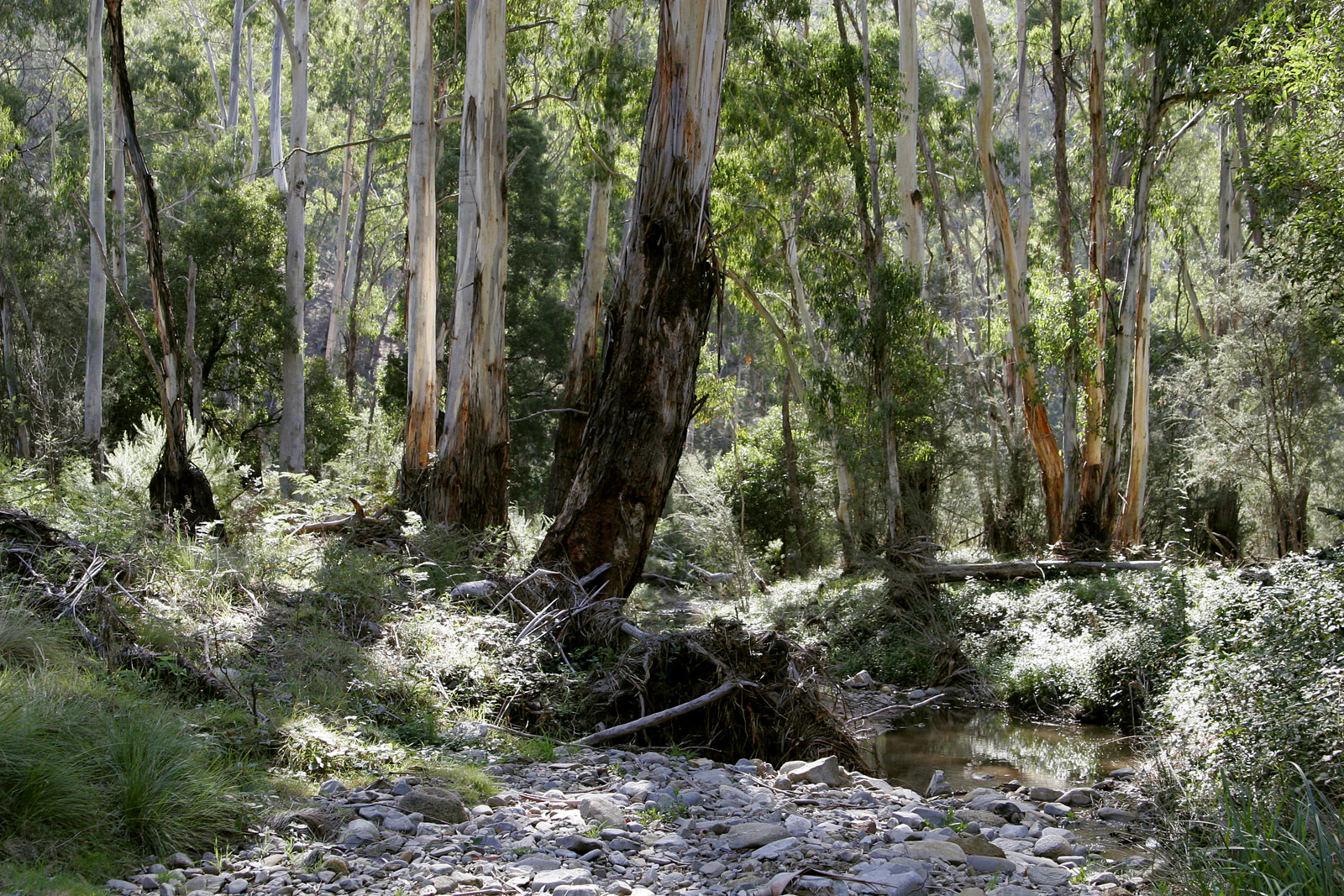
"The bush", a term mostly used in the English vernacular of Australia, New Zealand and South Africa, is largely synonymous with hinterlands or backwoods. The fauna and flora contained within the bush is typically native to the region, although exotic species may also be present. The word derives from Old French bos, and Old Norse buski, and related to Dutch bos and German Busch with the sense ‘uncultivated country’ coming directly from Dutch bos,
The expression has been in use in Australia from the earliest years of British settlement, and it has inspired many derivative Australian English terms, such as bush tucker, bush mechanic, bush ballad and bushranger. The term is also widely used in Canada and the American state of Alaska to refer to the large, forested portions of their landscapes.
The term "the bush" was imprinted in developing Australian English as a sign of settlers’ attempts to relate to their adopted country, so very different from the green European landscapes familiar to them, to refer at first to wilderness, and then to any sparsely inhabited region, regardless of vegetation.
"The bush" in this sense became an iconic concept uniquely Australian a signifier also of a pioneering or adventuring spirit. Early uses of the term appear from the late 1700s, frequently in Dawson's The Present State of Australia of 1831, and in the 1839 compilation A Voice from the Bush in Australia, in which unnamed immigrants' letters are reproduced.
Conversely, the word attached to fear of the unknown, as a place of danger from bushfire, venomous or predatory creatures, and hostile aborigines, a vast interior in which settlers, especially their children, could be lost, the latter most notably being the theme of Joan Lindsay's 1967 novel Picnic at Hanging Rock.
The term "Outback" is also used, but usually in association with the more arid inland areas of Australia, as is, to a lesser degree "mulga". "The bush" also refers to any populated region outside of the major metropolitan areas, including mining and agricultural areas. Consequently, it is not unusual to have a mining town in the desert such as Port Hedland (population 14,000) referred to as "the bush".
The First Nations over thousands of years developed ways of utilising natural resources for survival, mainly with bush tucker and the physical and spiritual healing of bush medicine. For more than a century after the first British settlement in 1788 onwards, land was squatted, granted or sold to settlers and returned soldiers, resulting in many generally small but permanent human settlements in vast tracts of bush. Closer settlement in Australia has often resulted in fragmentation of the bush, and bushfires, an ever-present hazard in many areas in summer months, have become more frequent with increasing suburbanisation of the Australian population.
The bush is a frequent theme or setting in Australian literature. Bush poets such as Henry Lawson, in such works as The Bush Girl (1901) or The Bush Undertaker (1892) and Banjo Paterson in A Bushman's Song (1892), In Defence of the Bush (1892), or A Bush Christening (1893), revered the bush as a source of national ideals, as did contemporaneous painters in the Heidelberg School such as Tom Roberts (1856–1931), Arthur Streeton (1867–1943) and Frederick McCubbin (1855–1917). Romanticising the bush in this way through folklore cultivated 19th-century Australians' development of a distinct self-identity.
Hub AI
The bush AI simulator
(@The bush_simulator)
The bush
"The bush", a term mostly used in the English vernacular of Australia, New Zealand and South Africa, is largely synonymous with hinterlands or backwoods. The fauna and flora contained within the bush is typically native to the region, although exotic species may also be present. The word derives from Old French bos, and Old Norse buski, and related to Dutch bos and German Busch with the sense ‘uncultivated country’ coming directly from Dutch bos,
The expression has been in use in Australia from the earliest years of British settlement, and it has inspired many derivative Australian English terms, such as bush tucker, bush mechanic, bush ballad and bushranger. The term is also widely used in Canada and the American state of Alaska to refer to the large, forested portions of their landscapes.
The term "the bush" was imprinted in developing Australian English as a sign of settlers’ attempts to relate to their adopted country, so very different from the green European landscapes familiar to them, to refer at first to wilderness, and then to any sparsely inhabited region, regardless of vegetation.
"The bush" in this sense became an iconic concept uniquely Australian a signifier also of a pioneering or adventuring spirit. Early uses of the term appear from the late 1700s, frequently in Dawson's The Present State of Australia of 1831, and in the 1839 compilation A Voice from the Bush in Australia, in which unnamed immigrants' letters are reproduced.
Conversely, the word attached to fear of the unknown, as a place of danger from bushfire, venomous or predatory creatures, and hostile aborigines, a vast interior in which settlers, especially their children, could be lost, the latter most notably being the theme of Joan Lindsay's 1967 novel Picnic at Hanging Rock.
The term "Outback" is also used, but usually in association with the more arid inland areas of Australia, as is, to a lesser degree "mulga". "The bush" also refers to any populated region outside of the major metropolitan areas, including mining and agricultural areas. Consequently, it is not unusual to have a mining town in the desert such as Port Hedland (population 14,000) referred to as "the bush".
The First Nations over thousands of years developed ways of utilising natural resources for survival, mainly with bush tucker and the physical and spiritual healing of bush medicine. For more than a century after the first British settlement in 1788 onwards, land was squatted, granted or sold to settlers and returned soldiers, resulting in many generally small but permanent human settlements in vast tracts of bush. Closer settlement in Australia has often resulted in fragmentation of the bush, and bushfires, an ever-present hazard in many areas in summer months, have become more frequent with increasing suburbanisation of the Australian population.
The bush is a frequent theme or setting in Australian literature. Bush poets such as Henry Lawson, in such works as The Bush Girl (1901) or The Bush Undertaker (1892) and Banjo Paterson in A Bushman's Song (1892), In Defence of the Bush (1892), or A Bush Christening (1893), revered the bush as a source of national ideals, as did contemporaneous painters in the Heidelberg School such as Tom Roberts (1856–1931), Arthur Streeton (1867–1943) and Frederick McCubbin (1855–1917). Romanticising the bush in this way through folklore cultivated 19th-century Australians' development of a distinct self-identity.