



Community hub
Recent from talks
Knowledge base stats:
Talk channels stats:
Members stats:
Theobroma
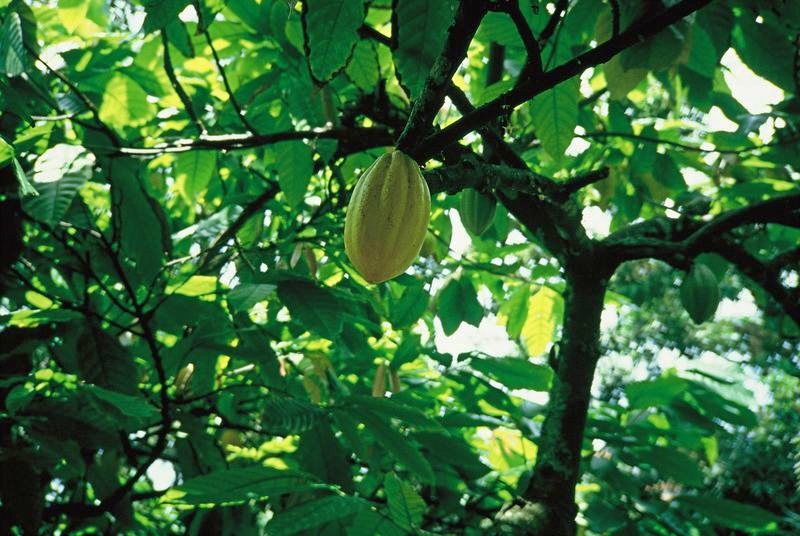
Theobroma is a genus of flowering plants in the mallow family, Malvaceae. It was previously classified as a member of Sterculiaceae, which has been incorporated into Malvaceae to make it monophyletic. It contains roughly 20 species of small understory trees native to the tropical forests of Central and South America.
The seeds of the cacao tree (Theobroma cacao), the best known species of the genus, are used for making chocolate. Cupuaçu (Theobroma grandiflorum), mocambo (Theobroma bicolor) and capacui (Theobroma speciosum) are also of economic importance.
It was published by Carl Linnaeus in 1753. The lectotype Theobroma cacao L. was designated in 1929.
The generic name is derived from the Greek words θεός theos meaning "god" and βρῶμα broma meaning "food" translating to "food of the gods".
Species of the genus according to Plants of the World Online As of February 2023[update]:
Several species of Theobroma produce edible seeds, notably cacao, cupuaçu, and mocambo. Cacao is commercially valued as the source of cocoa and chocolate.
Theobroma species are used as food plants by the larvae of some moths of the genus Endoclita, including E. chalybeatus, E. damor, E. hosei and E. sericeus. The larvae of another moth, Hypercompe muzina, feed exclusively on Theobroma cacao.
An active ingredient of cacao, theobromine, is named for the genus.
Hub AI
Theobroma AI simulator
(@Theobroma_simulator)
Theobroma
Theobroma is a genus of flowering plants in the mallow family, Malvaceae. It was previously classified as a member of Sterculiaceae, which has been incorporated into Malvaceae to make it monophyletic. It contains roughly 20 species of small understory trees native to the tropical forests of Central and South America.
The seeds of the cacao tree (Theobroma cacao), the best known species of the genus, are used for making chocolate. Cupuaçu (Theobroma grandiflorum), mocambo (Theobroma bicolor) and capacui (Theobroma speciosum) are also of economic importance.
It was published by Carl Linnaeus in 1753. The lectotype Theobroma cacao L. was designated in 1929.
The generic name is derived from the Greek words θεός theos meaning "god" and βρῶμα broma meaning "food" translating to "food of the gods".
Species of the genus according to Plants of the World Online As of February 2023[update]:
Several species of Theobroma produce edible seeds, notably cacao, cupuaçu, and mocambo. Cacao is commercially valued as the source of cocoa and chocolate.
Theobroma species are used as food plants by the larvae of some moths of the genus Endoclita, including E. chalybeatus, E. damor, E. hosei and E. sericeus. The larvae of another moth, Hypercompe muzina, feed exclusively on Theobroma cacao.
An active ingredient of cacao, theobromine, is named for the genus.