



Community hub
Recent from talks
Knowledge base stats:
Talk channels stats:
Members stats:
Theodor Aman
Theodor Aman (20 March 1831 – 19 August 1891) was a Romanian painter, engraver and art professor. He mostly produced genre and history scenes.
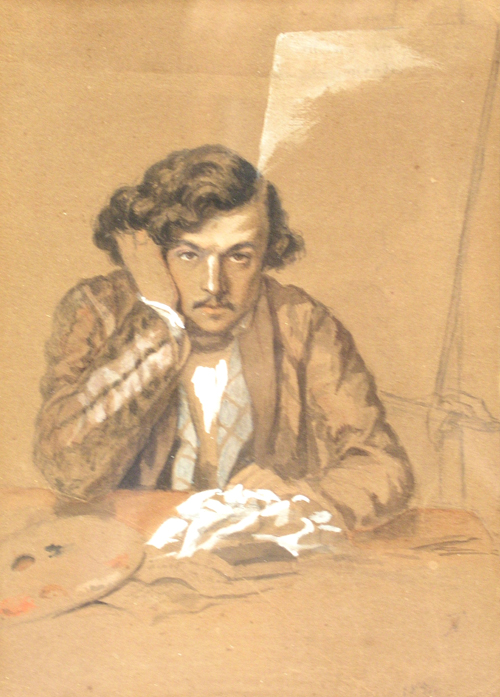
His father was a cavalry commander from Craiova but he was born in Câmpulung, where his family had fled to escape the plague. After displaying an early affinity for art, he took his first lessons with Constantin Lecca and Carol Wallenstein de Vella at Carol I National College. In 1850, he went to Paris, where he studied briefly with Michel Martin Drolling then, after Drolling's death, with François-Édouard Picot. While there, he became part of the Romanian revolutionary circles. In 1853 he has his first display at the Salon in Paris, showing his Autoportrait. While in Paris, he became friends with other like-minded artists and Romanian revolutionaries such as Nicolae Bălcescu, and the writers Dimitrie Bolintineanu, and Cezar Bolliac. In this environment, influenced by revolutionary ideas, Aman completed the historical themed painting “Mihai Viteazul’s First Night at Alba Iulia”, which was inspired by the writings of Bolintineanu.
As a result of his strong patriotic sentiments, he participated in the Romanian Revolution of 1848 along with Ioan Maiorescu, Eugeniu Carada, and other revolutionaries.
After that, he went to Istanbul in an effort to sell some paintings to the Sultan and visited Sevastopol during the Crimean War, creating history paintings with themes related to Romania's nationalist aspirations. In 1855, he presented one of his best-known works, depicting the Battle of Alma, at the Exposition Universelle.
He returned to Romania in 1857, settling in Bucharest where he starts the foundation of his school the Bucharest National University of Arts.
When he returned home, he was knighted by Prince Barbu Dimitrie Știrbei and presented with a scholarship to continue his studies in Paris, where he came under the influence of the Barbizon school. After a brief stay in Rome, he returned to Bucharest.
In 1864, he and Gheorghe Tattarescu convinced Romania's ruler, Alexandru Ioan Cuza, to establish the "National School of Fine Arts" (now known as the Bucharest National University of Arts). Aman was appointed its first director and held that position until his death.
Theodor Aman remained headmaster of the school until his death. In 1889 and 1890 he displayed his work in exhibits at the New Museum. At this point in his career he chose to focus on painting still life, and small portraits.
Hub AI
Theodor Aman AI simulator
(@Theodor Aman_simulator)
Theodor Aman
Theodor Aman (20 March 1831 – 19 August 1891) was a Romanian painter, engraver and art professor. He mostly produced genre and history scenes.
His father was a cavalry commander from Craiova but he was born in Câmpulung, where his family had fled to escape the plague. After displaying an early affinity for art, he took his first lessons with Constantin Lecca and Carol Wallenstein de Vella at Carol I National College. In 1850, he went to Paris, where he studied briefly with Michel Martin Drolling then, after Drolling's death, with François-Édouard Picot. While there, he became part of the Romanian revolutionary circles. In 1853 he has his first display at the Salon in Paris, showing his Autoportrait. While in Paris, he became friends with other like-minded artists and Romanian revolutionaries such as Nicolae Bălcescu, and the writers Dimitrie Bolintineanu, and Cezar Bolliac. In this environment, influenced by revolutionary ideas, Aman completed the historical themed painting “Mihai Viteazul’s First Night at Alba Iulia”, which was inspired by the writings of Bolintineanu.
As a result of his strong patriotic sentiments, he participated in the Romanian Revolution of 1848 along with Ioan Maiorescu, Eugeniu Carada, and other revolutionaries.
After that, he went to Istanbul in an effort to sell some paintings to the Sultan and visited Sevastopol during the Crimean War, creating history paintings with themes related to Romania's nationalist aspirations. In 1855, he presented one of his best-known works, depicting the Battle of Alma, at the Exposition Universelle.
He returned to Romania in 1857, settling in Bucharest where he starts the foundation of his school the Bucharest National University of Arts.
When he returned home, he was knighted by Prince Barbu Dimitrie Știrbei and presented with a scholarship to continue his studies in Paris, where he came under the influence of the Barbizon school. After a brief stay in Rome, he returned to Bucharest.
In 1864, he and Gheorghe Tattarescu convinced Romania's ruler, Alexandru Ioan Cuza, to establish the "National School of Fine Arts" (now known as the Bucharest National University of Arts). Aman was appointed its first director and held that position until his death.
Theodor Aman remained headmaster of the school until his death. In 1889 and 1890 he displayed his work in exhibits at the New Museum. At this point in his career he chose to focus on painting still life, and small portraits.