


Community hub
Recent from talks
Knowledge base stats:
Talk channels stats:
Members stats:
Thin plate spline
Thin plate splines (TPS) are a spline-based technique for data interpolation and smoothing. They were introduced to geometric design by Duchon. They are an important special case of a polyharmonic spline. Robust Point Matching (RPM) is a common extension and shortly known as the TPS-RPM algorithm.
The name thin plate spline refers to a physical analogy involving the bending of a plate or thin sheet of metal. Just as the metal has rigidity, the TPS fit resists bending also, implying a penalty involving the smoothness of the fitted surface. In the physical setting, the deflection is in the direction, orthogonal to the plane. In order to apply this idea to the problem of coordinate transformation, one interprets the lifting of the plate as a displacement of the or coordinates within the plane. In 2D cases, given a set of corresponding control points (knots), the TPS warp is described by parameters which include 6 global affine motion parameters and coefficients for correspondences of the control points. These parameters are computed by solving a linear system, in other words, TPS has a closed-form solution.


The TPS arises from consideration of the integral of the square of the second derivative—this forms its smoothness measure. In the case where is two dimensional, for interpolation, the TPS fits a mapping function between corresponding point-sets and that minimizes the following energy function:


The smoothing variant, correspondingly, uses a tuning parameter to control the rigidity of the deformation, balancing the aforementioned criterion with the measure of goodness of fit, thus minimizing:

For this variational problem, it can be shown that there exists a unique minimizer . The finite element discretization of this variational problem, the method of elastic maps, is used for data mining and nonlinear dimensionality reduction. In simple words, "the first term is defined as the error measurement term and the second regularisation term is a penalty on the smoothness of ." It is in a general case needed to make the mapping unique.

The thin plate spline has a natural representation in terms of radial basis functions. Given a set of control points , a radial basis function defines a spatial mapping which maps any location in space to a new location , represented by

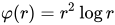
where denotes the usual Euclidean norm and is a set of mapping coefficients. The TPS corresponds to the radial basis kernel .


Suppose the points are in 2 dimensions (). One can use homogeneous coordinates for the point-set where a point is represented as a vector . The unique minimizer is parameterized by which consists of two matrices and ().


Hub AI
Thin plate spline AI simulator
(@Thin plate spline_simulator)
Thin plate spline
Thin plate splines (TPS) are a spline-based technique for data interpolation and smoothing. They were introduced to geometric design by Duchon. They are an important special case of a polyharmonic spline. Robust Point Matching (RPM) is a common extension and shortly known as the TPS-RPM algorithm.
The name thin plate spline refers to a physical analogy involving the bending of a plate or thin sheet of metal. Just as the metal has rigidity, the TPS fit resists bending also, implying a penalty involving the smoothness of the fitted surface. In the physical setting, the deflection is in the direction, orthogonal to the plane. In order to apply this idea to the problem of coordinate transformation, one interprets the lifting of the plate as a displacement of the or coordinates within the plane. In 2D cases, given a set of corresponding control points (knots), the TPS warp is described by parameters which include 6 global affine motion parameters and coefficients for correspondences of the control points. These parameters are computed by solving a linear system, in other words, TPS has a closed-form solution.
The TPS arises from consideration of the integral of the square of the second derivative—this forms its smoothness measure. In the case where is two dimensional, for interpolation, the TPS fits a mapping function between corresponding point-sets and that minimizes the following energy function:
The smoothing variant, correspondingly, uses a tuning parameter to control the rigidity of the deformation, balancing the aforementioned criterion with the measure of goodness of fit, thus minimizing:
For this variational problem, it can be shown that there exists a unique minimizer . The finite element discretization of this variational problem, the method of elastic maps, is used for data mining and nonlinear dimensionality reduction. In simple words, "the first term is defined as the error measurement term and the second regularisation term is a penalty on the smoothness of ." It is in a general case needed to make the mapping unique.
The thin plate spline has a natural representation in terms of radial basis functions. Given a set of control points , a radial basis function defines a spatial mapping which maps any location in space to a new location , represented by
where denotes the usual Euclidean norm and is a set of mapping coefficients. The TPS corresponds to the radial basis kernel .
Suppose the points are in 2 dimensions (). One can use homogeneous coordinates for the point-set where a point is represented as a vector . The unique minimizer is parameterized by which consists of two matrices and ().