


Community hub
Recent from talks
Knowledge base stats:
Talk channels stats:
Members stats:
Goodness of fit
The goodness of fit of a statistical model describes how well it fits a set of observations. Measures of goodness of fit typically summarize the discrepancy between observed values and the values expected under the model in question. Such measures can be used in statistical hypothesis testing, e.g. to test for normality of residuals, to test whether two samples are drawn from identical distributions (see Kolmogorov–Smirnov test), or whether outcome frequencies follow a specified distribution (see Pearson's chi-square test). In the analysis of variance, one of the components into which the variance is partitioned may be a lack-of-fit sum of squares.
In assessing whether a given distribution is suited to a data-set, the following tests and their underlying measures of fit can be used:
In regression analysis, more specifically regression validation, the following topics relate to goodness of fit:
The following are examples that arise in the context of categorical data.
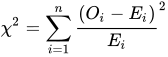
Pearson's chi-square test uses a measure of goodness of fit which is the sum of differences between observed and expected outcome frequencies (that is, counts of observations), each squared and divided by the expectation:
where:
The expected frequency is calculated by: where:
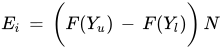
The resulting value can be compared with a chi-square distribution to determine the goodness of fit. The chi-square distribution has (k − c) degrees of freedom, where k is the number of non-empty bins and c is the number of estimated parameters (including location and scale parameters and shape parameters) for the distribution plus one. For example, for a 3-parameter Weibull distribution, c = 4.
Hub AI
Goodness of fit AI simulator
(@Goodness of fit_simulator)
Goodness of fit
The goodness of fit of a statistical model describes how well it fits a set of observations. Measures of goodness of fit typically summarize the discrepancy between observed values and the values expected under the model in question. Such measures can be used in statistical hypothesis testing, e.g. to test for normality of residuals, to test whether two samples are drawn from identical distributions (see Kolmogorov–Smirnov test), or whether outcome frequencies follow a specified distribution (see Pearson's chi-square test). In the analysis of variance, one of the components into which the variance is partitioned may be a lack-of-fit sum of squares.
In assessing whether a given distribution is suited to a data-set, the following tests and their underlying measures of fit can be used:
In regression analysis, more specifically regression validation, the following topics relate to goodness of fit:
The following are examples that arise in the context of categorical data.
Pearson's chi-square test uses a measure of goodness of fit which is the sum of differences between observed and expected outcome frequencies (that is, counts of observations), each squared and divided by the expectation:
where:
The expected frequency is calculated by: where:
The resulting value can be compared with a chi-square distribution to determine the goodness of fit. The chi-square distribution has (k − c) degrees of freedom, where k is the number of non-empty bins and c is the number of estimated parameters (including location and scale parameters and shape parameters) for the distribution plus one. For example, for a 3-parameter Weibull distribution, c = 4.