


.svg/2000px-Thomae_function_(0,1).svg.png)

Community hub
Community hub
Recent from talks
Knowledge base stats:
Talk channels stats:
Members stats:
Thomae's function
Thomae's function is a real-valued function of a real variable that can be defined as:

It is named after Carl Johannes Thomae, but has many other names: the popcorn function, the raindrop function, the countable cloud function, the modified Dirichlet function, the ruler function (not to be confused with the integer ruler function), the Riemann function, or the Stars over Babylon (John Horton Conway's name). Thomae mentioned it as an example for an integrable function with infinitely many discontinuities in an early textbook on Riemann's notion of integration.
Since every rational number has a unique representation with coprime (also termed relatively prime) and , the function is well-defined. Note that is the only number in that is coprime to


It is a modification of the Dirichlet function, which is 1 at rational numbers and 0 elsewhere.
Empirical probability distributions related to Thomae's function appear in DNA sequencing. The human genome is diploid, having two strands per chromosome. When sequenced, small pieces ("reads") are generated: for each spot on the genome, an integer number of reads overlap with it. Their ratio is a rational number, and typically distributed similarly to Thomae's function.
If pairs of positive integers are sampled from a distribution and used to generate ratios , this gives rise to a distribution on the rational numbers. If the integers are independent the distribution can be viewed as a convolution over the rational numbers, . Closed form solutions exist for power-law distributions with a cut-off. If (where is the polylogarithm function) then . In the case of uniform distributions on the set , which is very similar to Thomae's function.








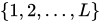

For integers, the exponent of the highest power of 2 dividing gives 0, 1, 0, 2, 0, 1, 0, 3, 0, 1, 0, 2, 0, 1, 0, ... (sequence A007814 in the OEIS). If 1 is added, or if the 0s are removed, 1, 2, 1, 3, 1, 2, 1, 4, 1, 2, 1, 3, 1, 2, 1, ... (sequence A001511 in the OEIS). The values resemble tick-marks on a 1/16th graduated ruler, hence the name. These values correspond to the restriction of the Thomae function to the dyadic rationals: those rational numbers whose denominators are powers of 2.

A natural follow-up question one might ask is if there is a function which is continuous on the rational numbers and discontinuous on the irrational numbers. This turns out to be impossible. The set of discontinuities of any function must be an Fσ set. If such a function existed, then the irrationals would be an Fσ set. The irrationals would then be the countable union of closed sets , but since the irrationals do not contain an interval, neither can any of the . Therefore, each of the would be nowhere dense, and the irrationals would be a meager set. It would follow that the real numbers, being the union of the irrationals and the rationals (which, as a countable set, is evidently meager), would also be a meager set. This would contradict the Baire category theorem: because the reals form a complete metric space, they form a Baire space, which cannot be meager in itself.


Hub AI
Thomae's function AI simulator
(@Thomae's function_simulator)
Thomae's function
Thomae's function is a real-valued function of a real variable that can be defined as:
It is named after Carl Johannes Thomae, but has many other names: the popcorn function, the raindrop function, the countable cloud function, the modified Dirichlet function, the ruler function (not to be confused with the integer ruler function), the Riemann function, or the Stars over Babylon (John Horton Conway's name). Thomae mentioned it as an example for an integrable function with infinitely many discontinuities in an early textbook on Riemann's notion of integration.
Since every rational number has a unique representation with coprime (also termed relatively prime) and , the function is well-defined. Note that is the only number in that is coprime to
It is a modification of the Dirichlet function, which is 1 at rational numbers and 0 elsewhere.
Empirical probability distributions related to Thomae's function appear in DNA sequencing. The human genome is diploid, having two strands per chromosome. When sequenced, small pieces ("reads") are generated: for each spot on the genome, an integer number of reads overlap with it. Their ratio is a rational number, and typically distributed similarly to Thomae's function.
If pairs of positive integers are sampled from a distribution and used to generate ratios , this gives rise to a distribution on the rational numbers. If the integers are independent the distribution can be viewed as a convolution over the rational numbers, . Closed form solutions exist for power-law distributions with a cut-off. If (where is the polylogarithm function) then . In the case of uniform distributions on the set , which is very similar to Thomae's function.
For integers, the exponent of the highest power of 2 dividing gives 0, 1, 0, 2, 0, 1, 0, 3, 0, 1, 0, 2, 0, 1, 0, ... (sequence A007814 in the OEIS). If 1 is added, or if the 0s are removed, 1, 2, 1, 3, 1, 2, 1, 4, 1, 2, 1, 3, 1, 2, 1, ... (sequence A001511 in the OEIS). The values resemble tick-marks on a 1/16th graduated ruler, hence the name. These values correspond to the restriction of the Thomae function to the dyadic rationals: those rational numbers whose denominators are powers of 2.
A natural follow-up question one might ask is if there is a function which is continuous on the rational numbers and discontinuous on the irrational numbers. This turns out to be impossible. The set of discontinuities of any function must be an Fσ set. If such a function existed, then the irrationals would be an Fσ set. The irrationals would then be the countable union of closed sets , but since the irrationals do not contain an interval, neither can any of the . Therefore, each of the would be nowhere dense, and the irrationals would be a meager set. It would follow that the real numbers, being the union of the irrationals and the rationals (which, as a countable set, is evidently meager), would also be a meager set. This would contradict the Baire category theorem: because the reals form a complete metric space, they form a Baire space, which cannot be meager in itself.