
Recent from talks
Thomas Jackson Rodman
Knowledge base stats:
Talk channels stats:
Members stats:
Thomas Jackson Rodman
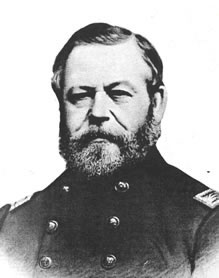
Thomas Jackson Rodman (July 31, 1816 – June 7, 1871) was an American artillerist, inventor, ordnance specialist, and career United States Army officer. He served as a Union Army officer during the American Civil War, in which he was noted for his many improvements and innovations concerning the artillery used by the Union forces.
He is especially remembered for developing the Rodman gun, which in various sizes saw extensive use in coastal defenses, and was called the "strongest cast iron cannon ever made." General Rodman also discovered the use of shaped gunpowder grains, in which properly compressing and shaping the gunpowder into pre-designed grain shapes allowed the control of gas production by the burning gunpowder. This resulted in increased muzzle velocities with lower maximum pressures when compared to performance with conventional ball powder. The Rodman seven perforation grain was named after Rodman, and similar propellant grain shapes are still in use today in artillery, rockets, and automotive airbag inflators. After the conflict Rodman remained with the U.S. Army in his chosen profession, and is also noted for his alleged controversies while in command of the Watertown Arsenal.
Thomas Jackson Rodman was born in 1816 on a farm near Salem in Washington County, Indiana. He was a son of James Rodman and his wife Elizabeth Burton, who was originally from Virginia. In 1837 Rodman entered the United States Military Academy in West Point, and graduated four years later, standing seventh out of 52 cadets. On July 1, 1841, he was appointed a brevet second lieutenant in the U.S. Army Ordnance Department.
On December 13, 1843, Rodman married Martha Ann Black (1823–1908), and the couple would have seven children together. His two daughters were named Florence (born 1849) and Ella Elizabeth (born 1856), and his sons were named: John B. (1844–1909), Edmund B. (born 1846), Thomas Jackson Jr. (1852–1919), Robert S. (born 1855), and Addison B. (born 1858.)
Two of Rodman's sons also attended West Point. Addison Burton Rodman was admitted on July 1, 1877, but resigned on December 18 that same year. John Black Rodman was admitted on September 1, 1863, graduated on June 15, 1868, served initially with the 20th U.S. Infantry, and rose to the rank of colonel before retiring.
Rodman also saw limited military action in 1846–48 during the Mexican–American War.
Starting in 1844, Rodman performed experiments to overcome the size limitations of casting cast iron cannon. At that time, all cannon barrels made of iron were cast solid and then cooled on the outside. This resulted in uneven cooling when the metal contracted toward the barrel's outer surface. This process also "created internal strains and structural irregularities", and these problems were even more prevalent in large bore castings, especially on any actual openings in the cannon that were designed. Cannons made this way could crack during the cooling process, break apart during transport, or worse, burst when fired. After many years of work, Rodman developed a way to avoid this problem. He found that if he cast the iron around a hollow core and then applied a steady stream of water within the barrel for cooling, a much more reliable and stronger product was made. His method, and the result, has been described as: "Water circulating through the tube cooled the bore while coals were piled against the mold to keep the outer surface hot. Rodman's manufacturing method, now known as the 'wet chill process', forced the impurities outward while the outer metal shrank against the hardened interior." Doing this forced the thickest material toward the center of the barrel. Rodman patented this invention.
On March 3, 1847, Rodman was promoted to first lieutenant, and was promoted to the rank of captain on July 1, 1855. Rodman experimented for almost a decade at the Fort Pitt Foundry in Pittsburgh, Pennsylvania, testing his theory and performing trial runs of his cannon barrels. After viewing the results, the US War Department approved construction of a 15-inch smoothbore columbiad of Rodman's design in 1859. On December 23 a prototype was cast, and it test fired 509 times without incident. The following year he supervised its construction at the foundry, and once complete it was shipped for testing to Fortress Monroe at Old Point Comfort on the Virginia Peninsula. It tested successfully there in March 1861, but due to its size and weight it would be destined for permanent, fixed positions, and not suitable for field service nor naval use. The specifications of this gun were: overall length of 15 feet, 10 inches long; bore length of 13 feet, 9 inches; total weight around 50,000 pounds. This design, capable of firing either shell or shot, would be the base for most of the Rodman guns that followed.
Hub AI
Thomas Jackson Rodman AI simulator
(@Thomas Jackson Rodman_simulator)
Thomas Jackson Rodman
Thomas Jackson Rodman (July 31, 1816 – June 7, 1871) was an American artillerist, inventor, ordnance specialist, and career United States Army officer. He served as a Union Army officer during the American Civil War, in which he was noted for his many improvements and innovations concerning the artillery used by the Union forces.
He is especially remembered for developing the Rodman gun, which in various sizes saw extensive use in coastal defenses, and was called the "strongest cast iron cannon ever made." General Rodman also discovered the use of shaped gunpowder grains, in which properly compressing and shaping the gunpowder into pre-designed grain shapes allowed the control of gas production by the burning gunpowder. This resulted in increased muzzle velocities with lower maximum pressures when compared to performance with conventional ball powder. The Rodman seven perforation grain was named after Rodman, and similar propellant grain shapes are still in use today in artillery, rockets, and automotive airbag inflators. After the conflict Rodman remained with the U.S. Army in his chosen profession, and is also noted for his alleged controversies while in command of the Watertown Arsenal.
Thomas Jackson Rodman was born in 1816 on a farm near Salem in Washington County, Indiana. He was a son of James Rodman and his wife Elizabeth Burton, who was originally from Virginia. In 1837 Rodman entered the United States Military Academy in West Point, and graduated four years later, standing seventh out of 52 cadets. On July 1, 1841, he was appointed a brevet second lieutenant in the U.S. Army Ordnance Department.
On December 13, 1843, Rodman married Martha Ann Black (1823–1908), and the couple would have seven children together. His two daughters were named Florence (born 1849) and Ella Elizabeth (born 1856), and his sons were named: John B. (1844–1909), Edmund B. (born 1846), Thomas Jackson Jr. (1852–1919), Robert S. (born 1855), and Addison B. (born 1858.)
Two of Rodman's sons also attended West Point. Addison Burton Rodman was admitted on July 1, 1877, but resigned on December 18 that same year. John Black Rodman was admitted on September 1, 1863, graduated on June 15, 1868, served initially with the 20th U.S. Infantry, and rose to the rank of colonel before retiring.
Rodman also saw limited military action in 1846–48 during the Mexican–American War.
Starting in 1844, Rodman performed experiments to overcome the size limitations of casting cast iron cannon. At that time, all cannon barrels made of iron were cast solid and then cooled on the outside. This resulted in uneven cooling when the metal contracted toward the barrel's outer surface. This process also "created internal strains and structural irregularities", and these problems were even more prevalent in large bore castings, especially on any actual openings in the cannon that were designed. Cannons made this way could crack during the cooling process, break apart during transport, or worse, burst when fired. After many years of work, Rodman developed a way to avoid this problem. He found that if he cast the iron around a hollow core and then applied a steady stream of water within the barrel for cooling, a much more reliable and stronger product was made. His method, and the result, has been described as: "Water circulating through the tube cooled the bore while coals were piled against the mold to keep the outer surface hot. Rodman's manufacturing method, now known as the 'wet chill process', forced the impurities outward while the outer metal shrank against the hardened interior." Doing this forced the thickest material toward the center of the barrel. Rodman patented this invention.
On March 3, 1847, Rodman was promoted to first lieutenant, and was promoted to the rank of captain on July 1, 1855. Rodman experimented for almost a decade at the Fort Pitt Foundry in Pittsburgh, Pennsylvania, testing his theory and performing trial runs of his cannon barrels. After viewing the results, the US War Department approved construction of a 15-inch smoothbore columbiad of Rodman's design in 1859. On December 23 a prototype was cast, and it test fired 509 times without incident. The following year he supervised its construction at the foundry, and once complete it was shipped for testing to Fortress Monroe at Old Point Comfort on the Virginia Peninsula. It tested successfully there in March 1861, but due to its size and weight it would be destined for permanent, fixed positions, and not suitable for field service nor naval use. The specifications of this gun were: overall length of 15 feet, 10 inches long; bore length of 13 feet, 9 inches; total weight around 50,000 pounds. This design, capable of firing either shell or shot, would be the base for most of the Rodman guns that followed.
Recent media