Hubbry Logo
Virginia PeninsulaVirginia PeninsulaMain
Open search
Virginia Peninsula
Community hub
Virginia Peninsula
logo
8 pages, 0 posts
0 subscribers
Be the first to start a discussion here.
Virginia Peninsula
Virginia Peninsula
from Wikipedia

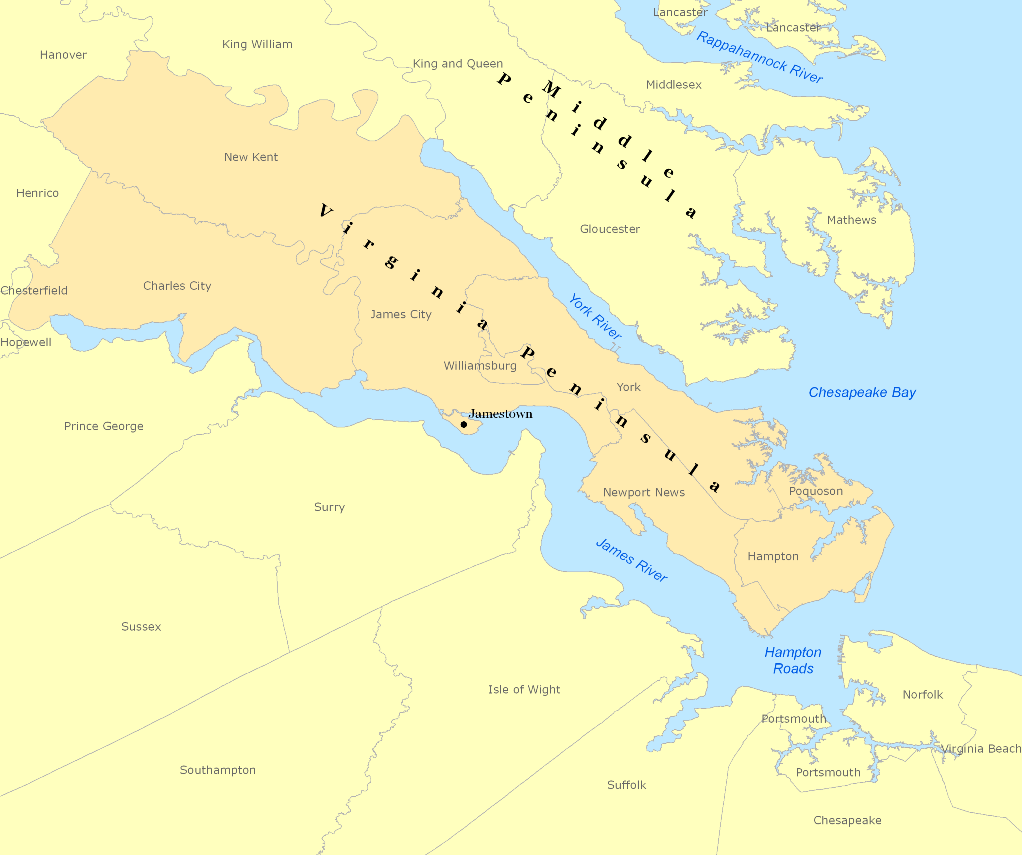
The Virginia Peninsula is highlighted in orange
Virginia Peninsula
This 1996 satellite photo shows Hampton Roads, with the lower (southeastern) end of Virginia Peninsula filling most of the top half of the image

The Virginia Peninsula is the natural landform located in southeast Virginia outlined by the York River, James River, Hampton Roads and Chesapeake Bay. It is sometimes known as the Lower Peninsula to distinguish it from two other peninsulas to the north, the Middle Peninsula and the Northern Neck.

It is the site of historic Jamestown, founded in 1607 as the first permanent English settlement in North America. Geographically located at the northwestern reaches, Charles City and New Kent counties are part of the Virginia Peninsula. In the 21st century, they are also considered part of the Richmond–Petersburg region. The rest of the Virginia Peninsula is all part of the Virginia Beach–Norfolk–Newport News, VA–NC MSA (metropolitan statistical area) with a population of about 1.8 million. The Hampton Roads MSA is the common name for the metropolitan area that surrounds the body of water of the same name. It is the seventh-largest metropolitan area in the Southeast and the 32nd largest in the United States.

The land portion of Hampton Roads has been historically divided into two regions, the Virginia Peninsula or Peninsula on the north side, and South Hampton Roads on the south side. (Locally, South Hampton Roads is commonly called "the Southside", but this is not to be confused with "Southside Virginia", a separate region of the south central portion of Virginia located farther inland.) More recently, the boundaries of the Hampton Roads metropolitan area have expanded to include the two southernmost counties of the Middle Peninsula (Gloucester and Matthews), across the York River from the Virginia Peninsula.

History

[edit]

Spanish exploration

[edit]

Early in the 16th century, Spanish explorers were the first Europeans to see the Chesapeake Bay, which they called Bahía de Madre de Dios or Bahía de Santa Maria.[1] They were searching for the Northwest Passage to India and the Orient. [citation needed] They named the land now known as Virginia, as Ajacán.

The Spanish succeeded in founding a colonial settlement in the New World in 1565 at St. Augustine, Florida. It was the first founded by Europeans in what is now the United States. They established small Spanish outposts along the eastern coast into present-day Georgia and the Carolinas. The northernmost post was Santa Elena (today Port Royal, South Carolina). From there Juan Pardo was commissioned to lead expeditions into the interior, founding Fort San Juan in 1567–1568 at the regional Mississippian culture chiefdom of Joara. Located in present-day western North Carolina, this was the first European settlement in the interior of North America.

English settlement

[edit]

The first permanent English settlement in North America was established in 1607 at Jamestown. The first continuously occupied settlement was at Kecoughtan in Elizabeth City County what is now the City of Hampton. Nearby, Fort Monroe, formerly the country's oldest military base still in use, is located at Old Point Comfort. Old Point Comfort is also the site of the first landing of Africans in America, in 1619.[2] After declaring independence from Great Britain, Virginia's first state capital was Williamsburg. Also, the decisive battle of the American Revolution, the siege of Yorktown in 1781, took place on the Virginia Peninsula.

The Battle of Hampton Roads, as depicted by Currier and Ives

American Civil War

[edit]

During the American Civil War (1861–1865), the Union Army invaded the Virginia Peninsula as part of the Peninsula Campaign in 1862 to capture Richmond, beginning from Fort Monroe at the entrance to Hampton Roads, which had remained in Union control after Virginia seceded in 1861. At the outset of the Peninsula Campaign, the Battle of Hampton Roads between the first ironclad warships took place near the mouth of the James River off the eastern tip of Warwick County. The 1862 Siege of Yorktown took place along the York River. Finally, after a lengthy standoff, the largest Union Army of the war under General George B. McClellan chased the retreating Confederates through the Williamsburg Line and westward literally to the "Gates of Richmond", where the swampy upper reaches of the Chickahominy River created a natural barrier behind which the defenders successfully held the Confederate capital, essentially prolonging the war for three more devastating years.

Post-war

[edit]

As the region and Virginia rebuilt during Reconstruction, the Chesapeake and Ohio Railway (C&O) under the leadership of Collis P. Huntington was completed from Richmond to the Ohio River by 1871. Long a dream of Virginians, and later sponsored by both Virginia and West Virginia, the new railroad opened paths to ship products west, as well as offering an economically viable method of shipping the rich bituminous coal of the region to fuel the Industrial Revolution. However, the tidal portion of the James River, while navigable from Hampton Roads to the Fall Line at Richmond, couldn't accommodate the deep drafts of collier ships.

The Peninsula had been long without a railroad, which had been newly developing technology beginning in the 1830s. In 1881, the Peninsula Extension of the C&O was built from Richmond through Williamsburg to Newport News Point. There, Collis Huntington, his associates, and his Old Dominion Land Company developed his vision for the area. Within only 15 years, a rural farm community in Warwick County turned into the new independent city of Newport News, Virginia, by 1896 as new coal piers brought ships to what would become the world's largest shipyard, Newport News Shipbuilding and Drydock Company. Hotels, houses, schools and businesses sprung up there, and at many points along the new rail line in Warwick, York and James City counties. Oyster Point became a shipping place for the watermen and the new town of Lee Hall, Virginia, emerged, and became an important point due to its proximity to Yorktown and later to the new military base which became the U.S. Army's Fort Eustis. In Elizabeth City County, tracks were extended from Newport News to reach Old Point Comfort, where resort hotels and Buckroe Beach were developed. There, a new town was incorporated. Phoebus was named after one of its early leading citizens, Harrison Phoebus.

20th century

[edit]

In James City County, Toano became a major shipping point for the area's truck farming and an entire new development planned by a C&O land agent to attract farmers of Scandinavian descent from the colder regions of the American Mid-West emerged at Norge shortly after the start of the 20th century. Later in the first half of the 20th century, especially during the two world wars, massive military facilities were established on large reservations which today contain Langley Air Force Base, Fort Eustis, Naval Weapons Station Yorktown, and Camp Peary. To make way, all of Mulberry Island and entire communities including Lackey, Halstead's Point, Penniman, Bigler's Mill, and Magruder disappeared in the process. However, many of the displaced Virginians chose to relocate to Grove in James City County and other areas close by on the Peninsula.

After the capital of Virginia moved to Richmond in 1780 for greater security during the American Revolutionary War, Williamsburg became much less busy. By the early 20th century, it was described as a "sleepy little hamlet", known best for the College of William and Mary and Eastern State Hospital, which was the successor to the country's first mental hospital, as well as its fading memories and deteriorating colonial sites. All that changed dramatically beginning in 1926. The restoration and recreation of Colonial Williamsburg, one of the largest historic restorations ever undertaken, was championed by the Reverend Dr. W.A.R. Goodwin and the patriarch of the Rockefeller family, John D. Rockefeller Jr., along with the active participation of his wife, Abby Aldrich Rockefeller, who wanted to celebrate the patriots and the early history of the United States. The restoration of the colonial capital, construction of the Colonial Parkway by the U.S. National Park Service, several major enhancements at Jamestown and Yorktown, and development of several theme parks such as Busch Gardens Williamsburg beginning in the 1970s, all combined to help make the Historic Triangle area of Colonial Virginia become one of the most popular tourist destinations in the United States by the end of the 20th century.[3]

Local government

[edit]

In Colonial times, and even in the first 150 years of the United States, much like Virginia as a whole, the Virginia Peninsula was in an almost constant state of change in terms of local government, largely due to growth, as counties were divided and towns were formed as the population grew. Some towns grew to become cities. Under the state constitutional changes in 1871, extant and future cities in Virginia became independent cities of the counties they had formerly been located within.[citation needed]

However, in the second half of the 20th century, an unprecedented wave of city-county-town local government consolidations took place in South Hampton Roads and on the Virginia Peninsula. Nowhere else in Virginia have rural areas and more dense cities been combined in such a manner as these two areas. The changes resulted in the two areas having Virginia's cities with the largest land areas and the most farming, even over 30 years after the consolidations in some instances.[citation needed]

Newport News–Hampton Metropolitan Area (1960–1983)

[edit]

In 1960, the "Newport News–Hampton Metropolitan Statistical Area" was designated a metropolitan area by the U.S. Census Bureau. It comprised the cities of Newport News, Hampton and York County.

In 1983, the MSA, comprising the cities of Newport News, Hampton, Poquoson and Williamsburg, and the counties of Gloucester, James City and York, was combined with the Norfolk–Virginia Beach–Portsmouth MSA and renamed the "Norfolk–Virginia Beach–Newport News MSA".

Virginia Peninsula Metropolitan Population History 1960–1980[4]
# City/County 1960 1970 1980
1 Newport News 113,662 138,177 144,903
2 Hampton 89,258 120,779 122,617
3 Williamsburg - - 9,870
4 Poquoson - - 8,726
5 York County, VA 21,583 33,203 35,463
6 James City County, VA - - 22,763
7 Gloucester County, VA - - 20,107
Metropolitan Area total 224,503 292,159 364,449

Current political subdivisions

[edit]

The Virginia Peninsula subregion includes four independent cities (Hampton, Newport News, Poquoson and Williamsburg) and two counties (James City County and York County). There are currently no incorporated towns. There were also a number of political subdivisions which are now extinct, primarily due to both growth of communities and consolidation of local government (see section below).

Name County Seat Area (km2) Population
1990 Census
Population
2000 Census
Population
2010 Census
Population
2020 Census
Hampton none 352.83 133,811 146,437 137,436 137,148
Newport News none 308.34 170,045 180,150 180,719 186,247
Poquoson Yorktown (Courts shared) 203.13 11,005 11,566 12,150 12,460
Williamsburg Williamsburg 22.46 11,530 11,998 14,068 15,425
James City County Williamsburg 465.45 34,859 48,102 67,009 78,254
York County Yorktown 558.19 42,422 56,297 65,464 70,045
Totals 1,910.40 403,672 454,550 476,846 499,579

Defunct political subdivisions

[edit]

Many incorporated (formally constituted) localities have become legally void, though most have not been abandoned by their citizens, with the notable exception of Jamestown. Exclusive of towns which became cities and still have the same name, no less than 4 shires, 2 counties, 4 towns, and 1 city no longer exist in the Virginia Peninsula area under their earlier names.

The following is a listing of these 11 extinct shire, counties, towns, and cities, with the approximate dates they existed:

Major bridges, bridge tunnels, ferry system

[edit]
James River Bridge, viewed from Huntington Park Beach

Generally surrounded by water, the Virginia Peninsula is linked to other areas across the surrounding water barriers of the James and York Rivers, and the harbor of Hampton Roads by 2 bridge–tunnels, 2 large drawbridges, and a state-operated ferry system. These are:[citation needed]

Interstate Highways

[edit]

U.S. and State Routes

[edit]

Scenic parkways and trails

[edit]

U.S. military installations

[edit]
Two F-22A turn in on final approach to Langley Air Force Base

The Virginia Peninsula is home to several military bases.

City of Hampton

[edit]

Langley Air Force Base is located in Hampton. Fort Monroe had been the oldest installation in the region but closed in September 2011. The now decommissioned Fort Wool, located on a manmade island called Rip Raps across the mouth of Hampton Roads from Fort Monroe, is also in Hampton.

City of Newport News

[edit]

Fort Eustis, home of the U.S. Army Training and Doctrine Command (TRADOC) is in Newport News. A major military contractor, Newport News Shipbuilding, is also in the city.

York County

[edit]

York County is home to the U.S. Navy's Yorktown Naval Weapons Station and a supply depot at nearby Cheatham Annex. Camp Peary and Coast Guard Training Center Yorktown[5] are also located in York County.

James City County

[edit]

Although each is primarily located in other jurisdictions, portions of Fort Eustis, Naval Weapons Station Yorktown, Cheatham Annex, and Camp Peary extend into James City County.

See also

[edit]

References

[edit]

Sources

[edit]

37°4′47.4″N 76°24′22.5″W / 37.079833°N 76.406250°W / 37.079833; -76.406250

Revisions and contributorsEdit on WikipediaRead on Wikipedia
from Grokipedia

The Virginia Peninsula is a coastal landform in southeastern Virginia, bounded by the York River to the north, the James River to the south, Hampton Roads harbor to the southeast, and Chesapeake Bay. This region, encompassing independent cities such as Hampton, Newport News, Williamsburg, and Poquoson along with parts of James City and York counties, spans approximately 70 miles in length and features a mix of urban, suburban, and rural landscapes shaped by tidal rivers and wetlands.
Historically, the Peninsula holds foundational significance in American colonial development, site of Jamestown—the first permanent English settlement in established in 1607—and Yorktown, where the decisive 1781 siege marked the effective conclusion of the Revolutionary War. During the Civil War, it witnessed key naval engagements, including the 1862 between the ironclads USS Monitor and CSS Virginia. In the modern era, the area integrates into the metropolitan region, supporting a population exceeding 500,000 across its core municipalities and sustaining an economy anchored in defense, maritime industry via Newport News Shipbuilding, and heritage tourism linked to .

Geography and Environment

Physical Features

The Virginia Peninsula, also known as the Lower Peninsula, forms a narrow land protrusion in southeastern , bounded hydrologically by the York River to the north and the to the south, with its eastern margin at connecting to the . This configuration creates a distinct geographic finger approximately 400 square miles in area, separating the two major tidal estuaries that influence its drainage and coastal morphology. The topography of the peninsula lies within the Atlantic Coastal Plain , characterized by flat to gently rolling terrain with maximum elevations rarely exceeding 100 feet above and an average of about 62 feet. Sedimentary deposits from ancient river systems and marine transgressions dominate the surficial , resulting in poorly drained soils prone to saturation. Wetlands and tidal marshes fringe the riverbanks and shoreline, comprising significant portions of the landscape and forming intricate hydrological networks that buffer upland areas but also expand during high water events. While the mainland peninsula lacks extensive barrier islands directly attached, offshore features in the , including spits and small islands, contribute to dynamics and wave along its eastern flank. The low-relief profile and tidal influences heighten susceptibility to inundation, as demonstrated by on September 18, 2003, when storm surges exceeding 8 feet propagated up the York and James Rivers, flooding extensive low-lying zones due to the constrained and minimal elevation gradients. This event underscored the causal link between the region's subdued , riverine funneling of surges, and amplified flood risks.

Climate and Natural Resources

The Virginia Peninsula features a with four distinct seasons, marked by hot, humid summers and mild winters. The average annual temperature is 61.9°F, with July highs averaging 88°F and January lows around 32°F. Annual precipitation totals approximately 49 inches, with peaks in late summer from thunderstorms and tropical systems, and the region experiences high relative humidity year-round, often exceeding 70%. Coastal influences contribute to frequent nor'easters in winter, delivering strong winds and storm surges, while the area's low elevation heightens vulnerability to sea-level rise, which has accelerated to rates of 4 millimeters per year at the Chesapeake Bay's mouth, driven by both eustatic rise and land . Relative sea-level rise in coastal has totaled over 14 inches since 1930, the highest along the U.S. Atlantic coast. Key natural resources include from the and adjacent waters, where blue crabs and dominate commercial harvests, generating significant economic value through direct sales, processing, and induced effects estimated at billions annually in Virginia's industry as of 2019. Timber from remnant forested areas and arable soils historically supported and cultivation, but extraction has shifted toward sustainable practices like , with state programs promoting and farming to bolster production without depleting wild stocks. These resources underpin local economies, though overharvesting and degradation have prompted empirical monitoring of rates, which average several feet per year along unprotected shorelines due to wave action and rising seas. Conservation efforts focus on Chesapeake Bay restoration, including oyster reef rebuilding to filter pollutants and stabilize substrates against erosion. Since the 1990s, initiatives have added nearly 2,300 acres of oyster habitat across tributaries, with projects in areas like the Lynnhaven River achieving self-sustaining populations by 2025 goals in select Virginia rivers. The U.S. Army Corps of Engineers has led reef construction in five tributaries, enhancing biodiversity and resilience to sea-level rise without relying on unsubstantiated projections. These measures address documented declines in native oyster densities, which fell over 99% from historical levels due to disease and siltation, by prioritizing substrate addition and spat-on-shell planting based on field trials showing improved recruitment rates.

History

Pre-Colonial Period and Early European Exploration

Archaeological evidence from sites across Virginia, including the Tidewater region encompassing the Peninsula, documents human habitation dating to the Paleoindian period approximately 15,000–8,000 years ago, characterized by nomadic hunting and gathering in post-glacial environments. More settled patterns emerged during the Woodland period starting around 1200 BCE, with artifacts indicating semi-permanent villages, pottery, and early horticultural practices such as the cultivation of native plants including sunflowers for seeds by 2000 BCE. By the Late Woodland period (circa 900–1600 CE), Algonquian-speaking groups had developed maize-based agriculture supplemented by beans, squash, hunting, and fishing, supporting populations in palisaded villages along rivers and bays. The Peninsula fell within the territory of the paramount chiefdom, a confederacy of approximately 30 Algonquian tribes controlling tidewater from the northward to the Potomac by the late , with an estimated 20,000 inhabitants across 128 villages at its peak around 1600. Key settlements included , the chief's primary residence on the York River in present-day Gloucester County, and Kecoughtan near the Peninsula's southeastern tip, where inhabitants relied on riverine resources and managed cleared fields for crops. These societies featured hierarchical structures under werowances (chiefs), longhouses for communal living, and seasonal migrations for oyster harvesting and , as evidenced by excavated shell middens and tools. Spanish explorers were the first Europeans to reach the region in the early , with expeditions probing the coast for passages to the Pacific and potential colonies; in 1526, de Ayllón's fleet entered Chesapeake waters en route to failed settlements farther south. More direct contact occurred in 1561 when Álvar Núñez Cabeza de Vaca's associates encountered Chesapeake natives, leading to the abduction of a Powhatan-related figure known as Don Luís de Velasco, who was taken to and later guided a 1570 mission to the area. That mission, aimed at conversion, landed near Kecoughtan but collapsed within months due to native resistance, with eight Jesuits killed by 1571, marking an early, abortive European incursion amid unverified reports of prior landings. English exploration intensified in 1607 with the arrival of the Jamestown fleet in on April 26, prompting initial surveys of the for settlement sites. Captain John Smith, aboard exploratory shallops, ascended the James, Chickahominy, and Rivers between May and December 1607, charting over 3,000 miles of waterways, documenting villages, and negotiating with leaders through trade and hostage exchanges, including leaving Thomas Savage at . These voyages revealed the Peninsula's strategic riverine geography and native alliances, though fraught with skirmishes, laying groundwork for subsequent colonization without establishing permanent outposts at the time.

Colonial Settlement and Revolutionary War

The Virginia Peninsula, situated between the James and York Rivers, hosted the establishment of Jamestown in 1607, marking the first permanent in . Chartered by the Virginia Company of London, three ships—the , Godspeed, and Discovery—carried approximately 104 men and boys who arrived in in late April and selected a marshy site on the James River's north bank for its defensibility and deep-water access, naming it Jamestown upon landing on May 14. Initial challenges included from , inadequate food supplies, and hostilities with the Powhatan Confederacy, resulting in over two-thirds mortality in the first year. The colony endured near collapse during the "" of winter 1609–1610, when poor leadership under Captain John Smith’s successors, crop failures, and a Powhatan blockade reduced the population from over 500 to 60 amid famine, disease from contaminated water, and documented instances of . Resupply ships arriving in May 1610 under Lord De La Warr reinforced the settlers, averting abandonment and stabilizing the outpost. Economic salvation came with John Rolfe's cultivation of marketable strains starting in 1612, which by the 1620s generated export revenues exceeding £20,000 annually, fueling plantation expansion along the Peninsula's tidal rivers and shifting focus from subsistence to commercial agriculture. Tobacco plantations proliferated, initially laboring under indentured servants who comprised 75–80% of Virginia's bound workforce in the mid-1600s, drawn by headright grants promising land after four-to-seven-year terms. As servant supply waned post-1660s due to improved English conditions and exposing class tensions, planters transitioned to enslaved Africans, whose numbers rose from 300 in 1650 to over 13,000 by 1700, codified by lifetime, inheritable servitude laws like Virginia's 1662 statute tying bondage to maternal status. This labor regime underpinned the Peninsula's export-oriented economy, with Yorktown—laid out in 1691 under the Port Act as a customs-designated —emerging as a key York River hub for shipping thousands of hogsheads yearly to . In the Revolutionary War, the Peninsula's strategic geography proved decisive at the 1781 , where British General Lord Cornwallis entrenched 7,000–8,000 troops expecting naval support. A orchestrated the entrapment: French Admiral de Grasse's fleet defeated British forces at the on September 5, securing dominance and blocking reinforcements or escape, while 16,000 Continental and French troops under Washington and Rochambeau marched south to besiege the town starting September 28. Allied artillery parallels and parallel trenches, supported by French engineering, overwhelmed British defenses despite ; Cornwallis surrendered on October 19 after failed evacuation attempts, yielding 7,247 prisoners and hastening the war's end via the 1783 Treaty of Paris. The blockade's isolation of Cornwallis highlighted naval logistics and foreign aid—totaling 12,000 French troops and decisive fleet superiority—as primary causal drivers, rather than isolated American maneuvers.

Antebellum Era and Civil War

In the antebellum era, the Virginia Peninsula's economy centered on agriculture reliant on enslaved labor, with principal crops including , corn, , and market shipped via the York and James Rivers to urban markets in Richmond and . By 1860, enslaved individuals constituted approximately 30-40% of the in Peninsula counties such as York and Gloucester, performing field work, domestic service, and skilled trades amid a broader slave population of 490,865. Maritime activities, including oystering and small-scale in Hampton and Yorktown, also depended on slave labor, though the region's output lagged behind the industrialized Norfolk shipyards. Hampton emerged as a notable hub for free Black residents, who numbered around 200 in the town by mid-century and engaged in fishing, boatbuilding, and petty trade, benefiting from proximity to and looser enforcement of restrictive laws compared to inland areas. These free Blacks navigated legal constraints, such as annual registration fees and bans on owning firearms or testifying against whites, while maintaining community networks that foreshadowed wartime refugee support systems. Economic tensions arose from soil exhaustion in older fields, prompting diversification into grains and livestock, yet slavery's persistence underscored the Peninsula's alignment with Southern planter interests, contributing to Virginia's on April 17, 1861. The Civil War's Peninsula Campaign began in March 1862 when Union Major General disembarked over 100,000 troops at , advancing westward along a 70-mile neck of land toward Richmond to bypass Confederate defenses around Washington. Initial Union progress captured Yorktown on after a , but delays allowed Confederate General to reinforce, leading to the on May 5, where Union forces repelled a Confederate at a cost of 2,200 casualties. Johnston's wounding at Seven Pines (May 31-June 1) elevated to command of the , who then launched offensive maneuvers in the Seven Days Battles from June 25 to July 1, 1862. Lee's aggressive flanking attacks across Mechanicsville, Gaines' Mill, Savage's Station, and Malvern Hill inflicted 16,000 Confederate casualties against 15,000 Union losses, compelling McClellan to withdraw to a defensive perimeter at Harrison's Landing on the despite tactical Union advantages in artillery at Malvern Hill. The campaign secured a persistent Union foothold on the , enabling naval support and logistics, but its strategic failure to capture Richmond—due to McClellan's caution and intelligence overestimations of enemy strength—shifted initiative to Confederate counteroffensives elsewhere. Concurrently, Union occupation at under General Benjamin F. Butler from May 1861 prompted the "contraband" policy, classifying escaped slaves as wartime property exempt from return, drawing over 10,000 refugees to the Grand Contraband Camp in burned-out Hampton by 1863. These contrabands, leveraging Union military needs for labor in fortifications and supply lines, accelerated de facto emancipation through pragmatic wartime utility rather than ideological decree, with many enlisting in United States Colored Troops units formed after 1863. Quaker relief networks, operating from York County and Williamsburg, supplied food, clothing, and rudimentary education to Peninsula refugees starting in 1862, coordinating with military authorities amid disease outbreaks that claimed up to 1,000 lives in makeshift camps. This aid underscored causal disruptions from Union advances, as slaves self-emancipated by fleeing to lines, pressuring Confederate resources while bolstering Northern morale without reliance on pre-war abolitionist campaigns.

Reconstruction, Industrialization, and World Wars

Following the Civil War, the Virginia Peninsula faced severe economic disruption from wartime destruction, including ruined and disrupted , as Confederate forces retreated and Union occupations persisted until 1865. Virginia's readmission to the Union in 1870 under conservative terms preserved many prewar power structures, limiting radical reforms. The state enacted vagrancy laws in January 1866 that targeted freed , requiring those without or means of support to be arrested and bound out as laborers, effectively resembling Black Codes to enforce labor discipline amid labor shortages. Economic recovery pivoted toward transportation , with the Chesapeake and Ohio Railway's Peninsula Extension completing in 1881, linking Richmond to Newport News and facilitating exports from to ports, spurring trade and urban development without reliance on federal reconstruction mandates. Industrialization accelerated through private initiative, exemplified by railroad magnate Collis P. Huntington's founding of the Chesapeake Dry Dock and Construction Company in 1886 at Newport News, initially focused on ship repairs to support burgeoning port activity. The yard expanded into full , capitalizing on the Peninsula's strategic location for maritime commerce. During , Newport News Shipbuilding contributed significantly to Allied efforts by constructing and repairing vessels, while served as a key embarkation port, handling troop and supply shipments that underscored the region's logistical importance driven by commercial shipyard capacity rather than government-directed programs. Interwar growth saw diversification into turbines and locomotives, sustaining employment and reinforcing the Peninsula's industrial base through market demands. World War II catalyzed unprecedented expansion at , which produced 243 vessels, including 186 Liberty ships for merchant marine needs and major naval combatants, under the U.S. . Peak employment reached approximately 35,000 workers by , transforming the local economy via high-wage manufacturing that attracted labor migration and boosted prosperity, with output reflecting efficient private-sector scaling to wartime contracts rather than centralized planning. This shipyard boom solidified the Peninsula's role as a defense-industrial hub, with causal links to sustained regional growth attributable to entrepreneurial foresight in infrastructure and production capabilities established decades prior.

Post-1945 Developments and Recent Economic Shifts

![F-22 Raptor from Langley AFB][float-right] Following , the Virginia Peninsula experienced significant economic growth driven by expansions in aerospace and defense research. The , originally established in 1917 as part of the (NACA), transitioned to in 1958 and played a pivotal role in Cold War-era advancements, including high-speed flight and rocketry research spurred by the Soviet Sputnik launch in 1957. This expansion bolstered local employment and technological innovation, with the center contributing to military aircraft developments through the 1990s. Concurrently, shifted to responsibilities, emphasizing air defense and superiority training against potential threats, which solidified the region's strategic military importance. In the , urban consolidation efforts aimed to streamline governance and infrastructure amid rapid postwar . Proposals included a 1956 attempt to merge Newport News and Hampton into "Port City," which failed, followed by tit-for-tat consolidations among surrounding localities that reflected competitive economic and political dynamics rather than broad regional unification. These moves absorbed counties like into Newport News in 1958, enhancing the Peninsula's capacity to support industrial expansion tied to and defense. Recent economic shifts have focused on diversifying beyond traditional defense dependencies through state-led initiatives like GO Virginia, which funded regional supply chain development and green energy projects in , including a $1.4 million grant in for offshore wind and related technologies. The project, operational since , has injected nearly $1.8 billion into the area by 2024, fostering new and jobs in renewables. Meanwhile, core defense sectors remain robust; secured a $1.29 billion contract modification in April 2025 for two additional Block V Virginia-class submarines, part of multi-billion-dollar awards supporting sustained employment amid statewide GDP slowdowns from 6.2% in 2024 to 1.7% in 2025. This defense resilience, contributing significantly to regional GDP, has buffered the against broader economic contractions.

Demographics

The combined population of the Virginia Peninsula's core jurisdictions— the independent cities of Hampton, Newport News, Poquoson, and Williamsburg, and the counties of James City and —totaled approximately 496,000 in the 2020 U.S. , with the urban centers of Hampton (137,000 residents) and Newport News (186,000 residents) accounting for the largest shares. Recent estimates indicate modest overall growth of around 1-2% through 2023, outpacing some rural areas but lagging national metro trends, primarily due to net in-migration tied to military assignments and defense contractor relocations rather than broad economic booms. Demographically, the region features a slim non-Hispanic majority of about 52%, a substantial or African American population at 30%, and or Latino residents at roughly 7%, reflecting historical settlement patterns, naval heritage, and diverse enlistment. These proportions have shifted incrementally since 2000, with Black shares stable amid urban concentrations and Hispanic growth from 4-5% to current levels via inflows and limited local industry draws, though without the rapid diversification seen in southwestern inflows. The median age stands at approximately 37 years, younger than Virginia's statewide 39.7 due to active-duty personnel and families, yet elevated by retirees settling post-service, contributing to aging cohorts in suburban and James City counties. Population distribution remains heavily urbanized, with over 70% residing in the contiguous Hampton-Newport News area, where density supports base operations and shipyard employment; sparser rural pockets in Poquoson and Williamsburg show slower growth from retiree appeal. Post-2000 military drawdowns under (BRAC) processes temporarily reduced personnel-driven inflows, prompting net out-migration of 1,000-2,000 annually in affected years, but sustained defense presence at and mitigated deeper declines, stabilizing trends through targeted relocations.

Socioeconomic Indicators

The median household income in major Virginia Peninsula jurisdictions averaged approximately $67,000 in 2023, with Newport News at $66,718 and Hampton at $67,758, while suburban York County ($108,326) and James City County ($109,735) exceeded $100,000; this regional figure trails Virginia's statewide median of $90,974, reflecting demographic concentrations in urban areas despite stabilizing influences from defense-related employment. remained below 4% throughout 2023, averaging 3.1% in the broader area encompassing the Peninsula, supported by consistent demand in and military logistics sectors that prioritize skilled trades over cyclical vulnerabilities. Educational attainment includes roughly 30% of adults aged 25 and older holding a or higher, below the state average of 41.5% but elevated by vocational pathways such as apprenticeships at and associate degrees from institutions like Virginia Peninsula Community College, which emphasize practical skills aligned with local labor demands in and aviation maintenance. Poverty rates hovered around 12-15% in 2023, with Newport News at 15.1% and lower figures (5-8%) in counties like ; these disparities correlate empirically with higher incidences of single-parent households (which face elevated risks due to divided labor resources) and persistent skill mismatches in non-defense sectors, as evidenced by labor statistics linking lower educational credentials to reduced access to high-wage opportunities.

Government and Infrastructure

Political Subdivisions and Administration

The Virginia Peninsula consists of four independent cities—Hampton, Newport News, Poquoson, and Williamsburg—and two counties, James City County and York County. These entities function as coequal political subdivisions under Virginia's unique system, where independent cities serve as county equivalents with complete fiscal and administrative separation from surrounding counties, enabling autonomous taxation, budgeting, and public service delivery. This structure, rooted in the state's 1902 constitution, prioritizes local sovereignty, allowing each jurisdiction to tailor governance to its population and economic profile without inter-jurisdictional overlap. Historically, the region's administrative landscape evolved through consolidations and failed regionalization attempts that underscored resistance to centralized authority. Warwick County, a former rural jurisdiction on the Peninsula, merged with Newport News via voter-approved , becoming effective on July 1, 1958, to form a larger capable of addressing post-war growth. In 1956, a proposal to unify portions of the eastern Peninsula—including Warwick, Newport News, and Hampton—into a single "Port City" entity was defeated at the polls, as residents favored retaining discrete local controls over , taxation, and services amid suburban expansion. Such experiments, including later 1960s regional commissions, highlighted persistent preferences for fragmented to safeguard fiscal independence and community-specific priorities. Contemporary administration emphasizes mayoral leadership and elected councils or boards of supervisors, with policies oriented toward property rights protection via strict , low rates relative to state averages, and resistance to unfunded mandates. The Peninsula's electorate displays a conservative disposition, driven by military-affiliated voters who emphasize intervention; , for example, supported Republican gubernatorial candidate with 58.6% in 2021 and with 52.1% in the 2024 presidential contest. similarly leans Republican in rural and exurban precincts, offsetting Democratic strengths in denser urban cores like Hampton and Newport News, where presence tempers progressive shifts. This dynamic fosters administrations attuned to defense-related economic stability and individual liberties over expansive regulatory frameworks.

Transportation Networks and Major Projects

Interstate 64 serves as the primary east-west highway spine through the Virginia Peninsula, connecting Williamsburg and County eastward to Hampton and Newport News before crossing to via the Bridge-Tunnel. This corridor handles significant commuter and freight traffic, with peak-hour congestion routinely exceeding 100,000 vehicles daily across the Bridge-Tunnel segment alone, contributing to regional delay costs estimated in billions annually. The Hampton Roads Bridge-Tunnel, opened in 1957 as a 3.5-mile facility with two-lane immersed-tube tunnels and trestle bridges, links Hampton on the to and forms a critical bottleneck for and U.S. Route 60 traffic. Ongoing expansions, including twin bored tunnels and additional lanes, aim to add four general-purpose lanes, two high-occupancy toll lanes, and drivable shoulders across a 10-mile corridor, with a total project budget surpassing $3.8 billion funded largely by regional toll authorities. Maintenance of such facilities remains costly, with annual preservation expenditures historically around $14 million for the original structure, escalating amid corrosion and needs. The Bridge, a vertical-lift structure completed in 1975 connecting Newport News to Isle of Wight County, provides an alternative southern crossing for traffic, accommodating about 30,000 vehicles daily but requiring frequent interventions like the 2020s wire-rope replacements for its counterweight system to ensure operational reliability. services, operated by the Department of Transportation, supplement roadways with routes such as the Jamestown-Scotland across the , transporting over 300,000 vehicles annually between Surry County and James City County while easing bridge dependencies during maintenance closures. The Port of , encompassing terminals in Newport News and , functions as the largest coal export hub , shipping over 40 million short tons annually in peak years and ranking second overall on the East by tonnage due to bulk commodities like from Appalachian sources. Infrastructure enhancements, supported by initiatives like GO Virginia's regional grants exceeding $85 million since inception for site development and workforce-aligned projects, include 2025 allocations for playbook-driven investments to sustain port competitiveness amid rising maintenance demands from tidal surges and . Post-Hurricane Matthew flooding in 2016, which disrupted roadways with up to 10 inches of rain and widespread closures, prompted resilience upgrades such as elevated infrastructure and drainage reinforcements in hazard mitigation plans covering bridges and tunnels.

Economy

Primary Industries and Employment

The Virginia Peninsula's primary non-defense industries encompass , and operations, and burgeoning sectors in advanced and , supporting a that forms a substantial share of the broader labor pool of approximately 852,000 individuals. These private-sector activities have demonstrated resilience to fluctuations in federal spending and policy, as evidenced by steady employment growth in and amid broader economic uncertainties in 2025. Local efforts emphasize innovation in these areas, with initiatives targeting site readiness for and tech firms to diversify beyond government-dependent roles. Logistics and port-related employment stand as cornerstones, facilitated by the Port of Virginia's operations and rail connectivity through , which handles freight across 22 states and supports transload facilities in the region. The port's collaboration with on emission-reduction programs like RailGreen has enhanced efficiency for shippers, sustaining thousands of jobs in transportation, warehousing, and distribution without reliance on defense contracts. complements this, drawing visitors to historic sites and generating indirect employment; while statewide visitor spending hit a record $35.1 billion in 2024, —encompassing the Peninsula—accounted for roughly 20% of Virginia's total, bolstering local hospitality and service sectors. Agriculture plays a limited role compared to logistics and tourism, with niche contributions from seafood harvesting in Chesapeake Bay areas and small-scale poultry operations in rural counties like York, though these yield lower employment volumes than statewide averages where Virginia ranks sixth in turkey production and third in seafood landings. Emerging private-sector shifts toward advanced manufacturing and cybersecurity are accelerating, with over 470 cybersecurity positions available in Newport News alone as of late 2025, reflecting demand for skills in IT and systems engineering. Offshore wind initiatives, including Dominion Energy's Coastal Virginia Offshore Wind project, are projected to inject construction and operations jobs into the region through 2025, building on national trends where such developments support tens of thousands of roles annually in manufacturing and port logistics. These sectors underscore innovation-driven growth, with apprenticeship programs in cybersecurity and related fields expanding workforce capabilities.

Defense and Shipbuilding Sector

Huntington Ingalls Industries' division serves as the primary hub for the Virginia Peninsula's defense and shipbuilding sector, functioning as the sole U.S. facility capable of constructing large-deck, nuclear-powered aircraft carriers. This role underscores its critical contribution to by enabling the production of advanced naval assets essential for . For instance, delivered the lead ship of the Gerald R. Ford-class, (CVN-78), to the on May 31, 2017, incorporating innovations such as electromagnetic catapults and enhanced automation to modernize the carrier fleet. The shipyard's operations drive substantial economic activity in the region, employing over 25,000 workers and positioning it as Virginia's largest industrial employer, with ripple effects supporting suppliers and local services. While direct defense spending, including contracts, accounts for a significant portion of ' GDP—estimated at around 40% from Department of Defense activities—Newport News specifically bolsters skilled labor development through its century-old , established in 1919, which provides tuition-free, multi-year training in 19 trades to thousands of participants without reliance on traditional union structures. This model has graduated over 11,000 apprentices, cultivating a self-sustaining tailored to complex naval needs. Despite these strengths, the sector faces challenges, including production delays on programs like the Columbia-class submarines, where Huntington Ingalls' contributions to hull sections have contributed to a 12-to-16-month slippage in the lead boat's delivery, alongside cost overruns exceeding $1.7 billion for initial vessels due to and workforce constraints. These issues highlight execution risks in sustaining industrial base capacity amid evolving threats. Nonetheless, achievements in fleet modernization persist, evidenced by multi-billion-dollar contracts for carrier refueling and overhauls, such as the $3 billion award for (CVN-74) in 2021, which extend vessel service life and integrate next-generation technologies.

Military Installations and Strategic Importance

Langley Air Force Base and Hampton Facilities

, established on December 30, 1916, as the U.S. Army's first military airfield, predates America's entry into and stands as one of the oldest continuously active in the United States. Initially named Langley Field after aviation pioneer , it served as a hub for early aeronautical experimentation and pilot training. In 2010, it merged with to form Langley-Eustis, under the U.S. Air Force's 633rd Air Base Wing, which provides installation support. The base hosts the , headquarters of Air Combat Command, and operates F-22 Raptor stealth fighters, with the first operational aircraft delivered there in 2005 and marking 20 years of service in May 2025. These aircraft enable air superiority missions, including air-to-air and air-to-ground operations, as demonstrated in exercises like the January 2025 involving over 20 F-22s. Adjacent to the base, NASA Langley Research Center, established in 1917 as the NACA's first laboratory, has driven aeronautical advancements through pioneering testing. The Langley Aeronautical Laboratory, created in 1920, developed the original complex by 1929, enabling high-quality aerodynamic data for aircraft design. Ongoing contributions include and research, supporting military and civilian innovations such as for airframes and buffet load predictions to extend fatigue life. The facilities generate substantial economic effects, with Joint Base Langley-Eustis contributing $3.5 billion to the region in fiscal year 2022 through direct spending, jobs, and supply chains. Langley supports approximately 7,900 active-duty personnel alongside civilian roles, fostering spinoffs in composite technologies like deployable booms and out-of-autoclave processes that enhance aircraft strength-to-weight ratios. These advancements, including software for structural optimization and composite wing materials, have transferred to commercial applications, reducing production costs and weights in vehicles.

Newport News Shipbuilding and Naval Operations

Newport News Shipbuilding, a division of Huntington Ingalls Industries established in 1886, serves as the sole U.S. facility for designing, constructing, and refueling nuclear-powered aircraft carriers for the Navy. Since its founding, the yard has delivered more than 700 vessels, including over 30 aircraft carriers and the world's first nuclear-powered carrier, USS Enterprise (CVN-65), commissioned in 1961. This monopoly on carrier production stems from post-World War II collaborations with the Navy, positioning it as a cornerstone of American naval supremacy. The shipyard currently produces Virginia-class nuclear attack submarines in partnership with , having delivered 13 of the 27 boats in the class as of mid-2025. In April 2025, it received a contract modification worth over $1.29 billion to construct two additional Block V -class submarines, incorporating for enhanced strike capacity. These submarines, with advanced stealth and multi-mission capabilities, underscore the yard's role in maintaining undersea superiority amid rising peer competition. Employing approximately 26,000 workers as of 2025, represents Virginia's largest private employer and drives regional economic stability through specialized nuclear shipbuilding expertise. The workforce has expanded by about 2,400 hires since April 2025 to address production backlogs, though challenges persist with supply chains limiting output to below the Navy's target of two Virginia-class submarines annually. Innovations include the implementation of electronic weld records (eWR) systems starting in 2023 to enhance welding traceability and in nuclear components. However, safety and quality assurance faced scrutiny in late 2024 when fewer than two dozen workers were implicated in suspected intentional faulty welds on carriers and submarines, prompting internal investigations and potential delays without evidence of broader systemic failure. Strategically, Newport News Shipbuilding's irreplaceable nuclear capabilities enable U.S. , with its carriers forming the backbone of global naval presence. Yet, debates highlight risks of over-reliance on a single yard, as production shortfalls—exacerbated by workforce and supplier constraints—contrast with adversaries like , which outpace U.S. rates. Proponents argue its specialized infrastructure and expertise provide unmatched quality and security for sensitive nuclear technologies, outweighing diversification costs, while critics advocate industrial base expansion to mitigate vulnerabilities in sustained high-tempo operations. This tension reflects broader congressional concerns over aligning shipyard capacity with fleet goals amid fiscal and geopolitical pressures.

York County and Weapons Facilities

The Naval Weapons Station Yorktown in York County serves as a critical logistics hub for ordnance management, supporting the U.S. Atlantic Fleet through storage, maintenance, and distribution of munitions and related equipment. The facility was established as the U.S. Navy Mine Depot on August 7, 1918, after acquisition of roughly 20 square miles of land via presidential proclamation, initially focusing on mine storage and loading for naval operations. By 1932, it had expanded to handle broader ordnance needs, prompting redesignation as the Naval Mine Depot. Post-World War II growth in naval requirements led to further mission expansion; on August 7, 1958—marking the site's 40th anniversary—the installation was renamed to encompass comprehensive ordnance , including and handling for fleet combat systems. Today, it coordinates with tenant commands to deliver responsive services such as explosive ordnance storage, support, and expeditionary , ensuring operational readiness without compromising safety protocols. Located adjacent to the historic Yorktown battlefield and Colonial National Historical Park, the station balances military functions with preservation efforts, adhering to Section 106 of the National Historic Preservation Act by evaluating project impacts on cultural resources and incorporating public input. This includes protective easements on adjacent lands with Revolutionary and Civil War ties, alongside environmental compliance measures to mitigate operational effects on the surrounding ecosystem.

Culture, Tourism, and Education

Historic Sites and Heritage

The , administered by the , encompasses foundational sites of English colonization and the on the Virginia Peninsula, including the and Yorktown battlefield. Jamestown, established on May 13, 1607, by 104 English men and boys under the , represents the first permanent English settlement in , marked by early interactions among European, Native American, and African populations amid high mortality from disease, starvation, and conflict. The park's Yorktown unit preserves the 1781 siege fields where combined American and French forces compelled the surrender of British General Charles Cornwallis's army on October 19, effectively ending major hostilities in the Revolutionary War. Archaeological investigations at Historic Jamestowne, jointly managed by the and Preservation Virginia, have yielded over 3 million artifacts since , including tools, armor, and evidence of the 1609-1610 "" famine, as well as structures like the 1608 church where colonial governance began. These digs confirm the site's role as the capital of the colony until 1699, with findings such as glass beads traded with Confederacy tribes underscoring economic and diplomatic exchanges predating armed hostilities. Fort Monroe, located in Hampton, exemplifies 19th-century coastal fortifications and Civil War significance, constructed from 1819 to 1834 as a pentagonal stone fort to defend . During the 1862 , it served as a Union base under General John Wool, sheltering approximately 10,000 escaped enslaved people as "contrabands" under policies initiated by in May 1861, providing refuge and labor contributions that strained Confederate resources. The fort's and , designed by Simon Bernard, withstood Confederate threats and later housed Confederate President as a prisoner from 1865 to 1867. The of 1862, led by Union General George McClellan, featured preserved earthworks and battle sites around Yorktown and Williamsburg, where Confederate forces under delayed advances through fortified lines spanning from the York to James Rivers. Nearby, the March 8-9, 1862, pitted the ironclads USS Monitor and CSS Virginia (ex-Merrimack), marking the advent of armored and securing Union control of key waterways. These sites attract approximately 2.55 million visitors annually to the as of 2024, generating economic impacts through tourism spending on lodging, food, and recreation that supported over $15 billion in system visitor expenditures in 2023, with multiplier effects in local employment and revenue. Preservation efforts prioritize structural integrity and artifact recovery over interpretive overlays, enabling empirical reconstruction of events through primary like period maps and ordnance remnants.

Modern Cultural and Educational Institutions

in Newport News serves as a key liberal arts institution, with a total enrollment of 4,503 students in 2023, of which 4,407 were undergraduates pursuing degrees in fields such as sciences, , and social sciences. , a private historically Black university in Hampton, reported 3,649 total students in 2023, including 3,390 full-time enrollees in programs spanning , , liberal arts, and health professions, alongside a 34% enrollment increase noted in recent years. These universities foster local identity through and research initiatives tied to regional strengths in and maritime sectors. Vocational education aligns with the Peninsula's industrial base via Newport News Shipbuilding's Apprentice School, established in 1919, which provides four- to eight-year apprenticeships in 19 trades including welding, electrical work, and hull construction, combining paid work with classroom instruction to build skilled labor for naval operations. Complementing this, the company's Marine Trades Trainee programs offer course-to-hire pathways in critical shipbuilding skills, emphasizing hands-on training for entry-level workers. Innovation receives impetus from NASA's in Hampton, where 103 researchers contributed to 34 patents in 2021, advancing , , and computational technologies with applications in and beyond. The in Newport News houses a collection of 35,000 maritime artifacts, including extensive holdings on naval and the International Small Craft Center displaying 150 historical boats, supporting educational outreach on global trade and . Performing arts thrive through the Virginia Arts Festival, the largest such organization in southeastern , delivering over 250 annual performances across venues in —including Peninsula sites—with programming in music, theater, and dance that engages students via educational initiatives.

References

Add your contribution
Related Hubs
User Avatar
No comments yet.