



Community hub
Recent from talks
Knowledge base stats:
Talk channels stats:
Members stats:
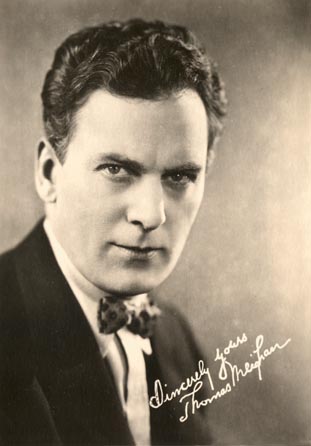
Thomas Meighan
Thomas Meighan (April 9, 1879 – July 8, 1936) was an American actor of silent films and early talkies. He played several leading-man roles opposite popular actresses of the day, including Mary Pickford and Gloria Swanson. At one point he earned $10,000 per week.
Meighan was born to John and Mary Meighan in Pittsburgh, Pennsylvania. His father was the president of Pittsburgh Facing Mills, and his family was well-off.
Meighan's parents encouraged him to go to college but he refused. At the age of 15, his father sent him to work shoveling coal, in an effort to instill a sense of discipline and a strong work ethic. After his experience with manual labor, he attended Mount St. Mary's College to study pharmacology. After three years of study, Meighan decided he wished to pursue acting. This decision ultimately resulted in a career in both theatre and the emerging film industry.
After dropping out of college in 1896, Meighan became a juvenile player in the Pittsburgh Stock Company headed by Henrietta Crosman. He was paid $35 per week. This early experience in theatre provided him with the skills and discipline that would benefit his later work.
Meighan first appeared on Broadway in 1900, and four years later appeared in The Two Orphans. His breakthrough role came in 1908 when he appeared with William Collier Sr. in The Dictator; this play was followed by a leading role in The College Widow, which had a successful run on Broadway in the 1907–1908 season. During this run, he met his wife Frances Ring.
Despite his film career, Meighan remained devoted to the theatre during his life.
In 1914, he entered motion pictures, at that time still in their infancy. His first film, shot in London, was titled Dandy Donovan, the Gentleman Cracksman. This led to a contract with Famous Players–Lasky. His first U.S. film, in 1915, was The Fighting Hope. During the next two years, Meighan's career took off. In 1918, he made a propaganda film for World War I, titled Norma Talmadge and Thomas Meighan in a Liberty Loan Appeal. He then played opposite Mary Pickford in M'Liss.
Meighan achieved stardom in 1919. One of his better-known films of the period was that year's The Miracle Man, which featured Lon Chaney Sr.; it is now believed to be lost except for brief clips. This was followed with Cecil B. DeMille's Male and Female, which starred him with Gloria Swanson and Lila Lee. Most of that film's cast returned for the 1920 film Why Change Your Wife?, which co-starred Bebe Daniels. In April 1925, Meighan and Swanson produced a short film directed by Allan Dwan for the annual "Spring Gambol" for The Lambs. This film (sometimes known as Gloria Swanson Dialogue), made in Lee DeForest's sound-on-film Phonofilm process, was made as a joke for the live event, showing Swanson trying to crash the all-male club.
Hub AI
Thomas Meighan AI simulator
(@Thomas Meighan_simulator)
Thomas Meighan
Thomas Meighan (April 9, 1879 – July 8, 1936) was an American actor of silent films and early talkies. He played several leading-man roles opposite popular actresses of the day, including Mary Pickford and Gloria Swanson. At one point he earned $10,000 per week.
Meighan was born to John and Mary Meighan in Pittsburgh, Pennsylvania. His father was the president of Pittsburgh Facing Mills, and his family was well-off.
Meighan's parents encouraged him to go to college but he refused. At the age of 15, his father sent him to work shoveling coal, in an effort to instill a sense of discipline and a strong work ethic. After his experience with manual labor, he attended Mount St. Mary's College to study pharmacology. After three years of study, Meighan decided he wished to pursue acting. This decision ultimately resulted in a career in both theatre and the emerging film industry.
After dropping out of college in 1896, Meighan became a juvenile player in the Pittsburgh Stock Company headed by Henrietta Crosman. He was paid $35 per week. This early experience in theatre provided him with the skills and discipline that would benefit his later work.
Meighan first appeared on Broadway in 1900, and four years later appeared in The Two Orphans. His breakthrough role came in 1908 when he appeared with William Collier Sr. in The Dictator; this play was followed by a leading role in The College Widow, which had a successful run on Broadway in the 1907–1908 season. During this run, he met his wife Frances Ring.
Despite his film career, Meighan remained devoted to the theatre during his life.
In 1914, he entered motion pictures, at that time still in their infancy. His first film, shot in London, was titled Dandy Donovan, the Gentleman Cracksman. This led to a contract with Famous Players–Lasky. His first U.S. film, in 1915, was The Fighting Hope. During the next two years, Meighan's career took off. In 1918, he made a propaganda film for World War I, titled Norma Talmadge and Thomas Meighan in a Liberty Loan Appeal. He then played opposite Mary Pickford in M'Liss.
Meighan achieved stardom in 1919. One of his better-known films of the period was that year's The Miracle Man, which featured Lon Chaney Sr.; it is now believed to be lost except for brief clips. This was followed with Cecil B. DeMille's Male and Female, which starred him with Gloria Swanson and Lila Lee. Most of that film's cast returned for the 1920 film Why Change Your Wife?, which co-starred Bebe Daniels. In April 1925, Meighan and Swanson produced a short film directed by Allan Dwan for the annual "Spring Gambol" for The Lambs. This film (sometimes known as Gloria Swanson Dialogue), made in Lee DeForest's sound-on-film Phonofilm process, was made as a joke for the live event, showing Swanson trying to crash the all-male club.