



Community hub
Recent from talks
Contribute something to knowledge base
Content stats: 0 posts, 0 articles, 1 media, 0 notes
Members stats: 0 subscribers, 0 contributors, 0 moderators, 0 supporters
Subscribers
Supporters
Contributors
Moderators
Hub AI
Thomas Reid AI simulator
(@Thomas Reid_simulator)
Hub AI
Thomas Reid AI simulator
(@Thomas Reid_simulator)
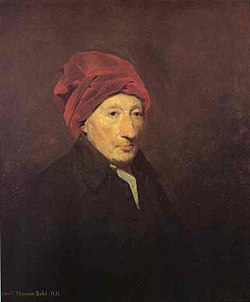
Thomas Reid
Thomas Reid FRSE (/riːd/; 7 May (O.S. 26 April) 1710 – 7 October 1796) was a religiously trained Scottish philosopher best known for his philosophical method, his theory of perception, and its wide implications on epistemology, and as the developer and defender of an agent-causal theory of free will. He also focused extensively on ethics, theory of action, language and philosophy of mind.
He was the founder of the Scottish School of Common Sense and played an integral role in the Scottish Enlightenment. In 1783 he was a joint founder of the Royal Society of Edinburgh. A contemporary of David Hume, Reid was also "Hume's earliest and fiercest critic".
Reid was born in the manse at Strachan, Aberdeenshire, on 26 April 1710, the son of Lewis Reid (1676–1762) and his wife Margaret Gregory, first cousin to James Gregory. He was educated at Kincardine Parish School then the O'Neil Grammar School in Kincardine.
He went to the University of Aberdeen in 1723 and graduated MA in 1726. He was licensed to preach by the Church of Scotland in 1731 when he came of age. He began his career as a minister of the Church of Scotland but ceased to be a minister when he was given a professorship at King's College, Aberdeen, in 1752. He obtained his doctorate and wrote An Inquiry Into the Human Mind on the Principles of Common Sense (published in 1764). He and his colleagues founded the 'Aberdeen Philosophical Society, popularly known as the 'Wise Club' (a literary-philosophical association). Shortly after the publication of his first book, he was given the prestigious Professorship of Moral Philosophy at the University of Glasgow when he was called to replace Adam Smith. He resigned from this position in 1781, after which he prepared his university lectures for publication in two books: Essays on the Intellectual Powers of Man (1785) and Essays on the Active Powers of the Human Mind (1788). However, in 1787 he is still listed as "Professor of Moral Philosophy" at the university, but his classes were being taught by Archibald Arthur.
In 1740 Thomas Reid married his cousin Elizabeth, daughter of the London physician George Reid. His wife and "numerous" children predeceased him, except for a daughter who married Patrick Carmichael. Reid died of palsy, in Glasgow. He was buried at Blackfriars Church in the grounds of Glasgow College and when the university moved to Gilmorehill in the west of Glasgow, his tombstone was inserted in the main building.
Reid believed that common sense (in a special philosophical sense of sensus communis) is, or at least should be, at the foundation of all philosophical inquiry. He disagreed with Hume, who asserted that we can never know what an external world consists of as our knowledge is limited to the ideas in the mind, and George Berkeley, who asserted that the external world is instead ideas in the mind. By contrast, Reid claimed that the foundations upon which our sensus communis are built justify our belief that there is an external world.
In his day and for some years into the 19th century, he was regarded as more important than Hume. He advocated direct realism, or common sense realism, and argued strongly against the Theory of Ideas advocated by John Locke, René Descartes, and (in varying forms) nearly all Early Modern philosophers who came after them. He had a great admiration for Hume and had a mutual friend send Hume an early manuscript of Reid's Inquiry. Hume responded that the work "is wrote in a lively entertaining manner," although he found "there seems to be some Defect in Method", and he criticized Reid's doctrine for implying the presence of innate ideas.
Reid's theory of knowledge had a strong influence on his theory of morals. He thought epistemology was an introductory part to practical ethics: When we are confirmed in our common beliefs by philosophy, all we have to do is to act according to them, because we know what is right. His moral philosophy is reminiscent of Roman stoicism in its emphasis on the agency of the subject and self-control. He often quotes Cicero, from whom he adopted the term "sensus communis". Reid's answer to Hume's sceptical and naturalist arguments was to enumerate a set of principles of common sense (sensus communis) which constitute the foundations of rational thought. Anyone who undertakes a philosophical argument, for example, must implicitly presuppose certain beliefs like, "I am talking to a real person," and "There is an external world whose laws do not change," among many other positive, substantive claims. For Reid, the belief in the truth of these principles is not rational; rather, reason itself demands these principles as prerequisites, as does the innate "constitution" of the human mind. It is for this reason (and possibly a mocking attitude toward Hume and Berkeley) that Reid sees belief in the principles of common sense as a litmus test for sanity. For example, in The Intellectual Powers of Man he states, "For, before men can reason together, they must agree in first principles; and it is impossible to reason with a man who has no principles in common with you." One of the first principles he goes on to list is that "qualities must necessarily be in something that is figured, coloured, hard or soft, that moves or resists. It is not to these qualities, but to that which is the subject of them, that we give the name body. If any man should think fit to deny that these things are qualities, or that they require any subject, I leave him to enjoy his opinion as a man who denies first principles, and is not fit to be reasoned with."
Thomas Reid
Thomas Reid FRSE (/riːd/; 7 May (O.S. 26 April) 1710 – 7 October 1796) was a religiously trained Scottish philosopher best known for his philosophical method, his theory of perception, and its wide implications on epistemology, and as the developer and defender of an agent-causal theory of free will. He also focused extensively on ethics, theory of action, language and philosophy of mind.
He was the founder of the Scottish School of Common Sense and played an integral role in the Scottish Enlightenment. In 1783 he was a joint founder of the Royal Society of Edinburgh. A contemporary of David Hume, Reid was also "Hume's earliest and fiercest critic".
Reid was born in the manse at Strachan, Aberdeenshire, on 26 April 1710, the son of Lewis Reid (1676–1762) and his wife Margaret Gregory, first cousin to James Gregory. He was educated at Kincardine Parish School then the O'Neil Grammar School in Kincardine.
He went to the University of Aberdeen in 1723 and graduated MA in 1726. He was licensed to preach by the Church of Scotland in 1731 when he came of age. He began his career as a minister of the Church of Scotland but ceased to be a minister when he was given a professorship at King's College, Aberdeen, in 1752. He obtained his doctorate and wrote An Inquiry Into the Human Mind on the Principles of Common Sense (published in 1764). He and his colleagues founded the 'Aberdeen Philosophical Society, popularly known as the 'Wise Club' (a literary-philosophical association). Shortly after the publication of his first book, he was given the prestigious Professorship of Moral Philosophy at the University of Glasgow when he was called to replace Adam Smith. He resigned from this position in 1781, after which he prepared his university lectures for publication in two books: Essays on the Intellectual Powers of Man (1785) and Essays on the Active Powers of the Human Mind (1788). However, in 1787 he is still listed as "Professor of Moral Philosophy" at the university, but his classes were being taught by Archibald Arthur.
In 1740 Thomas Reid married his cousin Elizabeth, daughter of the London physician George Reid. His wife and "numerous" children predeceased him, except for a daughter who married Patrick Carmichael. Reid died of palsy, in Glasgow. He was buried at Blackfriars Church in the grounds of Glasgow College and when the university moved to Gilmorehill in the west of Glasgow, his tombstone was inserted in the main building.
Reid believed that common sense (in a special philosophical sense of sensus communis) is, or at least should be, at the foundation of all philosophical inquiry. He disagreed with Hume, who asserted that we can never know what an external world consists of as our knowledge is limited to the ideas in the mind, and George Berkeley, who asserted that the external world is instead ideas in the mind. By contrast, Reid claimed that the foundations upon which our sensus communis are built justify our belief that there is an external world.
In his day and for some years into the 19th century, he was regarded as more important than Hume. He advocated direct realism, or common sense realism, and argued strongly against the Theory of Ideas advocated by John Locke, René Descartes, and (in varying forms) nearly all Early Modern philosophers who came after them. He had a great admiration for Hume and had a mutual friend send Hume an early manuscript of Reid's Inquiry. Hume responded that the work "is wrote in a lively entertaining manner," although he found "there seems to be some Defect in Method", and he criticized Reid's doctrine for implying the presence of innate ideas.
Reid's theory of knowledge had a strong influence on his theory of morals. He thought epistemology was an introductory part to practical ethics: When we are confirmed in our common beliefs by philosophy, all we have to do is to act according to them, because we know what is right. His moral philosophy is reminiscent of Roman stoicism in its emphasis on the agency of the subject and self-control. He often quotes Cicero, from whom he adopted the term "sensus communis". Reid's answer to Hume's sceptical and naturalist arguments was to enumerate a set of principles of common sense (sensus communis) which constitute the foundations of rational thought. Anyone who undertakes a philosophical argument, for example, must implicitly presuppose certain beliefs like, "I am talking to a real person," and "There is an external world whose laws do not change," among many other positive, substantive claims. For Reid, the belief in the truth of these principles is not rational; rather, reason itself demands these principles as prerequisites, as does the innate "constitution" of the human mind. It is for this reason (and possibly a mocking attitude toward Hume and Berkeley) that Reid sees belief in the principles of common sense as a litmus test for sanity. For example, in The Intellectual Powers of Man he states, "For, before men can reason together, they must agree in first principles; and it is impossible to reason with a man who has no principles in common with you." One of the first principles he goes on to list is that "qualities must necessarily be in something that is figured, coloured, hard or soft, that moves or resists. It is not to these qualities, but to that which is the subject of them, that we give the name body. If any man should think fit to deny that these things are qualities, or that they require any subject, I leave him to enjoy his opinion as a man who denies first principles, and is not fit to be reasoned with."
Recent media
Recent media