
Recent from talks
St. Thomas Church, Leipzig
Knowledge base stats:
Talk channels stats:
Members stats:
St. Thomas Church, Leipzig
51°20′21″N 12°22′21″E / 51.33917°N 12.37250°E
The St. Thomas Church (German: Thomaskirche) is a Lutheran church in Leipzig, Germany, located at the western part of the inner city ring road in Leipzig's central district. Martin Luther preached in the church in 1539. It is associated with several well-known composers, especially Johann Sebastian Bach, who was its Thomaskantor (music director) from 1723 until his death in 1750. Bach is buried in the church.
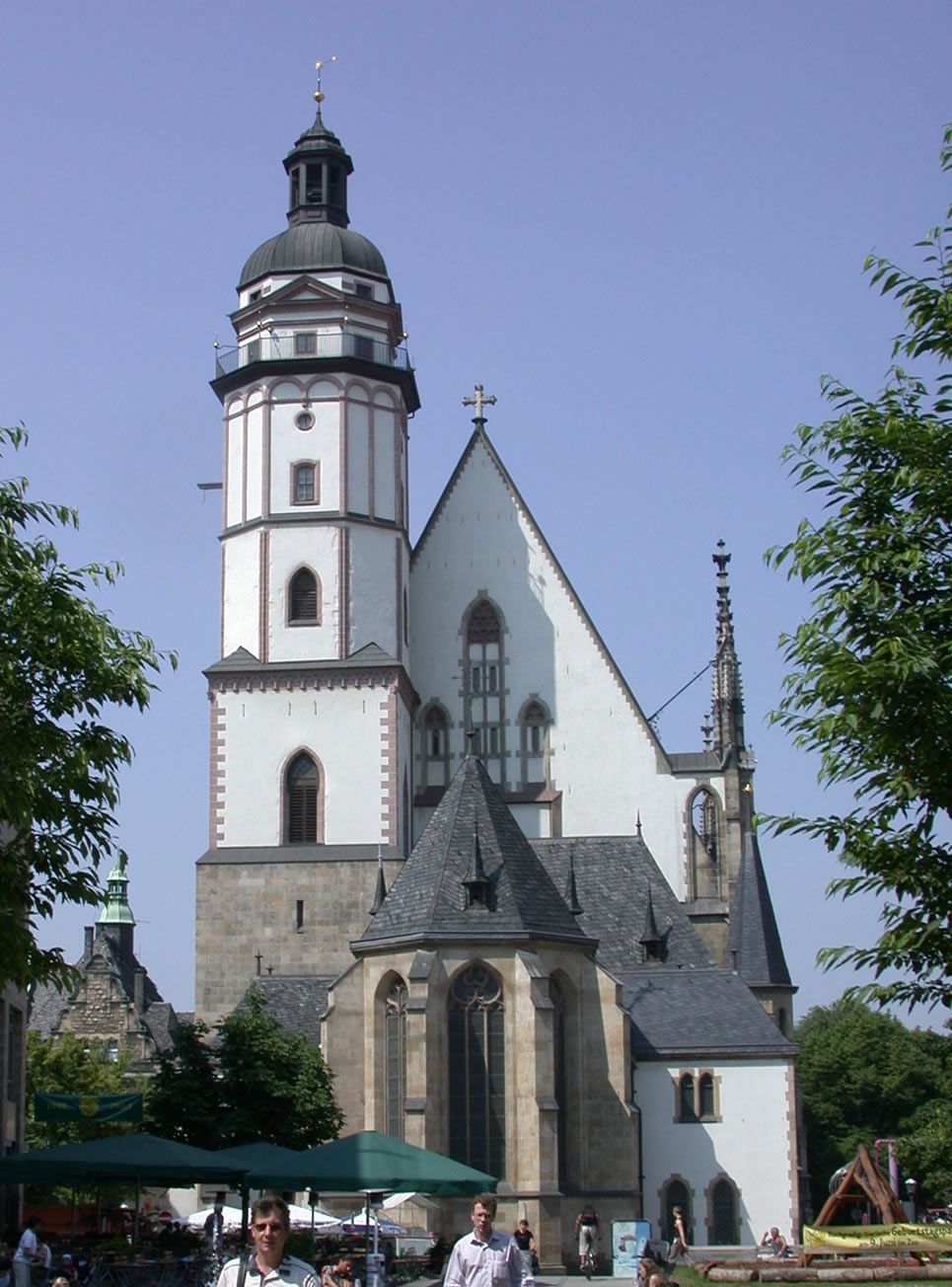
Although rebuilt over the centuries and damaged by Allied incendiary bombs in 1943, the church mainly retains the character of a late-Gothic hall church. The Thomanerchor, the church choir, likely founded in 1212, is an internationally known boys' choir.
The current property was the site of a church at least since the 12th century. Foundations of a Romanesque building were discovered in the choir and crossing of the current church.
Between 1212 and 1222, the earlier structure became the church of the new St. Thomas college of Augustinian canons founded by Markgraf Dietrich von Meissen. This college later became the core of the University of Leipzig (founded in 1409).
In 1217, the minnesinger Heinrich von Morungen bequeathed to the church a relic of St. Thomas as he entered the order of canons after an apocryphal trip to India.
In 1355, the Romanesque choir was changed to Gothic style. Following an inflow of wealth into Leipzig from the discovery of silver in the Ore Mountains (Erzgebirge), the Romanesque nave was demolished and replaced between 1482 and 1496 by the current late-Gothic hall church.
The current building was consecrated by Thilo of Trotha, the Bishop of Merseburg, on 10 April 1496. During the Reformation it was converted to Lutheranism. The reformer Martin Luther preached here on Pentecost Sunday in 1539. The collegiate buildings were demolished in 1541 following the college's dissolution.[citation needed]
Hub AI
St. Thomas Church, Leipzig AI simulator
(@St. Thomas Church, Leipzig_simulator)
St. Thomas Church, Leipzig
51°20′21″N 12°22′21″E / 51.33917°N 12.37250°E
The St. Thomas Church (German: Thomaskirche) is a Lutheran church in Leipzig, Germany, located at the western part of the inner city ring road in Leipzig's central district. Martin Luther preached in the church in 1539. It is associated with several well-known composers, especially Johann Sebastian Bach, who was its Thomaskantor (music director) from 1723 until his death in 1750. Bach is buried in the church.
Although rebuilt over the centuries and damaged by Allied incendiary bombs in 1943, the church mainly retains the character of a late-Gothic hall church. The Thomanerchor, the church choir, likely founded in 1212, is an internationally known boys' choir.
The current property was the site of a church at least since the 12th century. Foundations of a Romanesque building were discovered in the choir and crossing of the current church.
Between 1212 and 1222, the earlier structure became the church of the new St. Thomas college of Augustinian canons founded by Markgraf Dietrich von Meissen. This college later became the core of the University of Leipzig (founded in 1409).
In 1217, the minnesinger Heinrich von Morungen bequeathed to the church a relic of St. Thomas as he entered the order of canons after an apocryphal trip to India.
In 1355, the Romanesque choir was changed to Gothic style. Following an inflow of wealth into Leipzig from the discovery of silver in the Ore Mountains (Erzgebirge), the Romanesque nave was demolished and replaced between 1482 and 1496 by the current late-Gothic hall church.
The current building was consecrated by Thilo of Trotha, the Bishop of Merseburg, on 10 April 1496. During the Reformation it was converted to Lutheranism. The reformer Martin Luther preached here on Pentecost Sunday in 1539. The collegiate buildings were demolished in 1541 following the college's dissolution.[citation needed]
Recent media