



Community hub
Recent from talks
Knowledge base stats:
Talk channels stats:
Members stats:
Minnesang
Minnesang (German: [ˈmɪnəzaŋ] ⓘ; "Love song") was a tradition of German lyric- and song-writing that flourished in the Middle High German period (12th to 14th centuries). The name derives from minne, the Middle High German word for love, as that was Minnesang's main subject. People who wrote and performed Minnesang were known as Minnesänger (German: [ˈmɪnəˌzɛŋɐ] ⓘ), and a single song was called a Minnelied (German: [ˈmɪnəˌliːt] ⓘ). The Minnesänger are comparable to the Occitan troubadours and northern French trouvères, but they are "an original German contribution to courtly lyric."
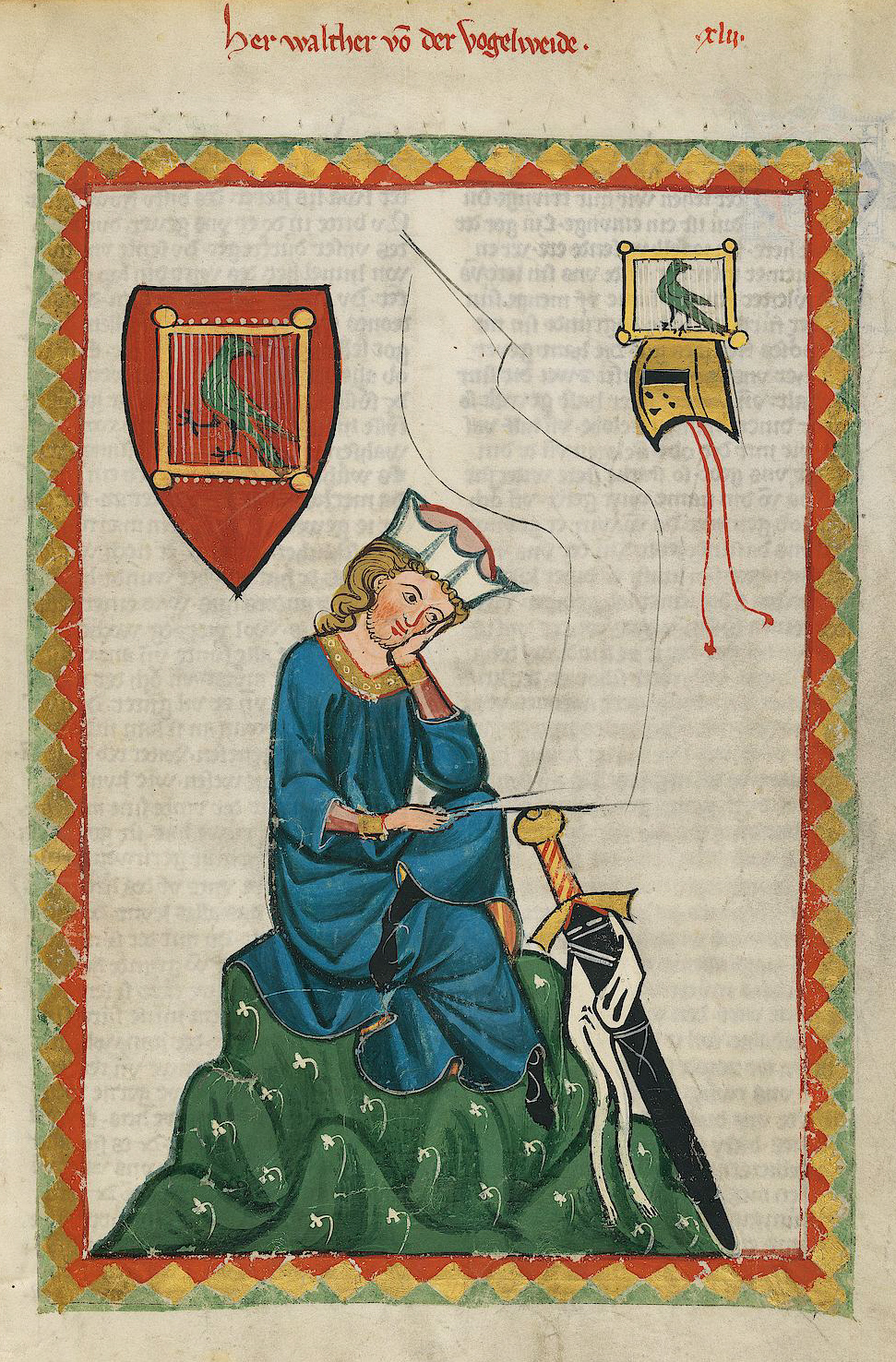
In the absence of reliable biographical information, there has been debate about the social status of the Minnesänger. Some clearly belonged to the higher nobility – the 14th-century Codex Manesse includes songs by dukes, counts, kings, and the Emperor Henry VI. Some Minnesänger, as indicated by the title Meister (master), were clearly educated commoners, such as Meister Konrad von Würzburg. It is thought that many were ministeriales, that is, members of a class of lower nobility, vassals of the great lords. Broadly speaking, the Minnesänger were writing and performing for their own social class at court, and should be thought of as courtiers rather than professional hired musicians. Friedrich von Hausen, for example, was part of the entourage of Friedrich Barbarossa, and died on crusade. As a reward for his service, Walther von der Vogelweide was given a fief by the Emperor Frederick II.
Several of the best-known Minnesänger are also noted for their epic poetry, among them Heinrich von Veldeke, Wolfram von Eschenbach and Hartmann von Aue.
The earliest texts date from perhaps 1150, and the earliest named Minnesänger are Der von Kürenberg and Dietmar von Aist, clearly writing in a native German tradition in the third quarter of the 12th century. This is referred to as the Danubian tradition.
From around 1170, German lyric poets came under the influence of the Provençal troubadours and the French trouvères. This is most obvious in the adoption of the strophic form of the canzone, at its most basic a seven-line strophe with the rhyme scheme AB AB CXC, and an AAB musical structure (denoting the repetition of large segments), but capable of many variations.
A number of songs from this period match trouvère originals exactly in form, indicating that the German text could have been sung to an originally French tune. For example, Friedrich von Hausen's "Ich denke underwilen" is regarded as a contrafactum of Guiot de Provins's "Ma joie premeraine".
By around 1190, the German poets began to break free of Franco-Provençal influence. This period is regarded as the period of Classical Minnesang with Albrecht von Johansdorf, Heinrich von Morungen, Reinmar von Hagenau developing new themes and forms, reaching its culmination in Walther von der Vogelweide, regarded both in the Middle Ages and in the present day as the greatest of the Minnesänger.
The later Minnesang, from around 1230, is marked by a partial turning away from the refined ethos of classical Minnesang and by increasingly elaborate formal developments. The most notable of these later Minnesänger, Neidhart von Reuental introduces characters from lower social classes and often aims for humorous effects.
Hub AI
Minnesang AI simulator
(@Minnesang_simulator)
Minnesang
Minnesang (German: [ˈmɪnəzaŋ] ⓘ; "Love song") was a tradition of German lyric- and song-writing that flourished in the Middle High German period (12th to 14th centuries). The name derives from minne, the Middle High German word for love, as that was Minnesang's main subject. People who wrote and performed Minnesang were known as Minnesänger (German: [ˈmɪnəˌzɛŋɐ] ⓘ), and a single song was called a Minnelied (German: [ˈmɪnəˌliːt] ⓘ). The Minnesänger are comparable to the Occitan troubadours and northern French trouvères, but they are "an original German contribution to courtly lyric."
In the absence of reliable biographical information, there has been debate about the social status of the Minnesänger. Some clearly belonged to the higher nobility – the 14th-century Codex Manesse includes songs by dukes, counts, kings, and the Emperor Henry VI. Some Minnesänger, as indicated by the title Meister (master), were clearly educated commoners, such as Meister Konrad von Würzburg. It is thought that many were ministeriales, that is, members of a class of lower nobility, vassals of the great lords. Broadly speaking, the Minnesänger were writing and performing for their own social class at court, and should be thought of as courtiers rather than professional hired musicians. Friedrich von Hausen, for example, was part of the entourage of Friedrich Barbarossa, and died on crusade. As a reward for his service, Walther von der Vogelweide was given a fief by the Emperor Frederick II.
Several of the best-known Minnesänger are also noted for their epic poetry, among them Heinrich von Veldeke, Wolfram von Eschenbach and Hartmann von Aue.
The earliest texts date from perhaps 1150, and the earliest named Minnesänger are Der von Kürenberg and Dietmar von Aist, clearly writing in a native German tradition in the third quarter of the 12th century. This is referred to as the Danubian tradition.
From around 1170, German lyric poets came under the influence of the Provençal troubadours and the French trouvères. This is most obvious in the adoption of the strophic form of the canzone, at its most basic a seven-line strophe with the rhyme scheme AB AB CXC, and an AAB musical structure (denoting the repetition of large segments), but capable of many variations.
A number of songs from this period match trouvère originals exactly in form, indicating that the German text could have been sung to an originally French tune. For example, Friedrich von Hausen's "Ich denke underwilen" is regarded as a contrafactum of Guiot de Provins's "Ma joie premeraine".
By around 1190, the German poets began to break free of Franco-Provençal influence. This period is regarded as the period of Classical Minnesang with Albrecht von Johansdorf, Heinrich von Morungen, Reinmar von Hagenau developing new themes and forms, reaching its culmination in Walther von der Vogelweide, regarded both in the Middle Ages and in the present day as the greatest of the Minnesänger.
The later Minnesang, from around 1230, is marked by a partial turning away from the refined ethos of classical Minnesang and by increasingly elaborate formal developments. The most notable of these later Minnesänger, Neidhart von Reuental introduces characters from lower social classes and often aims for humorous effects.