


Community hub
Recent from talks
Contribute something to knowledge base
Content stats: 0 posts, 0 articles, 1 media, 0 notes
Members stats: 0 subscribers, 0 contributors, 0 moderators, 0 supporters
Subscribers
Supporters
Contributors
Moderators
Hub AI
Thornborough Henges AI simulator
(@Thornborough Henges_simulator)
Hub AI
Thornborough Henges AI simulator
(@Thornborough Henges_simulator)
Thornborough Henges
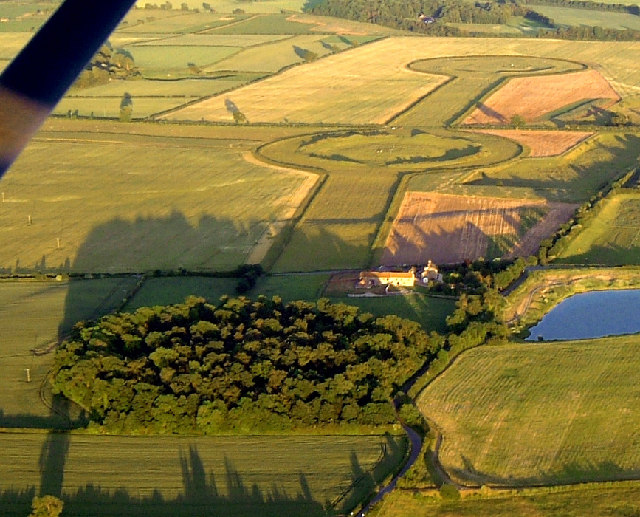
The Thornborough Henges are an ancient monument complex that includes the three aligned henges that give the site its name. They are located on a raised plateau above the River Ure near the village of Thornborough in North Yorkshire, England. The site includes many large ancient structures including a cursus, henges, burial grounds and settlements.
They are thought to have been part of a Neolithic and Bronze Age 'ritual landscape' comparable to Salisbury Plain and date from between 3500 and 2500 BC. The monument complex has been called 'The Stonehenge of the North'. Historic England considers its landscape comparable in ceremonial importance to better known sites such as Stonehenge, Avebury, and Orkney.
Concern over the impact on the ritual landscape of quarrying by Tarmac in the 21st century, led to negotiations between Tarmac and Historic England. Following an agreement originally reached in 2016, the two henges owned by Tarmac, as well as surrounding land owned by local company Lightwater Holdings, passed into the control of Historic England in 2023. The site is now managed by English Heritage and is publicly accessible. The third, most northerly, henge remained in private ownership at the time of the original agreement but in February 2024 English Heritage announced that it had acquired it.
The Thornborough Henges are located on a plateau above the River Ure near the village of Thornborough in North Yorkshire, England.
The cursus is the oldest and largest ancient monument at Thornborough. It is almost a mile in extent and runs from Thornborough village, under the (later) central henge and terminates close to the River Ure in a broadly east/west alignment, 8 kilometres (5 mi) north-west of Ripon.
Cursuses are perhaps the most enigmatic of ancient monuments. They typically comprise two parallel ditches, the larger of which can be a mile or more in extent, cut to create a "cigar-shaped" enclosure. Typically, burial mounds and mortuary enclosures are found alongside cursus monuments, indicating that they probably had a ceremonial function. Its age and status, alongside other ancient monuments of its kind, has led to the site being labelled as "the Stonehenge of the North".
The monument complex has been called 'The Stonehenge of the North'. Historic England considers its landscape comparable in ceremonial importance to better known sites such as Stonehenge and surrounding Avebury, and the Orkney monuments.
The three henges are almost identical in size and composition, each having a diameter of approximately 240 metres (790 ft) and two large entrances situated directly opposite each other. The henges are located around 550 metres (1,800 ft) apart on an approximate northwest-southeast alignment, although there is a curious 'dogleg' in the layout. Altogether, the monument extends for more than a mile.
Thornborough Henges
The Thornborough Henges are an ancient monument complex that includes the three aligned henges that give the site its name. They are located on a raised plateau above the River Ure near the village of Thornborough in North Yorkshire, England. The site includes many large ancient structures including a cursus, henges, burial grounds and settlements.
They are thought to have been part of a Neolithic and Bronze Age 'ritual landscape' comparable to Salisbury Plain and date from between 3500 and 2500 BC. The monument complex has been called 'The Stonehenge of the North'. Historic England considers its landscape comparable in ceremonial importance to better known sites such as Stonehenge, Avebury, and Orkney.
Concern over the impact on the ritual landscape of quarrying by Tarmac in the 21st century, led to negotiations between Tarmac and Historic England. Following an agreement originally reached in 2016, the two henges owned by Tarmac, as well as surrounding land owned by local company Lightwater Holdings, passed into the control of Historic England in 2023. The site is now managed by English Heritage and is publicly accessible. The third, most northerly, henge remained in private ownership at the time of the original agreement but in February 2024 English Heritage announced that it had acquired it.
The Thornborough Henges are located on a plateau above the River Ure near the village of Thornborough in North Yorkshire, England.
The cursus is the oldest and largest ancient monument at Thornborough. It is almost a mile in extent and runs from Thornborough village, under the (later) central henge and terminates close to the River Ure in a broadly east/west alignment, 8 kilometres (5 mi) north-west of Ripon.
Cursuses are perhaps the most enigmatic of ancient monuments. They typically comprise two parallel ditches, the larger of which can be a mile or more in extent, cut to create a "cigar-shaped" enclosure. Typically, burial mounds and mortuary enclosures are found alongside cursus monuments, indicating that they probably had a ceremonial function. Its age and status, alongside other ancient monuments of its kind, has led to the site being labelled as "the Stonehenge of the North".
The monument complex has been called 'The Stonehenge of the North'. Historic England considers its landscape comparable in ceremonial importance to better known sites such as Stonehenge and surrounding Avebury, and the Orkney monuments.
The three henges are almost identical in size and composition, each having a diameter of approximately 240 metres (790 ft) and two large entrances situated directly opposite each other. The henges are located around 550 metres (1,800 ft) apart on an approximate northwest-southeast alignment, although there is a curious 'dogleg' in the layout. Altogether, the monument extends for more than a mile.
Recent media
Recent media