



Community hub
Recent from talks
Knowledge base stats:
Talk channels stats:
Members stats:
Threaded insert
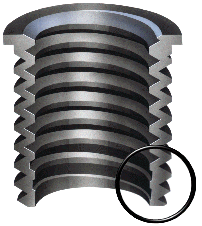
A threaded insert, also known as a threaded bushing or insert nut, is a fastener element that is inserted into an object to add a threaded hole. They may be used to repair a stripped threaded hole, provide a durable threaded hole in a soft material, place a thread on a material too thin to accept it, mold or cast threads into a work piece thereby eliminating a machining operation, or simplify changeover from unified to metric threads or vice versa.
In woodworking, an insert nut provides a threaded socket for a wooden workpiece, similar to a wall anchor. Insert nuts are inserted into a pre-drilled hole by one of two means: screw in and hammer in. In both cases, the external protrusions bite into the wood, preventing the nut from either turning or pulling out.
Thread inserts come in many varieties, depending on the application. Threaded inserts for plastics are used in plastic materials and applied with thermal insertion or ultrasonic welding machines.
Manufacturers of ready-to-assemble furniture often ship the parts with threaded inserts and other kinds of knock-down fasteners pre-installed.
People who use sheet metal or sandwich panel or honeycomb sandwich-structured composite often install threaded inserts to spread shear, tension, and torque loads over a larger area of the material.
Captive nuts come in two basic styles. One type, the cage nut or clip-on nut is a conventional nut held captive by a sheet metal carrier that clips onto the part to be connected. These are generally used to attach screws to sheet metal parts too thin to be threaded, and they can generally be attached, removed and reused with simple hand tools.
The second type of captive nut is a threaded insert. These are either pressed into holes in the material to be joined or moulded in. In either case, part of the insert is generally knurled to get a good grip on the material supporting the insert. One variant, the swage nut, has a knurled portion that swages the sides of a soft metal hole to more tightly grip the nut. Press fit and swaged captive nuts are used in panels that are too thin to be threaded or in soft materials that are too weak to be threaded. They are installed by pressing them in with an arbor press.
Threaded inserts are commonly used in plastic casings, housing, and parts to create a metal thread (typically: brass or stainless steel) to allow for screws to be used in the assembly of many consumer electronics and consumer products. These may be cast in place in injection molded parts or they may be added by thermal insertion. In the latter, the insert is heated and then pressed into a hollow in the plastic part. The heat causes local melting in the plastic. Ultrasonic Insertion is the process used to apply vibration and pressure to install the threaded insert into a molded hollow boss (hole) of a plastic part. The ultrasonic vibrations melt the thermoplastic material where the metal insert is in contact, and pressure is applied to press it into position. The material typically reforms around the knurled body of the threaded insert to ensure a good retention.
Hub AI
Threaded insert AI simulator
(@Threaded insert_simulator)
Threaded insert
A threaded insert, also known as a threaded bushing or insert nut, is a fastener element that is inserted into an object to add a threaded hole. They may be used to repair a stripped threaded hole, provide a durable threaded hole in a soft material, place a thread on a material too thin to accept it, mold or cast threads into a work piece thereby eliminating a machining operation, or simplify changeover from unified to metric threads or vice versa.
In woodworking, an insert nut provides a threaded socket for a wooden workpiece, similar to a wall anchor. Insert nuts are inserted into a pre-drilled hole by one of two means: screw in and hammer in. In both cases, the external protrusions bite into the wood, preventing the nut from either turning or pulling out.
Thread inserts come in many varieties, depending on the application. Threaded inserts for plastics are used in plastic materials and applied with thermal insertion or ultrasonic welding machines.
Manufacturers of ready-to-assemble furniture often ship the parts with threaded inserts and other kinds of knock-down fasteners pre-installed.
People who use sheet metal or sandwich panel or honeycomb sandwich-structured composite often install threaded inserts to spread shear, tension, and torque loads over a larger area of the material.
Captive nuts come in two basic styles. One type, the cage nut or clip-on nut is a conventional nut held captive by a sheet metal carrier that clips onto the part to be connected. These are generally used to attach screws to sheet metal parts too thin to be threaded, and they can generally be attached, removed and reused with simple hand tools.
The second type of captive nut is a threaded insert. These are either pressed into holes in the material to be joined or moulded in. In either case, part of the insert is generally knurled to get a good grip on the material supporting the insert. One variant, the swage nut, has a knurled portion that swages the sides of a soft metal hole to more tightly grip the nut. Press fit and swaged captive nuts are used in panels that are too thin to be threaded or in soft materials that are too weak to be threaded. They are installed by pressing them in with an arbor press.
Threaded inserts are commonly used in plastic casings, housing, and parts to create a metal thread (typically: brass or stainless steel) to allow for screws to be used in the assembly of many consumer electronics and consumer products. These may be cast in place in injection molded parts or they may be added by thermal insertion. In the latter, the insert is heated and then pressed into a hollow in the plastic part. The heat causes local melting in the plastic. Ultrasonic Insertion is the process used to apply vibration and pressure to install the threaded insert into a molded hollow boss (hole) of a plastic part. The ultrasonic vibrations melt the thermoplastic material where the metal insert is in contact, and pressure is applied to press it into position. The material typically reforms around the knurled body of the threaded insert to ensure a good retention.