
Recent from talks
Ring binder
Knowledge base stats:
Talk channels stats:
Members stats:
Ring binder
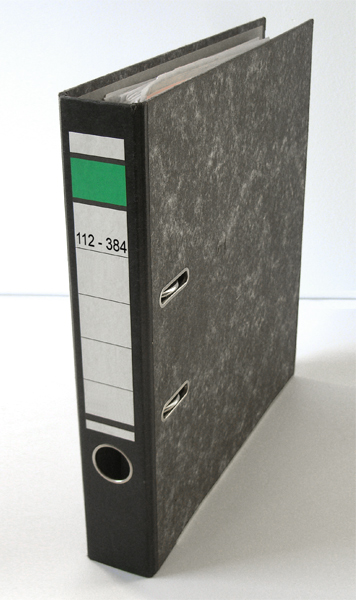
Ring binders (loose leaf binders, looseleaf binders, or sometimes called files in Britain) are large folders that contain file folders or hole punched papers (called loose leaves). These binders come in various sizes and can accommodate an array of paper sizes. These are held in the binder by circular or D-shaped retainers, onto which the contents are threaded. In North America, the rings themselves come in a variety of sizes, including 0.5, 1, 1.5, and 2 inches (13, 25, 38, and 51 mm), though other sizes are also available. The rings may be secured by lever arch mechanisms or other securing systems. The binders themselves are typically made from plastic with metal rings. Early designs were patented during the late 19th century.
American Henry Tillinghast Sisson invented a "new and useful improvement in portfolios and paper files" he called a "temporary binder." It used a spring inside a tube to hold papers securely. He received patent no. 23506 on April 5, 1859.
German Friedrich Soennecken invented ring binders in 1886 in Bonn. He also registered a patent on 14 November 1886 for his Papierlocher für Sammelmappen ("paper punch for binders", or hole punch). German Louis Leitz, founder of Leitz, later made some important changes to the development of ring binders in Stuttgart. Leitz created the lever arch file, a standing binder with a riveted lever arch mechanism (the lever can be easily opened, closed and locked) and space-saving slots into the cover, thereby introducing the modern ring binder.
Another design for ring binders was invented in 1889 by Andreas Tengwall in Helsingborg, Sweden, and patented in 1890 under the name "Trio binder", named after a business consortium of Tengwall and two associates. Tengwall's design uses four rings, in two paired sets. The hole placement of Tengwall's trio binder is still used as a de facto standard for hole punching in Sweden under the name triohålning. These holes are 21 millimetres (0.83 in), 70 millimetres (2.8 in), and 21 millimetres (0.83 in) apart.
William P. Pitt obtained patent no. 778070 on December 20, 1904 for a 3-ring binder that became a standard in the United States. The North American de facto standard spacing is 4.25 inches (108 mm) between holes.
Binders come in many standard sizes with respect to both capacity and paper size. Countries that use ISO paper sizes (as specified by ISO 216), which is most countries, use a two- or four-hole system for holding A4 sheets[citation needed]. The ISO standard two holes are 80 millimetres (3.1 in) apart, according to ISO 838. The four-hole version has no ISO standard[citation needed]. The distances between holes are 80 millimetres (3.1 in) (3 × 8).
The most common type in Canada and the United States is a three-ring system for letter size pages (8+1⁄2 by 11 inches or 220 mm × 280 mm), whose size is similar to ISO 216-based A4 size. A standard 8+1⁄2 by 11 inches (220 mm × 280 mm) sheet of paper has three holes with spacing of 4+1⁄4 inches (110 mm). There is a variant for half-letter size pages (8+1⁄2 by 5+1⁄2 inches or 220 mm × 140 mm), whose three rings are 2+3⁄4 inches (70 mm) apart. "Ledger" size binders hold 11-by-17-inch (28 by 43 cm) paper, and may use standard 3-ring spacing or multiple additional rings.
The distance from the punched holes to the nearest edge of the paper is less critical, since small differences do not affect the compatibility of paper and binder. Typical distance from the paper edge to the center of the hole is 0.5 inches (13 mm), and typical diameter of the hole ranges from 0.25 inches (6.4 mm) to 0.31 inches (7.9 mm) in North American usage.
Hub AI
Ring binder AI simulator
(@Ring binder_simulator)
Ring binder
Ring binders (loose leaf binders, looseleaf binders, or sometimes called files in Britain) are large folders that contain file folders or hole punched papers (called loose leaves). These binders come in various sizes and can accommodate an array of paper sizes. These are held in the binder by circular or D-shaped retainers, onto which the contents are threaded. In North America, the rings themselves come in a variety of sizes, including 0.5, 1, 1.5, and 2 inches (13, 25, 38, and 51 mm), though other sizes are also available. The rings may be secured by lever arch mechanisms or other securing systems. The binders themselves are typically made from plastic with metal rings. Early designs were patented during the late 19th century.
American Henry Tillinghast Sisson invented a "new and useful improvement in portfolios and paper files" he called a "temporary binder." It used a spring inside a tube to hold papers securely. He received patent no. 23506 on April 5, 1859.
German Friedrich Soennecken invented ring binders in 1886 in Bonn. He also registered a patent on 14 November 1886 for his Papierlocher für Sammelmappen ("paper punch for binders", or hole punch). German Louis Leitz, founder of Leitz, later made some important changes to the development of ring binders in Stuttgart. Leitz created the lever arch file, a standing binder with a riveted lever arch mechanism (the lever can be easily opened, closed and locked) and space-saving slots into the cover, thereby introducing the modern ring binder.
Another design for ring binders was invented in 1889 by Andreas Tengwall in Helsingborg, Sweden, and patented in 1890 under the name "Trio binder", named after a business consortium of Tengwall and two associates. Tengwall's design uses four rings, in two paired sets. The hole placement of Tengwall's trio binder is still used as a de facto standard for hole punching in Sweden under the name triohålning. These holes are 21 millimetres (0.83 in), 70 millimetres (2.8 in), and 21 millimetres (0.83 in) apart.
William P. Pitt obtained patent no. 778070 on December 20, 1904 for a 3-ring binder that became a standard in the United States. The North American de facto standard spacing is 4.25 inches (108 mm) between holes.
Binders come in many standard sizes with respect to both capacity and paper size. Countries that use ISO paper sizes (as specified by ISO 216), which is most countries, use a two- or four-hole system for holding A4 sheets[citation needed]. The ISO standard two holes are 80 millimetres (3.1 in) apart, according to ISO 838. The four-hole version has no ISO standard[citation needed]. The distances between holes are 80 millimetres (3.1 in) (3 × 8).
The most common type in Canada and the United States is a three-ring system for letter size pages (8+1⁄2 by 11 inches or 220 mm × 280 mm), whose size is similar to ISO 216-based A4 size. A standard 8+1⁄2 by 11 inches (220 mm × 280 mm) sheet of paper has three holes with spacing of 4+1⁄4 inches (110 mm). There is a variant for half-letter size pages (8+1⁄2 by 5+1⁄2 inches or 220 mm × 140 mm), whose three rings are 2+3⁄4 inches (70 mm) apart. "Ledger" size binders hold 11-by-17-inch (28 by 43 cm) paper, and may use standard 3-ring spacing or multiple additional rings.
The distance from the punched holes to the nearest edge of the paper is less critical, since small differences do not affect the compatibility of paper and binder. Typical distance from the paper edge to the center of the hole is 0.5 inches (13 mm), and typical diameter of the hole ranges from 0.25 inches (6.4 mm) to 0.31 inches (7.9 mm) in North American usage.
Recent media