



Community hub
Recent from talks
Knowledge base stats:
Talk channels stats:
Members stats:
Hole punch
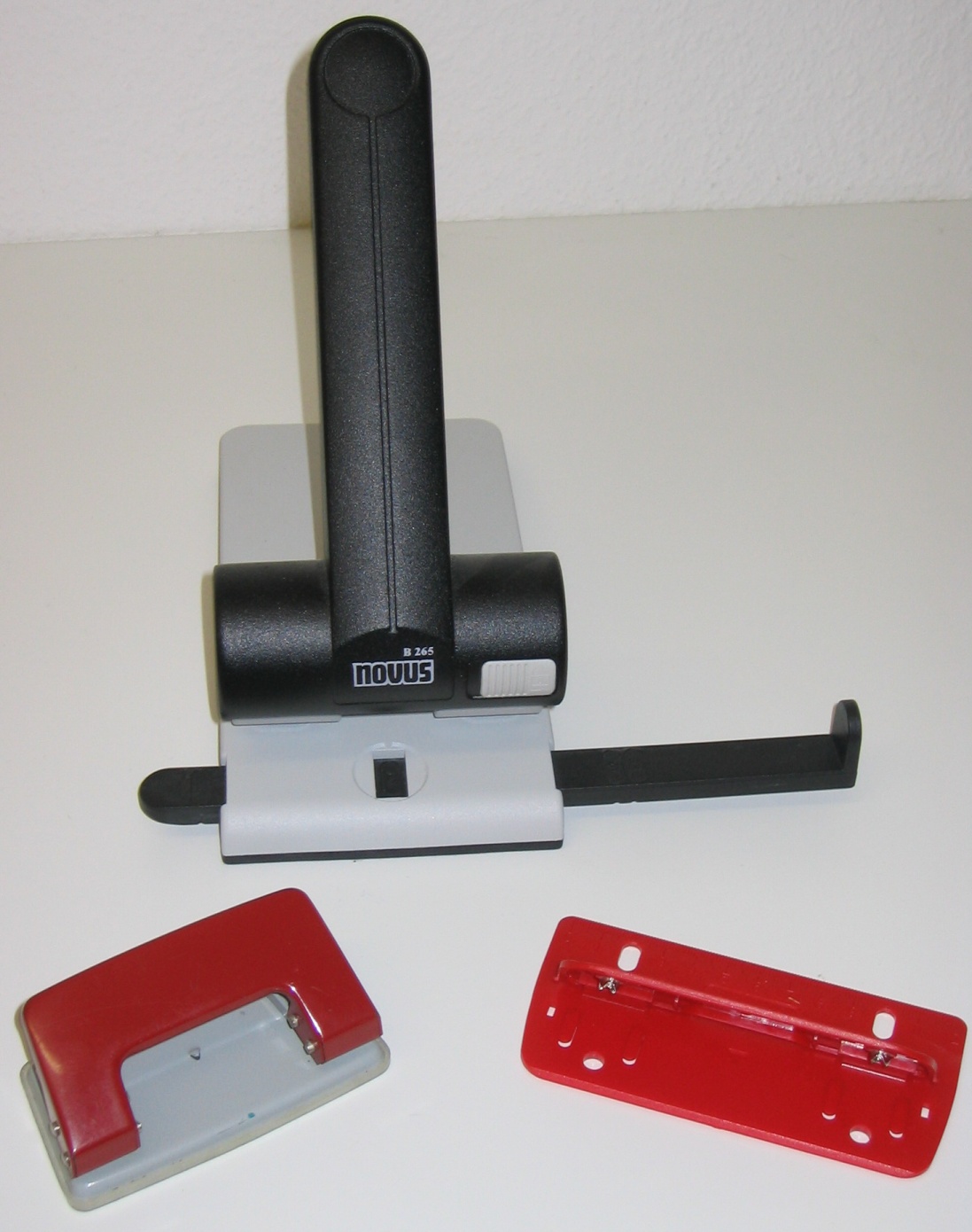
A hole punch, also known as a hole puncher or paper puncher, is an office tool that is used to create holes in sheets of paper, often for the purpose of collecting the sheets in a binder or folder (such collected sheets are called loose leaves). A hole punch can also refer to similar tools for other materials, such as leather, cloth, or sheets of plastic or metal.
The essential parts of a hole punch are the handle, the punch head, and the die. The punch head is typically a cylinder, with a flat end called the face. The die is a flat plate, with a hole matching the head. The head can move, while the die is fixed in place. Both head and die are usually made of a hard metal, with precise tolerances. One or more sheets of paper are inserted between the head and the die, with the flat face of the head parallel to the surface of the sheets. Moving the handle pushes the head straight through the sheets of paper. The hard edge of the punch vs the die cuts a hole in the paper, pushing the cut piece out the bottom of the die. The cut-out bit of paper scrap is called a chad.
The handle functions as a lever, decreasing the amount of force the operator needs to apply. The travel distance of the cylinder is generally very short—the thickness of the paper sheets—so the cylinder can be positioned close to the lever fulcrum. For low-volume hole punches, the resulting lever handle need not be more than 8 centimetres (3.1 in) long for sufficient force. Hole punches for larger volumes of paper (hundreds of sheets) feature longer lever arms, but function similarly.
There are hole punches which punch patterns of multiple holes at once, typically for binding multiple sheets together (see § Applications). Such punches generally feature two paper guides for alignment. One guide will be along the side of the paper to be punched, and sets the distance of the holes from the edge of the paper (the margin or gutter). The other guide will be on a perpendicular side, and aligns the holes between the top and bottom of the sheet. One or both guides may be adjustable.
On multiple-hole punches, the positions of individual punch heads may also be adjustable. Commonly, one or more punch heads are mounted in independent fittings, which can slide along a rail. A set screw holds each fitting in position. There may be marks on the device to identify standard hole positions. There may be positions where a punch head will not make contact with the activating handle, allowing holes to be "turned off".
Some punch designs use hollow punch heads (a thin-walled tube), with the edge a sharpened blade. This allows the chads to be pushed up and out the top, as the paper is being cut, making it more suitable for thicker volumes of paper. For very large amounts of paper, a paper drill may be used instead of a punch.
A single-hole punch makes a single hole per activation, usually at an arbitrary position (i.e., without alignment guides).
Single-hole punches are often used to punch an admission ticket or other document to indicate it has been used or processed. A specialized ticket punch may be used for this purpose. Some ticket punches have a longer reach/depth (allowing for a particular spot on the ticket to be punched), or punch a particular shape instead of a round hole.
Hub AI
Hole punch AI simulator
(@Hole punch_simulator)
Hole punch
A hole punch, also known as a hole puncher or paper puncher, is an office tool that is used to create holes in sheets of paper, often for the purpose of collecting the sheets in a binder or folder (such collected sheets are called loose leaves). A hole punch can also refer to similar tools for other materials, such as leather, cloth, or sheets of plastic or metal.
The essential parts of a hole punch are the handle, the punch head, and the die. The punch head is typically a cylinder, with a flat end called the face. The die is a flat plate, with a hole matching the head. The head can move, while the die is fixed in place. Both head and die are usually made of a hard metal, with precise tolerances. One or more sheets of paper are inserted between the head and the die, with the flat face of the head parallel to the surface of the sheets. Moving the handle pushes the head straight through the sheets of paper. The hard edge of the punch vs the die cuts a hole in the paper, pushing the cut piece out the bottom of the die. The cut-out bit of paper scrap is called a chad.
The handle functions as a lever, decreasing the amount of force the operator needs to apply. The travel distance of the cylinder is generally very short—the thickness of the paper sheets—so the cylinder can be positioned close to the lever fulcrum. For low-volume hole punches, the resulting lever handle need not be more than 8 centimetres (3.1 in) long for sufficient force. Hole punches for larger volumes of paper (hundreds of sheets) feature longer lever arms, but function similarly.
There are hole punches which punch patterns of multiple holes at once, typically for binding multiple sheets together (see § Applications). Such punches generally feature two paper guides for alignment. One guide will be along the side of the paper to be punched, and sets the distance of the holes from the edge of the paper (the margin or gutter). The other guide will be on a perpendicular side, and aligns the holes between the top and bottom of the sheet. One or both guides may be adjustable.
On multiple-hole punches, the positions of individual punch heads may also be adjustable. Commonly, one or more punch heads are mounted in independent fittings, which can slide along a rail. A set screw holds each fitting in position. There may be marks on the device to identify standard hole positions. There may be positions where a punch head will not make contact with the activating handle, allowing holes to be "turned off".
Some punch designs use hollow punch heads (a thin-walled tube), with the edge a sharpened blade. This allows the chads to be pushed up and out the top, as the paper is being cut, making it more suitable for thicker volumes of paper. For very large amounts of paper, a paper drill may be used instead of a punch.
A single-hole punch makes a single hole per activation, usually at an arbitrary position (i.e., without alignment guides).
Single-hole punches are often used to punch an admission ticket or other document to indicate it has been used or processed. A specialized ticket punch may be used for this purpose. Some ticket punches have a longer reach/depth (allowing for a particular spot on the ticket to be punched), or punch a particular shape instead of a round hole.