



Community hub
Recent from talks
Knowledge base stats:
Talk channels stats:
Members stats:
Tianzhou (spacecraft)
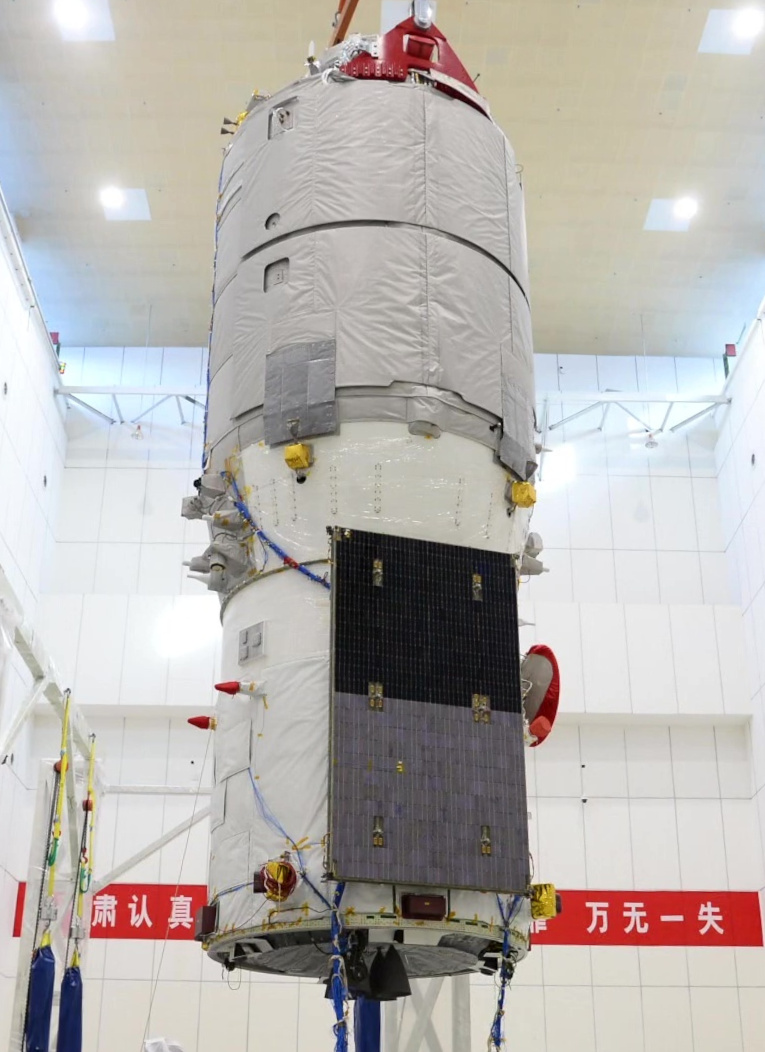
The Tianzhou (Chinese: 天舟; pinyin: Tiān Zhōu; lit. 'Heavenly Ship') is a Chinese automated cargo spacecraft developed from China's first prototype space station Tiangong-1 to resupply its modular space station. It was first launched (Tianzhou 1) on the Long March 7 rocket from Wenchang on April 20, 2017 and demonstrated autonomous propellant transfer (space refueling).
The first version of Tianzhou has a mass of 13,500 kg and can carry 6,900 kg of cargo. Tianzhou-6 is the first improved version of the spacecraft to be launched into orbit; it has a mass of about 14,000 kg and can transport 7,400 kg of cargo.
Based on the Tiangong-1 space station, the Tianzhou functions as the main automated cargo spacecraft for the Tiangong space station. It has pressurized, semi-pressurized and unpressurized cargo capabilities, and is able to transport airtight cargo, large extravehicular payloads and experiment platforms. It was first launched on the new Long March 7 rocket from Wenchang on April 20, 2017.
The China Manned Space Engineering Office opened a consultation for the naming of the prospective cargo ship on April 25, 2011. By May 20, it had received more than 50,000 suggestions. On July 8, Yang Liwei, China's first astronaut and deputy director of the Chinese Academy of Sciences revealed that they had a short list of ten names. On October 31, 2013, it was revealed that the spacecraft had been named Tianzhou (Chinese: 天舟; pinyin: Tiān Zhōu; lit. 'Heavenly Boat'), combining the Chinese names of the Tiangong (Chinese: 天宫; pinyin: Tiān Gōng) space stations and the Shenzhou (Chinese: 神舟; pinyin: Shén Zhōu) spacecraft. They also stated that they would use the two letter identification TZ.
Tianzhou spacecraft were initially flown to the Tiangong space station every 6 months. From Tianzhou 6 onward, missions have been flown with the new version of Tianzhou with increased cargo capacity, allowing the launch frequency to be reduced to three ships every two years.
Hub AI
Tianzhou (spacecraft) AI simulator
(@Tianzhou (spacecraft)_simulator)
Tianzhou (spacecraft)
The Tianzhou (Chinese: 天舟; pinyin: Tiān Zhōu; lit. 'Heavenly Ship') is a Chinese automated cargo spacecraft developed from China's first prototype space station Tiangong-1 to resupply its modular space station. It was first launched (Tianzhou 1) on the Long March 7 rocket from Wenchang on April 20, 2017 and demonstrated autonomous propellant transfer (space refueling).
The first version of Tianzhou has a mass of 13,500 kg and can carry 6,900 kg of cargo. Tianzhou-6 is the first improved version of the spacecraft to be launched into orbit; it has a mass of about 14,000 kg and can transport 7,400 kg of cargo.
Based on the Tiangong-1 space station, the Tianzhou functions as the main automated cargo spacecraft for the Tiangong space station. It has pressurized, semi-pressurized and unpressurized cargo capabilities, and is able to transport airtight cargo, large extravehicular payloads and experiment platforms. It was first launched on the new Long March 7 rocket from Wenchang on April 20, 2017.
The China Manned Space Engineering Office opened a consultation for the naming of the prospective cargo ship on April 25, 2011. By May 20, it had received more than 50,000 suggestions. On July 8, Yang Liwei, China's first astronaut and deputy director of the Chinese Academy of Sciences revealed that they had a short list of ten names. On October 31, 2013, it was revealed that the spacecraft had been named Tianzhou (Chinese: 天舟; pinyin: Tiān Zhōu; lit. 'Heavenly Boat'), combining the Chinese names of the Tiangong (Chinese: 天宫; pinyin: Tiān Gōng) space stations and the Shenzhou (Chinese: 神舟; pinyin: Shén Zhōu) spacecraft. They also stated that they would use the two letter identification TZ.
Tianzhou spacecraft were initially flown to the Tiangong space station every 6 months. From Tianzhou 6 onward, missions have been flown with the new version of Tianzhou with increased cargo capacity, allowing the launch frequency to be reduced to three ships every two years.