Hubbry Logo
Long March 7Long March 7Main
Open search
Long March 7
Community hub
Long March 7
logo
8 pages, 0 posts
0 subscribers
Be the first to start a discussion here.
Long March 7
Long March 7
from Wikipedia

Long March 7
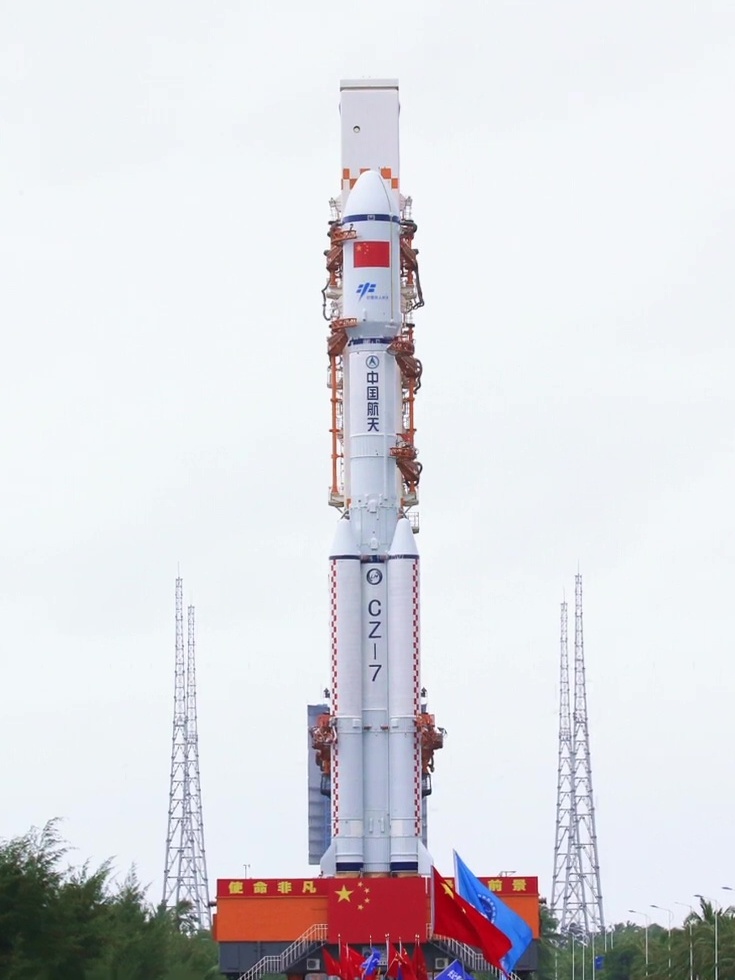
Long March 7 Y6 transporting to launch site
FunctionMedium to heavy-lift launch vehicle
ManufacturerChina Academy of Launch Vehicle Technology
Country of originChina
Size
Height
  • 7: 53.1 m (174 ft 3 in)
  • 7A: 60.13 m (197 ft 3 in)[1]
Diameter3.35 m (11 ft)
Mass
  • 7: 597,000 kg (1,316,000 lb)[2]
  • 7A: 573,000 kg (1,263,000 lb)[1]
Stages
Capacity
Payload to LEO
Altitude200 km × 400 km (120 mi × 250 mi)
Orbital inclination42°
Mass13,500 kg (29,800 lb)
Payload to GTO
Mass7,000 kg (15,000 lb)[3]
Payload to TLI
Mass5,000 kg (11,000 lb)
Payload to SSO
Altitude700 km (430 mi)
Mass5,500 kg (12,100 lb)
Associated rockets
FamilyLong March
Comparable
Launch history
StatusActive
Launch sitesWenchang, LC-2
Total launches24 (7: 10, 7A: 14)
Success(es)23 (7: 10, 7A: 13)
Failure1 (7: 0, 7A: 1)
First flight
  • 7: 25 June 2016
  • 7A: 16 March 2020
Last flight
  • 7: 14 July 2025 (most recent)
  • 7A: 30 December 2025 (most recent)
Boosters – K2
No. boosters4
Height27 m (89 ft)
Diameter2.25 m (7 ft 5 in)
Powered by1 × YF-100
Maximum thrustSL: 1,200 kN (270,000 lbf)
vac: 1,340 kN (300,000 lbf)
Total thrustSL: 4,800 kN (1,100,000 lbf)
vac: 5,360 kN (1,200,000 lbf)
Specific impulseSL: 300 s (2.9 km/s)
vac: 335 s (3.29 km/s)
PropellantRP-1 / LOX
First stage – K3
Diameter3.35 m (11.0 ft)
Powered by2 × YF-100
Maximum thrustSL: 2,400 kN (540,000 lbf)
vac: 2,680 kN (600,000 lbf)
Specific impulseSL: 300 s (2.9 km/s)
vac: 335 s (3.29 km/s)
PropellantRP-1 / LOX
Second stage
Diameter3.35 m (11.0 ft)
Powered by4 × YF-115
Maximum thrust706 kN (159,000 lbf)
Specific impulse342 s (3.35 km/s)
PropellantRP-1 / LOX
Third stage (CZ-7A)
Diameter3.0 m (9.8 ft)
Empty mass2,800 kg (6,200 lb)
Gross mass21,000 kg (46,000 lb)
Propellant mass18,200 kg (40,100 lb)
Powered by2 × YF-75
Maximum thrust167.17 kN (37,580 lbf)
Specific impulse4,295 m/s (438.0 s)
Burn time478 seconds
PropellantLH2 / LOX
Fourth stage (optional) – YZ-1A
Powered by1 × YF-50D
Maximum thrust6.5 kN (1,500 lbf)
Specific impulse315.5 s (3.094 km/s)
PropellantN2O4 / UDMH

The Long March 7 (Chinese: 长征七号运载火箭), or Chang Zheng 7 in pinyin, abbreviated LM-7 for export or CZ-7 within China, originally Long March 2F/H or Chang Zheng 2F/H, nicknamed Bingjian (冰箭; 'the Ice Arrow'), is a Chinese liquid-fuelled launch vehicle of the Long March family, developed by the China Aerospace Science and Technology Corporation (CAST).[4] It made its inaugural flight on 25 June 2016.

Designed as a replacement of the Long March 2F, Long March 7 and its variants was expected to be the workhorse of the fleet, projected to account for around 70% of all Chinese launches. Long March 7 plays a critical role in the Chinese Space Station program: it is used to launch the Tianzhou robotic cargo and resupply spacecraft to the station. The rocket was intended to replace the Long March 2F as China's crew-rated launch vehicle in the future,[4] although by 2023 this role has apparently been taken over by the under-development Long March 10 and Long March 10A.

Since 2020, in addition to the base Long March 7 configuration, there is the Long March 7A (CZ-7A etc.) variant which differs from the base CZ-7 by the addition of a liquid hydrogen-liquid oxygen third stage inherited from the third stage of the Long March 3B.[3] The rocket has also been developed into the Long March 8 (using fewer boosters).

History

[edit]
Rendering of Long March 7

The Long March 7 project started in 2008 with the formation of the development team within the traditional designer of space launch vehicles, CALT.[5] With the acquisition of the RD-120 technology and development of the YF-100 and YF-115 engines, the original plan was to re-engine the Long March 2F. The Long March 2F/H, as it would have been called, would "just" switch from N2O4 / UDMH to a LOX / kerosene propellant and improved thrust engines to offer better performance. But the switch resulted in a cascade of changes that increased the project complexity significantly.[6]

At the same time, the original Long March 5 project was expected to include heavy, medium and light versions. Since the Long March 2F/H and the medium Long March 5 had significant overlaps, it was decided to merge both projects. This way, the high reliability and flight legacy components and technologies of the Long March 2F were merged with the new technologies developed for the Long March 5.[6] Although finished nearly at the same time, the Long March 6 was a completely separate product developed by a young team within SAST. As such, it shares little more than tank diameters and propulsion with the LM-5 and LM7, but does cover the range of payloads between the medium Long March 7 and the very light Long March 11.[7]

In 2010, the project name was changed officially to Long March 7. According to the project deputy manager, Zhang Tao, the project required eleven new major technologies. But the innovation was not only at the product level, but one at the process itself. This was, according to the project manager, Wang Xiaojun, the first time the whole process was developed in digital 3D, using computer-aided design directly to computer-aided manufacturing.[8]

The inaugural flight was successfully performed on 25 June 2016, at 12:00 UTC from the Wenchang, LC-2 launch pad. It launched in the LM-7 configuration with the addition of the simultaneously debuting Yuanzheng-1A upper stage; the flight performed its multi-orbit mission successfully.[9]

Design

[edit]

The Long March 7 is the medium-lift variant of a new generation rocket family that includes the heavier-lift Long March 5 and the small-mid cargo Long March 6. The structure is based on the reliable, human-rated Long March 2F launch vehicle. It inherited the 3.35 m-diameter core stage and 2.25 m-diameter liquid rocket boosters, but with new engines. Where the earlier Long March 2 rocket family used expensive and dangerous N2O4 / UDMH propellants, the Long March 7 uses LOX and kerosene. The engines are shared with the Long March 5 and 6. The goal was to build a more cost-effective and less hazardous rocket family to replace today's Long March 2 and eventually the Long March 3.[10] It is capable of placing a 5,500 kg (12,100 lb) payload into a Sun-synchronous orbit (SSO) of 700 km (430 mi).[11]

Stages

[edit]

The Long March 7 inherits the modular stages of the original Long March 5 project. As such, its first stage is the same module as the LM-5 boosters. It also shares tank diameters and engines with the Long March 6, but the design groups were completely different. The LM-5 and LM-7 were developed by China Academy of Launch Vehicle Technology (CALT), while the LM-6 was done by Shanghai Academy of Spaceflight Technology (SAST). Even the avionics are different.[7]

The basic Long March 7 can be optimized by varying the number of boosters or enhanced by the addition of upper stages. These stages allow more mission flexibility, like direct injection to higher orbits or multiple orbit deployment. They can also increase the performance significantly. Thanks to this modularity, performance can be dialed between 4,000 kg (8,800 lb) and 13,500 kg (29,800 lb) for LEO, 2,000 kg (4,400 lb) and 8,000 kg (18,000 lb) for SSO and 4,000 kg (8,800 lb) and 7,000 kg (15,000 lb) to Geostationary transfer orbit (GTO).[12][13]

Boosters

[edit]

The Long March 7 can use 0, 2 or 4 boosters using RP-1 / LOX propellant.[14] They are powered by a single oxidizer-rich staged combustion YF-100 engine. Each boosters supplies 1,200 kN (270,000 lbf) at sea level and 1,340 kN (300,000 lbf) in vacuum of thrust. Its specific impulse is 300 s (2.9 km/s) at sea level and 335 s (3.29 km/s) in vacuum. Each module has its own single axis thrust vector control, and thus it required a special design in the control systems of the rocket to coordinate all the rocket's nozzles.[11][14] They use the legacy 2.25 m (7 ft 5 in) width of the Long March 2 and Long March 3 families, but due to the increased thrust of the YF-100 with respect to the YF-20 and YF-25, the boosters are almost twice as long, at 27 m (89 ft).[14]

Re-entry of a Long March 7 rocket booster created a fireball visible from portions of Utah, Nevada, Colorado, Idaho and California on the evening of 27 July 2016; its disintegration was widely reported on social media, and the uncontrolled re-entry of such a five-ton object was regarded as a rare event.[15]

First stage

[edit]

The first stage has 3.35 m (11.0 ft) diameter tanks carrying RP-1/LOX propellant. It is powered by two YF-100 engines, sharing the same propulsion elements as the boosters, only that for the first stage the engines can gimbal in two axes.[14] Also, this first stage is the same basic module as the Long March 5 boosters. The diameter was designed for land transport and as such, it will be able to launch from all the Chinese launch sites. This is a critical difference to the LM-5 that requires water transport for its 5 m (16 ft) diameter core stages.[11] While it shares diameter and engines with the Long March 6 first stage, the development was completely separated and done by different groups.[7]

Second stage

[edit]

The second stage also shares the first 3.35 m (11.0 ft) diameter tanks and propellant. It is powered by four oxidizer-rich staged combustion RP-1/LOX YF-115 engines. Two are fixed and two can gimbal in two axis.[14] It offers 706 kN (159,000 lbf) of thrust in vacuum with a specific impulse of 341.5 s (3.349 km/s).[11] While it shares engines with the Long March 6 second stage, the development were completely separated and done by different groups.[7]

Optional stages

[edit]

Yuanzheng-1A

[edit]

It can use the Yuanzheng-1A upper stage to increase payload to higher energy orbits and enable multiple ignition missions. Particularly, allows direct injection to SSO orbits.[16] The inaugural flight successfully used this upper stage to deliver multiple payloads to different orbits.[12]

Hydrogen stage

[edit]

The Long March 7 is expected to be enhanced by a high-energy liquid hydrogen and liquid oxygen stage. This stage and the low inclination of Wenchang would enable to launch payload between 4,000 kg (8,800 lb) and 7,000 kg (15,000 lb) to Geostationary transfer orbit (GTO) orbit. That would be a 25% increase with respect to the previously most powerful Chinese launcher, the Long March 3B, but well below the Long March 5.[12] The Long March 7A variant, active since March 2020, accomplishes just this enhancement; it is made of the initial two stages of Long March 7, with a third stage powered by liquid hydrogen and liquid oxygen.

In the 2013 presentation of variations, a hydrogen-powered stage was also used as a second stage. It was not clear if it would be the same stage used as the second stage or a different stage. In both cases (second and third stage) they would be powered by the YF-75 or the YF-75D.[14]

Solid boosters

[edit]

The 2013 presentation of the variation also proposed smaller 2 m (6 ft 7 in) diameter solid boosters as a cheaper option for smaller payloads.[14]

Avionics

[edit]

After the inaugural flight, Song Zhengyu, Deputy Chief Control Systems Designer for the Long March 7 project, stated that the flight had proven indigenous avionics. They had to work with the local industry to develop space rated dual processor PLCs. It was also stated that the real-time operating system was also an indigenous development. The general design was based on a distributed architecture to enable scalability and fault tolerance. This avionics would be the base for most future developments and had been designed with reusability in mind.[17]

2013 proposed variations

[edit]

In a paper published on the Manned Spaceflight publication of the CMSEO, the Long March 7 was presented as a family of launch vehicles.[14] The variations would be codified by a two number plus variable letters code, and a CZ-7 prefix in the form CZ-7##. The first digit would mean the number of stages in the core, which could be either 2 or 3. The second number would mean the number of boosters, which could be 0, 2 or 4, with an S appended if the boosters were of solid type. There was also proposed an alternative second stage powered by the LH/LOX propellant and dual YF-75 engines would be identified by appending an (HO) to the designation. At last, it could have an additional upper stage, later identified as the Yuanzheng-1A, that would be identified by appending to the designation /SM.[14]

For example, the version that debuted was codified under this nomenclature as the CZ-724/SM, since it had two RP-1/LOX core stages, four liquid boosters and was enhanced by the Yuanzheng-1A stage. A CZ-720 would have two RP-1/LOX stages and no boosters. A CZ-724S(HO) would have a RP-1/LOX first stage, a LH/LOX second stage and four solid boosters. A CZ-732 would have two RP-1/LOX stages, a LH/LOX third stage, and two liquid boosters. The paper expected the following performance from certain versions.[14]

Version LEO SSO GTO
CZ-720 2000 kg
CZ-722 7500 kg 1300 kg
CZ-724 13500 kg 5500 kg
CZ-720/SM 1000 kg
CZ-722/SM 4500 kg
CZ-724/SM 8500 kg
CZ-722S/SM 1800 kg
CZ-724S/SM 3900 kg
CZ-730 1200 kg
CZ-732 4500 kg
CZ-734 7000 kg
CZ-720(HO) 5500 kg 2900 kg 1500 kg
CZ-722S(HO) 7500 kg 4400 kg 2400 kg

The paper also presented the propulsion options for each stage. The RP-1/LOX second stage had only two YF-115 instead of the normal four, when used in the version with no boosters. It might have implied a different smaller upper stage or an under filled one.[14]

Version Boosters 1st Stage 2nd Stage 3rd Stage Maneuver Stage
CZ-720 0 YF-100 × 2 YF-115 × 2 / /
CZ-722 2.25 m liquid × 2 YF-100 × 2 YF-115 × 4 / /
CZ-724 2.25 m liquid × 4 YF-100 × 2 YF-115 × 4 / /
CZ-720/SM 0 YF-100 × 2 YF-115 × 2 / YF-50 × 1
CZ-722/SM 2.25 m liquid × 2 YF-100 × 2 YF-115 × 4 / YF-50 × 1
CZ-724/SM 2.25 m liquid × 4 YF-100 × 2 YF-115 × 4 / YF-50 × 1
CZ-722S/SM 2 m solid × 2 YF-100 × 2 YF-115 × 4 / YF-50 × 1
CZ-724S/SM 2 m solid × 4 YF-100 × 2 YF-115 × 4 / YF-50 × 1
CZ-720(HO) 0 YF-100 × 2 YF-75 × 2 / /
CZ-722(HO) 2.25 m liquid × 2 YF-100 × 2 YF-75 × 2 / /
CZ-724(HO) 2.25 m liquid × 4 YF-100 × 2 YF-75 × 2 / /
CZ-722S(HO) 2 m solid × 2 YF-100 × 2 YF-75 × 2 / /
CZ-724S(HO) 2 m solid × 4 YF-100 × 2 YF-75 × 2 / /
CZ-730 0 YF-100 × 2 YF-115 × 2 YF-75 × 2 /
CZ-732 2.25 m liquid × 2 YF-100 × 2 YF-115 × 4 YF-75 × 2 /
CZ-734 2.25 m liquid × 4 YF-100 × 2 YF-115 × 4 YF-75 × 2 /

CZ-7A variant

[edit]
Rendering of CZ-7A
Rendering of CZ-7A

Since 2020, the base two-stage CZ-7 configuration has been supplemented by the CZ-7A variant. This variant employs the boosters and the first two stages of the base configuration, and add to this a third stage that employs two cryogenic YF-75 engines operating on LH2 and LOX liquid fuels; the third stage of the 7A variant is inherited from the third stage of the Long March 3B. (Note that the 7A variant is similar to the CZ-73X variants first proposed in 2013; see previous subsection).

The maiden CZ-7A was launched on 16 March 2020 at 13:34 UTC from Wenchang Satellite Launch Center on Hainan island. Two hours after launch, state news sources announced that the flight ended in failure; no causes for the failure were indicated initially. Launch preparations for the maiden flight continued in the weeks prior to launch despite measures taken to combat the spread of the COVID-19 virus in China.[18] In 2021, some observers speculated, based on unconfirmed Chinese Baidu posts, that the failure of the CZ-7A's maiden flight was caused by the loss of pressurization in one of its four boosters just prior to main engine cutoff and the staging of the first stage (about 168 seconds into the flight).[19]

The second CZ-7A launched successfully from Wenchang on 11 March 2021.[20] The launch vehicle carried the Shiyan-9 satellite to test new technologies such as space environmental monitoring, according to the China Aerospace Science and Technology Corporation (CASC).[21]

Launch Statistics

[edit]

Launch outcomes :

1
2
3
4
5
6
7
2016
2020
2022
2024
2026
  •   Failure
  •   Partial failure
  •   Success
  •   Planned

List of launches

[edit]

See also

[edit]

References

[edit]
Revisions and contributorsEdit on WikipediaRead on Wikipedia
from Grokipedia
The Long March 7 (Chinese: 长征七号; pinyin: Chángzhēng Qīhào), also known as Chang Zheng 7, is a medium-lift, two-stage, developed by the China Academy of Launch Vehicle Technology (CALT) under the Aerospace Science and Technology Corporation (CASC). It utilizes kerosene and (RP-1/) as propellants and is optimized for (LEO) missions, with a capacity of up to 13,500 kg to a 400 km LEO or 5,500 kg to a 700 km (). Primarily designed as a workhorse for 's crewed program, it launches the Tianzhou automated cargo spacecraft to resupply the and has also supported military and scientific . The rocket's occurred on June 25, , from the Satellite Launch Center on Island, successfully placing a test into . Development of the Long March 7 began in May 2010 as part of China's effort to modernize its launch capabilities, evolving from earlier concepts like the Long March 2F/H and incorporating elements of the design to replace older hypergolic-fueled rockets such as the , 3, and 4 series. Key milestones included the certification of its YF-100 first-stage engine in May 2012 and the YF-115 second-stage engine in December 2012, with the first vehicle assembly completed by December 2014. The rocket measures 53.1 meters in length, with a core diameter of 3.35 meters and boosters of 2.25 meters, a launch mass of approximately 597 metric tons, and a liftoff of 7,200 kN generated by six YF-100 engines—two on the central core stage and one each on four strap-on boosters. The second stage employs four YF-115 engines for a total of 720 kN, and the is 4.2 meters in diameter and 12.5 meters long. Since its debut, the 7 has achieved a near-perfect success rate, with 22 launches as of November 2025, including the inaugural Tianzhou-1 cargo mission in April 2017 that docked with the Tiangong-2 space lab. It has become integral to the Tiangong space station's operations, supporting resupply flights such as Tianzhou-6 in May 2023 (delivering approximately 7,400 kg of cargo) and Tianzhou-9 in July 2025 (delivering approximately 6,500 kg of supplies). Additional missions have included scientific satellites like Shijian-23 in January 2023 and military reconnaissance payloads. A variant, the Long March 7A, introduced in 2020 with an added third stage using two YF-75 engines for (GTO) capabilities up to 7,000 kg, has conducted successful flights, including a communication launch in May 2025 and the Yaogan-46 on November 3, 2025. All launches occur from , leveraging its equatorial location for efficiency, and the rocket's non-toxic propellants mark a shift toward more operations compared to prior Chinese vehicles.

Development History

Project Origins

The Long March 7 project originated with conceptual work in 2008, with formal development beginning in May 2010 as part of 's broader initiative to modernize its fleet, specifically within the framework of the family of new-generation rockets aimed at addressing medium-lift requirements previously handled by aging vehicles such as the Long March 2F. This effort was led by the China Academy of Launch Vehicle Technology (CALT) under the China Aerospace Science and Technology Corporation (CASC), focusing on developing a versatile medium-lift launcher to support evolving national space priorities. Key performance requirements for the Long March 7 were established to enable payloads of up to 13,500 kg to low Earth orbit (LEO) and approximately 7,000 kg to geosynchronous transfer orbit (GTO), particularly with optional upper stages, to meet the demands of China's manned spaceflight program and the logistics needs of its planned space station. These capabilities were driven by the China National Space Administration's (CNSA) strategic goals for sustained human space presence, including resupply missions for the Tiangong space station using vehicles like the Tianzhou cargo spacecraft. A major design emphasis was placed on cost reduction and improved safety by transitioning from traditional hypergolic propellants to kerosene and liquid oxygen (kerolox), which are cheaper, less toxic, and more environmentally friendly compared to prior Long March variants. In 2010, the project received formal approval, coinciding with the integration of technologies from the parallel development, including shared kerolox engines like the YF-100, to streamline resources and accelerate progress through joint design reviews and component testing. This merger enhanced efficiency within CNSA's overarching space ambitions, setting the stage for subsequent prototyping and qualification efforts leading to the rocket's first flight in 2016.

Testing and Qualification

The development of the Long March 7 rocket involved the construction of multiple engineering prototypes to validate its design and performance prior to operational use. By late 2014, four such prototypes had been manufactured, with three dedicated to static firing and thruster compatibility tests to ensure structural and reliability. These efforts built on earlier engine qualifications, including the first successful ground hot-fire of the YF-100 kerosene-liquid oxygen in May 2012 and the YF-115 second-stage in December 2012, both critical for the rocket's first and second stages. Testing occurred at facilities including the for initial site compatibility assessments and the Wenchang Satellite Launch Center for vertical assembly and integrated evaluations in specialized 99.4-meter-tall buildings. These ground-based trials between 2013 and 2015 addressed key engineering challenges, such as propellant flow under dynamic loads and control system responses. The culmination of this phase was the maiden orbital flight on June 25, 2016, from Wenchang Launch Center, marking the rocket's inaugural orbital attempt. The 2016 mission achieved all primary objectives, successfully deploying a subscale model of a next-generation crewed into and demonstrating the rocket's 13.5-tonne payload capability to that regime, despite minor anomalies like a slightly offset capsule landing in Inner Mongolia's . This flight validated core technologies for future human-rated operations, including reentry dynamics and recovery procedures, paving the way for compatibility with the Tianzhou cargo vehicle. Subsequent qualification efforts incorporated vibration and acoustic testing to confirm the rocket's suitability for manned resupply missions, ensuring structural integrity under launch environments.

Vehicle Design

Core Configuration

The baseline Long March 7 rocket employs a two-stage configuration augmented by four strap-on liquid boosters attached to a central core stage, forming a clustered architecture optimized for medium-lift missions to . The vehicle's overall height measures 53.1 meters, with the core stage featuring a of 3.35 meters, while the total liftoff mass reaches approximately 597 tonnes. This layout enables a capacity of up to 13,500 kg to a 200 × 400 km at 42° inclination. The four identical liquid boosters, each 2.25 meters in diameter and approximately 27 meters long, encircle the core to deliver the primary initial thrust, burning in parallel with the first stage for the ascent's early phase. Each booster integrates a single engine from the YF-100 family, contributing to the vehicle's efficient vertical rise from launch. Following booster separation around 167 seconds after liftoff, the first stage continues independently. During ascent, the boosters and core first stage consume and propellants, propelling the stack to suborbital altitudes exceeding 140 km before the first stage exhausts and separates roughly 182 seconds into flight. The second stage then ignites to achieve orbital insertion, completing the baseline sequencing without upper stage additions in the standard configuration. This progression ensures reliable trajectory buildup for and deployments. Propellant tanks across the stages incorporate lightweight composite materials, such as those developed in 3.35-meter-diameter prototypes by the China Academy of Launch Vehicle Technology, to enhance structural efficiency and achieve a over 90%. These advancements reduce inert mass relative to load, improving overall performance compared to earlier all-metallic designs in the family.

Propulsion Systems

The Long March 7 rocket's propulsion systems rely on (LOX) and s across its primary stages, enabling efficient ascent performance with a total of approximately 570 tonnes for the configured vehicle. This kerolox combination supports high-thrust operations while maintaining compatibility with the rocket's . The systems emphasize reliability through advanced technology and precise management. The first stage and boosters collectively utilize six YF-100 engines—two on the central core and one each on the four strap-on boosters—each producing 1,200 kN of sea-level and a of 300 seconds. This setup generates a total liftoff of 7,200 kN, achieving a of approximately 1.2, which ensures stable initial ascent from the . The boosters operate for about 170 seconds before separation, followed by the core stage burning for roughly 180 seconds to propel the vehicle through the dense atmosphere. The YF-100 engines feature an oxidizer-rich , which recirculates most exhaust gases through the main chamber for enhanced efficiency over open-cycle alternatives, reducing propellant waste and boosting overall velocity gains. The second stage employs four YF-115 kerolox engines arranged in a clustered configuration, providing a combined thrust of 706 kN and a of 341.5 seconds. These engines support an extended burn duration of up to 600 seconds, with built-in restart capability to accommodate multiple ignition sequences for precise insertion. Like the YF-100, the YF-115 uses an oxidizer-rich , contributing to the stage's high efficiency in conditions and enabling delivery to diverse orbital regimes. This arrangement underscores the 7's role in supporting medium-lift missions, such as cargo resupply to .

Guidance and Avionics

The Long March 7 rocket utilizes a strapdown (INS) based on triple redundant (), incorporating fiber-optic gyroscopes (FOGs) and accelerometers to enable real-time trajectory monitoring and corrections during ascent. This configuration provides high-precision attitude and velocity data, with fault detection achieved through comparisons with global navigation satellite systems (GNSS) and convected acceleration methods, particularly effective at angular rates exceeding 40°/s. The INS supports the rocket's guidance algorithms, such as the enhanced iterative guidance mode (IGM), which predicts and corrects for variations to ensure accurate insertion. Avionics on the Long March 7 incorporate (TMR) in the onboard flight computers, utilizing majority voting to mask faults and maintain system integrity during autonomous flight operations after liftoff. The data bus employs a triple redundant architecture with cross-communication links, enhancing reliability against single-point failures in processing and control signals. This redundancy extends to servomechanisms for engine actuation, where hydraulic systems include fault-tolerant designs with flexible hoses to absorb vibrations and prevent leaks. Telemetry systems operate primarily on S-band frequencies (around 2-4 GHz) for uplink commands from ground stations and downlink of , supplemented by UHF (400 MHz) for tracking. GNSS augmentation, including GPS and the system, integrates with the INS to improve positioning accuracy during critical phases, such as stage separation and upper stage burns. Primary control mechanisms rely on thrust vector control (TVC) achieved through gimbaled nozzles on the YF-100 engines of the first stage and boosters, as well as the YF-115 engines of the second stage, allowing for pitch, yaw, and roll adjustments via hydraulic actuators. The guidance and integrate briefly with core stage sequencing to coordinate ascent phasing and ensure synchronized thrust buildup across boosters and the central core.

Variants

Long March 7A

The Long March 7A is a variant of the 7 optimized for geosynchronous transfer orbit (GTO) missions through the addition of a cryogenic third stage, enhancing its performance for heavier payloads compared to the baseline model. Developed by the China Academy of Launch Vehicle Technology under the China Aerospace Science and Technology Corporation, it retains the modular first and second stages of the standard Long March 7 while incorporating design modifications for improved efficiency and orbit insertion capabilities. The vehicle stands 60.13 meters tall with a liftoff mass of 573 metric tons and a core diameter of 3.35 meters. Key design changes include a longer overall structure to accommodate the third , and enhanced restart capabilities for the second to support multiple burns during ascent. The first configuration features four strap-on boosters, each powered by a single YF-100 kerosene- oxygen delivering about 1,200 kN of , paired with a central core using two YF-100 for a total liftoff of roughly 7,200 kN. The second employs a YF-115 vernier cluster for precise control, while the third uses two YF-75 hydrogen- oxygen , each providing 78 kN of vacuum , enabling reliable GTO insertions. These modifications simplify integration for upper- operations and omit the need for solid rocket boosters used in some other variants, focusing on propulsion for greater controllability. The Long March 7A offers significant payload gains over the standard Long March 7, with a capacity of 13,500 kg to (LEO) and 7,000–8,000 kg to GTO, depending on mission parameters and launch site inclination benefits from . Its debut flight occurred on March 16, 2020, from Launch Complex 201 at the Satellite Launch Center, carrying the classified XJY-6 satellite, but ended in failure due to a anomaly shortly after first-stage separation that prevented orbital insertion. A successful maiden operational flight followed on March 12, 2021, deploying the Shiyan-9 experimental satellite into a planned . As of November 2025, the 7A has completed 12 launches from , achieving 11 full successes and one failure, for an overall success rate exceeding 90%. Notable missions include the deployment of communications satellites like Shijian-23 in 2023 and multiple Shiyan-series test payloads, including Zhongxing 3B in May 2025 and Yaogan-46 in November 2025, demonstrating its reliability for and scientific objectives. The vehicle's design emphasizes cost-effectiveness and high-cadence operations, supporting China's expanding needs without the booster separation complexities of heavier-lift alternatives.

Upper Stage Integrations

The Long March 7 rocket features optional upper stage integrations that enhance its versatility for missions requiring higher energy orbits or increased payload mass. These modular add-ons include restartable third stages and additional boosters, allowing the vehicle to adapt to specific mission requirements such as geosynchronous transfer orbit (GTO) insertions or (LEO) heavy lifts. Such integrations are particularly valuable for commercial and scientific payloads, providing flexibility beyond the baseline two-stage configuration. The Yuanzheng-1A (YZ-1A) serves as a key optional for the 7, functioning as a restartable kick to place payloads into GTO. Developed by the Academy of Launch Vehicle Technology, the YZ-1A was first used during the 7's on June 25, 2016, from Satellite Launch Center, where it successfully deployed multiple small satellites after separation from the second . With the YZ-1A integrated, the 7 achieves a GTO capacity of 5,500 kg, significantly expanding its operational envelope for geostationary missions. Integration efforts have further included advancements in reusability, with powered descent capabilities for ocean recovery of the boosters demonstrated in ground and flight tests starting in 2020, aiming to reduce costs for recurrent missions. This aligns with broader compatibility for the 7A variant's core stage.

Operations and Launches

Launch Facilities

The primary launch facility for the Long March 7 is Launch Complex 2 (LC-2) at the Wenchang Satellite Launch Center in Hainan Province, , operational since the rocket's inaugural flight in June 2016. This coastal site, located at approximately 19° north latitude, offers strategic advantages including an eastward over-water trajectory that minimizes ground risks and enables potential sea-based recovery of spent stages, while the low-latitude position optimizes payload capacity for geosynchronous and low-Earth orbits. The center's seaport facilitates efficient delivery of large rocket components and payloads by , a departure from mainland sites reliant on . Assembly and integration of the Long March 7 occur horizontally within 502 at , allowing for streamlined stacking of stages and boosters in a controlled environment before the complete vehicle is erected and transported to LC-2 via a mobile transporter-erector. The at LC-2 supports and final preparations, including propellant loading, with infrastructure designed to handle the rocket's requirements of approximately 600 tonnes of and across its first and booster stages. Supporting systems include dedicated storage and supply farms capable of managing cryogenic liquids and hypergolics, ensuring rapid turnaround for missions such as resupply to the . To address the challenges of the tropical marine environment, 's facilities incorporate corrosion-resistant materials and coatings in structures, umbilical towers, and support equipment to mitigate effects from high humidity, salt spray, and frequent precipitation. Advanced weather monitoring systems, including high-precision wind forecasting accurate to within one meter, contribute to reliable operations by assessing conditions for safe liftoff. Early development phases for the Long March 7, including engine and subsystem testing, leveraged existing infrastructure at the before shifting to for full vehicle qualification and operations. This setup at enables efficient ascent profiles over the , supporting a range of mission inclinations.

Mission Profiles

The Long March 7 employs a nominal flight profile optimized for medium-lift missions, beginning with ignition of its four liquid-fueled strap-on boosters and central core stage at liftoff, generating a combined thrust of about 7,200 kN to overcome gravity and atmospheric drag. The vehicle rapidly accelerates through the dense lower atmosphere, with the boosters exhausting their propellants after approximately 150 seconds of burn time, leading to their separation while the core stage continues firing. Core stage engine cutoff occurs around 3 minutes and 5 seconds after launch, followed by separation of the first stage at T+3:08, typically at an altitude exceeding 100 km, allowing the second stage to take over the ascent. The second stage, powered by four fixed YF-115 engines supplemented by vernier thrusters for attitude control, performs the primary orbital insertion burn, placing payloads into low Earth orbit (LEO) at altitudes between 200 and 600 km, such as the initial 200 x 400 km parking orbit at 42° inclination used in early missions. Orbit types supported by the Long March 7 include for resupply missions to the , where the Tianzhou cargo spacecraft are delivered to a near-circular at roughly 380-400 km altitude and 41.5° inclination to match the station's path. For telecommunications satellites, the rocket targets geostationary transfer orbits (GTO) with a perigee of about 180 km and apogee near 36,000 km, enabling subsequent transfers to geosynchronous equatorial orbits via onboard propulsion. These profiles leverage the rocket's capability to inject up to 13,500 kg into LEO or 5,500 kg into GTO, with mission-specific trajectories adjusted via the second stage's engines for precise inclination and altitude control. The , a two-piece composite with a 4.2 m , encloses the upper stage and during atmospheric flight, protecting against and pressure until jettison at approximately 100 km altitude, around T+3:36 in typical sequences. This separation exposes the for final ascent and deployment, with integrated mechanisms such as spring-loaded pushers or pyrotechnic devices facilitating the release of multiple satellites in clustered configurations, as demonstrated in rideshare missions. The fairing's lightweight carbon fiber-reinforced polymer construction minimizes mass while providing structural integrity up to dynamic pressures exceeding 20 kPa. Recovery efforts for the Long March 7's first stage, which shares its YF-100 engine cluster design with the Long March 8, have included ground and flight tests of systems and grid fins since 2021 to enable controlled reentry and potential . These tests build on earlier demonstrations in 2019 using grid fins for attitude control during descent on other Long March variants, followed by deployment for recovery in designated sea areas, aiming to reduce debris risks and costs for future iterations. systems support autonomous sequencing of these recovery phases post-separation.

Launch Statistics

As of November 18, 2025, the Long March 7 rocket family has completed approximately 20 launches, including flights of both the standard Long March 7 and the Long March 7A variant, achieving an overall success rate of over 95% . The annual launch cadence has maintained a steady pace of 2 to 4 missions per year since the vehicle's operational debut in , reaching a peak of 5 launches in 2024, during which the family delivered a cumulative mass exceeding 200 tonnes to orbit. The sole failure took place on the inaugural Long March 7A mission in March 2020, stemming from an anomaly in the second stage that prevented orbital insertion, though subsequent investigations led to corrective measures implemented by 2021, enabling reliable operations thereafter. Notable trends include a growing emphasis on supporting crewed spaceflight activities, with approximately 70% of all Long March 7 family launches dedicated to missions under the China National Space Administration (CNSA), particularly resupply operations for the Tiangong space station.

Notable Missions

The Long March 7 marked its first operational mission supporting China's permanent with the launch of the Tianzhou 2 cargo on May 29, 2021, from the Wenchang Satellite Launch Center. The successfully docked with the approximately 12.5 hours after liftoff, delivering over 6,000 kg of supplies and enabling extended 6-month resupply operations for the station's crew during the initial construction phase. The 7A variant achieved a notable milestone in payload capacity during its launch of the Shijian-23 satellite on January 8, 2023, inserting approximately 7,000 kg into from . This classified experimental communications mission highlighted the rocket's enhanced performance for geosynchronous applications and advanced satellite technologies, contributing to China's strategic space capabilities. In 2025, the 7 launched the Tianzhou-9 cargo mission on July 14 from , carrying approximately 7,000 kg of supplies to the to support ongoing operations, including preparations for the Shenzhou-19 crew rotation. Later that year, on , the 7A conducted a successful launch of classified satellites, including the Yaogan-46 payload, into , advancing and objectives. The Long March 7 series has also facilitated international and commercial space efforts, including its first commercial rideshare mission in 2022 that deployed four satellites for private customers, as part of broader contributions to the Belt and Road Initiative's space cooperation framework. Overall, the rocket family has maintained a high success rate above 95% across its missions, underscoring its reliability for diverse orbital insertions.

References

Add your contribution
Related Hubs
User Avatar
No comments yet.