



Community hub
Recent from talks
Knowledge base stats:
Talk channels stats:
Members stats:
Tidal barrage
A tidal barrage is a dam-like structure used to capture the energy from masses of water moving in and out of a bay or river due to tidal forces.
Instead of damming water on one side like a conventional dam, a tidal barrage allows water to flow into a bay or river during high tide, and releases the water during low tide. This is done by measuring the tidal flow and controlling the sluice gates at key times of the tidal cycle. Turbines are placed at these sluices to capture the energy as the water flows in and out.
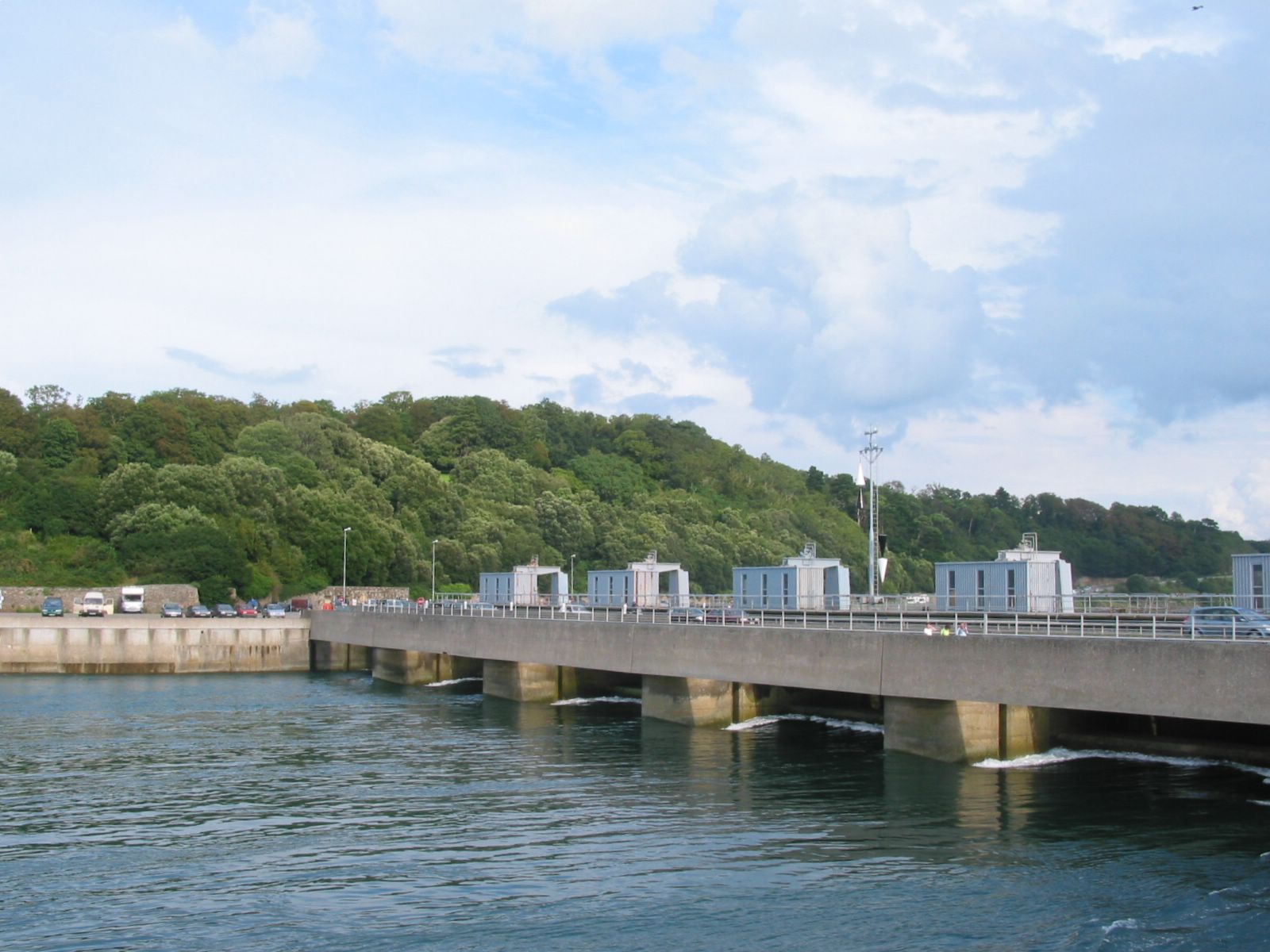
Tidal barrages are among the oldest methods of tidal power generation, with tide mills being developed as early as the sixth century. In the 1960s the 1.7 megawatt Kislaya Guba Tidal Power Station in Kislaya Guba, Russia, was built. Around the same time, the 240 MW la Rance Tidal Power Station was built in Brittany, France, opened in November 1966. La Rance was the largest tidal barrage in world for 45 years, until the 254 MW Sihwa Lake Tidal Power Station was commissioned in South Korea in 2011. However, there are few other examples worldwide.
The barrage method of extracting tidal energy involves building a barrage across a bay or river that is subject to tidal flow. Turbines installed in the barrage wall generate power as water flows in and out of the estuary basin, bay, or river. These systems are similar to a hydro dam that produces static head or pressure head (a height of water pressure). When the water level outside of the basin or lagoon changes relative to the water level inside, the turbines are able to produce power.
The basic elements of a barrage are caissons, embankments, sluices, turbines, and ship locks. Sluices, turbines, and ship locks are housed in caissons (very large concrete blocks). Embankments seal a basin where it is not sealed by caissons. The sluice gates applicable to tidal power are the flap gate, vertical rising gate, radial gate, and rising sector.
Only a few such plants exist. The first was the Rance Tidal Power Station, on the Rance river, in France, which has been operating since 1966 and generates 240MW. A larger 254MW plant began operation at Sihwa Lake, Korea, in 2011. Smaller plants include the Annapolis Royal Generating Station on the Bay of Fundy, and another across a tiny inlet in Kislaya Guba, Russia. A number of proposals have been considered for a barrage across the River Severn, from Brean Down in England to Lavernock Point near Cardiff in Wales.
Barrage systems are dependent on high civil infrastructure costs associated with what is in effect a dam being placed across estuarine systems. As people have become more aware of environmental issues, they have opposed barrages because of the adverse effects associated with changing a large ecosystem that is habitat for many varieties of species.
The basin is filled through the sluices until high tide. Then the sluice gates are closed. (At this stage there may be "Pumping" to raise the level further). The turbine gates are kept closed until the sea level falls, in order to create sufficient head across the barrage. The gates are opened so that the turbines generate until the head is again low. Then the sluices are opened, turbines disconnected and the basin is filled again. The cycle repeats with the tides. Ebb generation (also known as outflow generation) takes its name because generation occurs as the tide changes tidal direction.
Hub AI
Tidal barrage AI simulator
(@Tidal barrage_simulator)
Tidal barrage
A tidal barrage is a dam-like structure used to capture the energy from masses of water moving in and out of a bay or river due to tidal forces.
Instead of damming water on one side like a conventional dam, a tidal barrage allows water to flow into a bay or river during high tide, and releases the water during low tide. This is done by measuring the tidal flow and controlling the sluice gates at key times of the tidal cycle. Turbines are placed at these sluices to capture the energy as the water flows in and out.
Tidal barrages are among the oldest methods of tidal power generation, with tide mills being developed as early as the sixth century. In the 1960s the 1.7 megawatt Kislaya Guba Tidal Power Station in Kislaya Guba, Russia, was built. Around the same time, the 240 MW la Rance Tidal Power Station was built in Brittany, France, opened in November 1966. La Rance was the largest tidal barrage in world for 45 years, until the 254 MW Sihwa Lake Tidal Power Station was commissioned in South Korea in 2011. However, there are few other examples worldwide.
The barrage method of extracting tidal energy involves building a barrage across a bay or river that is subject to tidal flow. Turbines installed in the barrage wall generate power as water flows in and out of the estuary basin, bay, or river. These systems are similar to a hydro dam that produces static head or pressure head (a height of water pressure). When the water level outside of the basin or lagoon changes relative to the water level inside, the turbines are able to produce power.
The basic elements of a barrage are caissons, embankments, sluices, turbines, and ship locks. Sluices, turbines, and ship locks are housed in caissons (very large concrete blocks). Embankments seal a basin where it is not sealed by caissons. The sluice gates applicable to tidal power are the flap gate, vertical rising gate, radial gate, and rising sector.
Only a few such plants exist. The first was the Rance Tidal Power Station, on the Rance river, in France, which has been operating since 1966 and generates 240MW. A larger 254MW plant began operation at Sihwa Lake, Korea, in 2011. Smaller plants include the Annapolis Royal Generating Station on the Bay of Fundy, and another across a tiny inlet in Kislaya Guba, Russia. A number of proposals have been considered for a barrage across the River Severn, from Brean Down in England to Lavernock Point near Cardiff in Wales.
Barrage systems are dependent on high civil infrastructure costs associated with what is in effect a dam being placed across estuarine systems. As people have become more aware of environmental issues, they have opposed barrages because of the adverse effects associated with changing a large ecosystem that is habitat for many varieties of species.
The basin is filled through the sluices until high tide. Then the sluice gates are closed. (At this stage there may be "Pumping" to raise the level further). The turbine gates are kept closed until the sea level falls, in order to create sufficient head across the barrage. The gates are opened so that the turbines generate until the head is again low. Then the sluices are opened, turbines disconnected and the basin is filled again. The cycle repeats with the tides. Ebb generation (also known as outflow generation) takes its name because generation occurs as the tide changes tidal direction.