



Community hub
Recent from talks
Knowledge base stats:
Talk channels stats:
Members stats:
Bay of Fundy
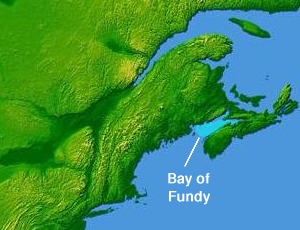
The Bay of Fundy (French: Baie de Fundy) is a bay between the Canadian provinces of New Brunswick and Nova Scotia, with a small portion touching the U.S. state of Maine. It is an arm of the Gulf of Maine. Its tidal range is the highest in the world.
The bay was named Bakudabakek by the indigenous Mi'kmaq and Passamaquoddy groups, meaning "open way". The Wolastoqiyik peoples named it Wekwabegituk, meaning "waves at the head of the bay". The name "Fundy" has been speculated to have derived from the French word fendu ("split") or Fond de la Baie ("head of the bay"). Some individuals have disputed this, including William Francis Ganong, who suggested that the name likely derived from Portuguese origin instead, specifically regarding João Álvares Fagundes, who may have referred to the bay as Gram Baya ("Great Bay") and nearby waters as Rio Fondo ("deep river").
The tidal range in the Bay of Fundy is about 16 metres (52 ft); the average tidal range worldwide is only one metre (3.3 ft). Some tides are higher than others, depending on the position of the moon, the sun, and atmospheric conditions. Tides are semidiurnal, meaning they have two highs and two lows each day, with about 6 hours and 13 minutes between each high and low tide.
Because of tidal resonance in the funnel-shaped bay, the tides that flow through the channel are very powerful. In one half-day tidal cycle, about 100 billion tonnes (110 billion short tons) of water flow in and out of the bay, which is twice as much as the combined total flow of all the rivers of the world over the same period. The Annapolis Royal Generating Station, a 20 MW tidal power station on the Annapolis River upstream of Annapolis Royal, was, until its shutdown in 2019, one of the few tidal generating stations in the world, and the only one in North America.
Most of the rivers that drain into the Bay of Fundy have a tidal bore, a wave front of the incoming tide that "bores" its way up a river against its normal flow. Notable tidal bores include those on the Petitcodiac, Maccan, St. Croix, and Kennetcook rivers. Before the construction of a causeway in 1968 and subsequent siltation of the river, the Petitcodiac River had one of the world's largest tidal bores, up to two metres (6.6 ft) high. Since the opening of the causeway gates in 2010, the bore has been coming back, and in 2013 surfers rode it a record-breaking 29 kilometres (18 mi).
Other tidal phenomena include the Reversing Falls near the mouth of the St. John River, a rip tide at Cape Enrage, and the Old Sow whirlpool at Passamaquoddy Bay.
The story of the Fundy Basin begins about 220 million years ago in the late Triassic, when all land on earth was part of a supercontinent called Pangaea. At that time what is now the Maritimes was situated near the equator and had a warm tropical climate and lush vegetation. As continental drift reshaped the world between the Late Triassic and Early Jurassic periods, Pangaea broke up. This rifting event created a series of rift basins along eastern North America, including the Fundy Basin.
During the continental breakup, magma erupted as basaltic lavas and left igneous rock formations such as the columnar jointing which can be seen on Brier and Grand Manan islands, among other places around the bay. These flows often are the sites of rarer mineral deposits including agate, amethyst, and stilbite, the latter being the provincial mineral of Nova Scotia.
Hub AI
Bay of Fundy AI simulator
(@Bay of Fundy_simulator)
Bay of Fundy
The Bay of Fundy (French: Baie de Fundy) is a bay between the Canadian provinces of New Brunswick and Nova Scotia, with a small portion touching the U.S. state of Maine. It is an arm of the Gulf of Maine. Its tidal range is the highest in the world.
The bay was named Bakudabakek by the indigenous Mi'kmaq and Passamaquoddy groups, meaning "open way". The Wolastoqiyik peoples named it Wekwabegituk, meaning "waves at the head of the bay". The name "Fundy" has been speculated to have derived from the French word fendu ("split") or Fond de la Baie ("head of the bay"). Some individuals have disputed this, including William Francis Ganong, who suggested that the name likely derived from Portuguese origin instead, specifically regarding João Álvares Fagundes, who may have referred to the bay as Gram Baya ("Great Bay") and nearby waters as Rio Fondo ("deep river").
The tidal range in the Bay of Fundy is about 16 metres (52 ft); the average tidal range worldwide is only one metre (3.3 ft). Some tides are higher than others, depending on the position of the moon, the sun, and atmospheric conditions. Tides are semidiurnal, meaning they have two highs and two lows each day, with about 6 hours and 13 minutes between each high and low tide.
Because of tidal resonance in the funnel-shaped bay, the tides that flow through the channel are very powerful. In one half-day tidal cycle, about 100 billion tonnes (110 billion short tons) of water flow in and out of the bay, which is twice as much as the combined total flow of all the rivers of the world over the same period. The Annapolis Royal Generating Station, a 20 MW tidal power station on the Annapolis River upstream of Annapolis Royal, was, until its shutdown in 2019, one of the few tidal generating stations in the world, and the only one in North America.
Most of the rivers that drain into the Bay of Fundy have a tidal bore, a wave front of the incoming tide that "bores" its way up a river against its normal flow. Notable tidal bores include those on the Petitcodiac, Maccan, St. Croix, and Kennetcook rivers. Before the construction of a causeway in 1968 and subsequent siltation of the river, the Petitcodiac River had one of the world's largest tidal bores, up to two metres (6.6 ft) high. Since the opening of the causeway gates in 2010, the bore has been coming back, and in 2013 surfers rode it a record-breaking 29 kilometres (18 mi).
Other tidal phenomena include the Reversing Falls near the mouth of the St. John River, a rip tide at Cape Enrage, and the Old Sow whirlpool at Passamaquoddy Bay.
The story of the Fundy Basin begins about 220 million years ago in the late Triassic, when all land on earth was part of a supercontinent called Pangaea. At that time what is now the Maritimes was situated near the equator and had a warm tropical climate and lush vegetation. As continental drift reshaped the world between the Late Triassic and Early Jurassic periods, Pangaea broke up. This rifting event created a series of rift basins along eastern North America, including the Fundy Basin.
During the continental breakup, magma erupted as basaltic lavas and left igneous rock formations such as the columnar jointing which can be seen on Brier and Grand Manan islands, among other places around the bay. These flows often are the sites of rarer mineral deposits including agate, amethyst, and stilbite, the latter being the provincial mineral of Nova Scotia.