Hubbry Logo
TidworthTidworthMain
Open search
Tidworth
Community hub
Tidworth
logo
8 pages, 0 posts
0 subscribers
Be the first to start a discussion here.
Tidworth
Tidworth
from Wikipedia

Tidworth is a garrison town and civil parish in south-east Wiltshire, England, on the eastern edge of Salisbury Plain. Lying on both sides of the A338 about 3+12 miles (5.6 km) north of the A303 primary route, the town is approximately 8 miles (13 km) west of Andover, 12 miles (19 km) south of Marlborough, and 13 miles (21 km) north by north-east of Salisbury. The population of the parish at the 2011 census was approximately 10,600.[2]

Key Information

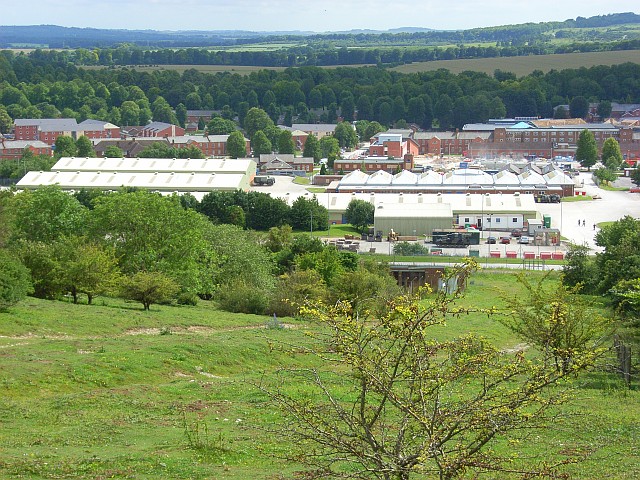
Originally two villages – North Tidworth and South Tidworth – the modern town is dominated by Tidworth Camp, a large British Army site. Swinton Barracks, another Army site, is in the west of the parish.

History

[edit]

Evidence of prehistoric activity in the area is in the form of several sites with bowl barrows, including a group of seven;[3] and an Iron Age hillfort at Sidbury Hill in the north of the parish.[4]

The name Tidworth derives from the Old English tudaworð meaning 'Tuda's enclosure'.[5]

Domesday Book of 1086 recorded four landowners and 18 households at what is now North Tidworth, in the Amesbury hundred of Wiltshire; and three landowners with 20 households and one church at South Tidworth, in the Broughton hundred of Hampshire. Placenames were written as Todeworde, Tedorde or Todeorde.[6][7]

The two villages developed in the valley of the small River Bourne, which flows south to join the Hampshire Avon near Salisbury; later the Oxford-Salisbury road also followed the valley.[8]

On John Speed's maps of 1611 the villages are North Tudworth, belonging to Amesbury hundred in "Wilshire", and South Tudworth within Andover hundred in "Hamshire". Before 1650 there was a substantial country house with parkland at South Tidworth; the present Tedworth House is a rebuilding of 18281830.[9]

In 1897 the War Office bought the house and grounds, together with land to the north which gave access to Salisbury Plain for Army training.[10] Extensive barracks were built in the early 20th century, largely in South Tidworth but spreading across the boundary to the north.[11] From 1902 to 1963 there was a railway station at North Tidworth, connected to the main line by a branch from Ludgershall.[12]

North and South were separate ecclesiastical parishes, and therefore became civil parishes in the 19th century. An Ordnance Survey map of 1958 labels the parishes as North Tidworth and South Tedworth.[11] When the boundary between Wiltshire and Hampshire was redrawn in 1992, the entire town became part of Wiltshire,[13] though remaining part of the Hampshire postal county. The two parts remained as separate civil parishes until 1 April 2004.[citation needed]

In the 21st century the population of the town increased as the barracks now known as Tidworth Camp expanded, in particular following the return of units from Germany in 2019 and 2020 under the Army Basing Plan.[14]

Religious sites

[edit]

Parish church

[edit]
Holy Trinity, North Tidworth

Holy Trinity, North Tidworth is the Church of England parish church. There may have been a church here in the 12th century but the earliest record is of 1291.[8] The present building, in flint and stone with repairs in red brick, is from the late 14th and 15th centuries.[15] Restoration designed by J. L. Pearson in 1882 included replacement of the roofs and rebuilding of the porch.[8] The church was recorded as Grade II* listed in 1988.[15]

The font is from the 12th century.[16] Three of the six bells were cast in 1619 by John Wallis, and another is from 1700.[17] There are two 17th-century chest tombs in the churchyard.[18][19] Parish registers from 1700 are held by the Wiltshire and Swindon History Centre, Chippenham.[20]

The Hampshire benefices of South Tidworth and Shipton Bellinger were united in 1926, with the incumbent to live at Tidworth, although the parishes remained separate.[21] In 1972 Shipton Bellinger was made a separate benefice, the parishes of North and South Tidworth were united, and the Victorian church at South Tidworth was declared redundant.[22] The benefice was united with the parish of Ludgershall and Faberstown in 1986.[8]

Others

[edit]

There was a church dedicated to St Mary at South Tidworth from the 13th or 14th centuries, but by 1784 it was in poor condition and Thomas Assheton Smith the elder, owner of Tedworth House, was given permission to demolish it.[23] Masonry from the church, including a 14th-century window and some monuments, was used to build a small chapel which remains in use as a mortuary chapel for the surrounding cemetery.[24][25]

St Mary's Church, South Tidworth

A replacement St Mary's Church was built closer to Tedworth House in 1878 to designs of John Johnson at the expense of Sir John Kelk, who had bought the estate in 1877. It is Grade I listed[26] and is now in the care of the Churches Conservation Trust.[27]

St Michael's Garrison Church (Church of England) and St Patrick's Garrison Church (Roman Catholic),[28][29] both built in 1912, are the military churches for the garrison.[30]

Governance

[edit]

The parish elects a town council. It is in the area of Wiltshire Council unitary authority, which is responsible for most local government functions. Tidworth elects two members of Wiltshire Council:[31] one for Tidworth North & West which covers most of the town, including Tidworth Camp, and one for Tidworth East & Ludgershall South which takes in a small eastern part of the town as well as Perham Down and the southern half of Ludgershall.[32]

For Westminster elections, the parish falls in the East Wiltshire constituency, which has been represented since 2024 by Danny Kruger for the Conservatives.[33]

Amenities

[edit]

Tidworth has a small commercial area containing two supermarkets (a Lidl and a large Tesco), two veterinary surgeries, a pharmacy, and other shops and services. A dental surgery serves Tidworth and the surrounding area, covering approximately 5,000 people. In 2003 a new medical centre was completed, the cost being split between the Ministry of Defence and the NHS, as it serves the armed forces and their dependants within the surrounding area.

Castledown FM, a community radio station, broadcasts to Tidworth and Ludgershall from studios in the grounds of Wellington Academy.[34]

Tidworth has one of the lowest crime rates per thousand in Wiltshire, and between 1990 and 2004 only one major crime took place.[35] In 2014, it was rated by the Royal Mail as the most attractive postcode area of England to live in.[36]

Tidworth Garrison Golf Club was constructed in 1904 initially for use by army officers. It was established in 1908 and gradually made available to all ranks and civilians. In 2000 it became a limited company.[37]

Tidworth Polo Club also known as Tedworth Park Polo Club is south of Tedworth House.[38][39] The ground is central to the British Army Polo Association and is affiliated to the UK Armed Forces Polo Association.[40]

South of Tidworth is a downhill mountain biking venue, first built in secret by the local mountain biking community in 2006. After the landowner discovered the site and forced the issue, Tidworth Freeride was taken over by B1KE, who now operate the site commercially, catering to a wide range of abilities.[41][42]

Education

[edit]

The Wellington Academy, a secondary school which was partly sponsored by Wellington College, opened in September 2009, replacing Castledown School. The academy has a sixth form college, an all-weather sports pitch, and dedicated Combined Cadet Force facilities. The parent unit of the CCF is 26 Royal Engineers, housed nearby at Swinton Barracks.[43]

The community is served by three primary schools and an infant school.

Media

[edit]

Local news and television programmes are provided by BBC South and ITV Meridian. Television signals are received from the Hannington and the local relay transmitters.[44][45]

Local radio stations are BBC Radio Wiltshire on 103.5 FM, Greatest Hits Radio Salisbury on 102 FM and British Forces Broadcasting Service that provides radio programmes for His Majesty's Armed Forces in nearby Salisbury Plain on 106.8 FM.[46]

The local newspapers that cover the town is the Salisbury Journal and Andover Advertiser.[47]

Notable residents

[edit]

Duggie Fields, artist, was born in Tidworth,[48] as was musician James Blunt in 1974.[49]

Owners of the South Tidworth estate and Tedworth House include John Smith (1656–1723), Speaker of the House of Commons and Chancellor of the Exchequer; Thomas Assheton Smith (1752–1828), owner of Dinorwic quarry and MP; and his son Thomas (1776–1858), cricketer, foxhunter, yacht designer and MP, who built the present house.

See also

[edit]

References

[edit]

Further reading

[edit]
[edit]
Revisions and contributorsEdit on WikipediaRead on Wikipedia
from Grokipedia
Tidworth is a town and in southeastern , , located on the county's border with and the eastern edge of , alongside the . With a population of 12,089 as recorded in the 2021 census, it functions primarily as a hub for operations, encompassing Tidworth Camp as part of the larger Tidworth, Netheravon, and Bulford Garrison. The town's modern character stems from the 1897 acquisition of the Tedworth Estate by the War Department, which spurred the development of , railways, and supporting infrastructure in the early to accommodate regiments including British, international, and units. Earlier settlement traces back to and activity, with medieval manors documented in the and Norman-era structures such as Holy Trinity Church dating to around 1250; however, military expansion has dominated its growth and economy since the late .

Geography

Location and Boundaries

Tidworth is a situated in southeastern , , at the eastern edge of Salisbury Plain. Its geographic center lies at approximately 51.24142° N latitude and 1.66449° W longitude. The town is positioned about 16 km west of Andover in , 19 km south of Marlborough, and 15 miles north-northeast of . The A338 road passes through the parish, connecting it to nearby settlements and facilitating access to the military installations that dominate the area. The of Tidworth straddles the historic boundary between and , with the River Bourne flowing centrally through the landscape toward the Hampshire Avon. North Tidworth forms the core within , while South Tidworth historically extended into , including parts of Tidworth Camp. The modern parish boundary is administered under , encompassing garrison facilities that overlap the county line. To the north, it adjoins Ludgershall , and to the south, it meets parishes such as Shipton Bellinger, reflecting its position on the - border.

Topography and Environment

Tidworth occupies a position on the eastern edge of Salisbury Plain, a chalk plateau in Wiltshire characterized by rolling terrain and open downland landscapes. The area features a high chalk plain with elevations averaging 136 meters above sea level, ranging from approximately 72 meters in lower valleys to over 150 meters on adjoining hills. This topography consists of undulating plateaus formed from underlying Cretaceous chalk bedrock, supporting large-scale fields and steep slopes typical of the region. The environment of Tidworth is dominated by chalk , which covers significant portions of and represents the largest expanse of unimproved chalk grassland in northwest , comprising about 40 percent of the remaining such in the . Military training activities on the adjacent Training Area, spanning over 94,000 acres, have inadvertently preserved this grassland by limiting agricultural intensification and , fostering habitats for specialized and including orchids, , and ground-nesting birds. Designated as a (SSSI), (SAC), and (SPA), the plain supports rare species amid its soils, though live-firing exercises pose localized risks such as and disturbance. Climatically, Tidworth experiences a temperate with short, comfortable summers averaging highs around 21°C and long, cold, windy winters with lows near 2°C, accompanied by annual exceeding 800 mm distributed throughout the year. This weather pattern influences the chalk grassland , promoting resilient, drought-tolerant vegetation adapted to exposed conditions and periodic wet spells that support seasonal displays. Environmental management efforts in the area balance use with conservation, including controlled and habitat restoration to mitigate from vehicle maneuvers.

History

Pre-Modern Period

Archaeological evidence indicates prehistoric human activity in the Tidworth area, including pits and a prehistoric uncovered during excavations. The surrounding landscape features numerous tumuli, earthworks, and ancient trackways, forming part of the broader ritual complex on . Early medieval occupation is attested by a mid-6th-century Anglo-Saxon quadruple on a spur east of Tidworth, containing the remains of four adult males equipped with spears, shields, and a , possibly representing a battlefield interment linked to conflicts on . Subsequent Saxon presence is evidenced by early and middle Saxon pits yielding pottery, animal bones, and a dog , as well as a mid-Saxon with 57 burials dating to the late 7th and early 8th centuries AD. In the of 1086, North Tidworth appears as a settlement in hundred, , with a recorded population of 18 households comprising 6 villagers, 7 smallholders, and 5 slaves, alongside 6 ploughlands, , and resources. South Tidworth is similarly documented in the survey, reflecting manorial holdings under Norman overlords. Tidworth persisted as a modest rural through the medieval and early modern periods, characterized by agricultural estates, scattered farmsteads, and limited in a valley setting peripheral to , with no major urban development prior to the . The presence of 16 scheduled ancient monuments, including hillforts like Sidbury Hill, underscores the continuity of the area's historical significance from into the post-medieval era.

Military Development and Modern Expansion

The establishment of Tidworth Camp began in the late 19th century when the British acquired Tedworth House and extensive surrounding land in 1897 to create a permanent military training area on . This initiative responded to the need for larger, centralized training facilities amid the Second Boer War and ongoing imperial commitments, transitioning from temporary tented encampments to fixed infrastructure. By 1904, the first permanent troops relocated from temporary tents and huts into newly constructed barracks, signaling the camp's operational inception. Further development accelerated in the early 20th century with the completion of Lucknow Barracks and Mooltan Barracks in 1905, followed by the in 1907, which supported growing troop numbers and medical needs. of Southern Command relocated to Tidworth in 1909, elevating its strategic role within the British Army's structure on . Expansion continued into the , including the construction of six additional brick-built in 1933, enhancing capacity for mechanized units and training. During the Second , the camp hosted American forces from 1942 to 1944, with infrastructure adaptations for Allied preparations ahead of D-Day, though no major permanent expansions occurred during the conflict. Post-war modernization included the closure of the in 1977 amid broader rationalizations. Significant contemporary expansion commenced in 2006 under the 's Project Allenby Connaught, involving a mix of new constructions and refurbishments that transformed living and working facilities across the . This program delivered over 160 upgraded or new buildings by the early , accommodating modern armored brigades such as the 3rd () Division's elements, with emphasis on energy-efficient designs and enhanced training infrastructure to support rapid deployment capabilities. These developments have solidified Tidworth's position as a key hub for the British Army's operational readiness in .

Military Presence

Garrison History

Tidworth originated from the British Army's acquisition of Tedworth House and extensive surrounding lands in 1897 by the , transforming the estate into a dedicated . This purchase formalized a military presence that had existed in the region for centuries, with troops utilizing the terrain for exercises prior to formal ownership. The development included construction across North and South Tidworth parishes, establishing such as those named after 19th-century campaigns in , including Bhurtpore, Mooltan, and Candahar. By 1909, Tidworth became the for Southern Command, relocating from and centralizing administrative functions on . During the First World War, the camp expanded as a major training hub, accommodating reinforcements and command structures, including the Australian Imperial Force's in 1916 for oversight of training and depots. developments, such as artillery and engineer facilities built around 1906-1907, supported regimental housing for units like the Royal Artillery. In the Second World War, Tidworth Garrison hosted diverse Allied forces, including the U.S. 17th Engineer Battalion from 1943, which focused on maintenance, bridge training, and preparations amid crowded conditions. The site contributed to mobilization efforts, with commemorations later recognizing its role in supporting thousands of wartime personnel and their families. Post-1945, it remained a strategic base, stationing units such as the 1st Guards Brigade in 1959 for brigade-level operations before deployments. Throughout the and beyond, the garrison evolved with modular structures and sustained training roles, adapting to force reductions while maintaining core facilities.

Current Operations and Facilities

Tidworth, as part of the Tidworth, Netheravon and Bulford Garrison, serves as a major hub for British Army units within the 3rd (United Kingdom) Division, emphasizing armoured, infantry, and reconnaissance operations for rapid deployment and training readiness. The garrison supports the 3rd Deep Reconnaissance Strike Brigade Combat Team, headquartered at Delhi Barracks, which integrates deep reconnaissance, strike capabilities, and artillery to enable division-level deep battle effects. Key stationed units include the Royal Tank Regiment at Aliwal Barracks, operating main battle tanks for armoured manoeuvre warfare. The 1st Battalion, The Royal Regiment of Fusiliers, provides support from Tidworth, participating in exercises and operational rotations as of 2025. The 4th Armoured Close Support Battalion, , based at Jellalabad Barracks since 2010, maintains and repairs armoured vehicles and equipment essential for brigade sustainment. Facilities encompass modernized barracks such as Aliwal, Assaye, and Bhurtpore, upgraded under the Ministry of Defence's infrastructure programmes to house over 4,000 personnel and families. In 2024, 142 service family homes in Tidworth were refurbished, part of a broader initiative to restore 1,000 military homes for improved habitability and retention. The includes welfare support via a dedicated team handling personnel issues from Monday to Thursday, alongside access to the expansive Training Area for live-fire, manoeuvre, and urban combat drills. A new £17 million urban fighting facility at adjacent Rollestone Camp, opened in September 2025, enhances close-quarters battle training with realistic scenario-based Skills Houses.

Contributions and Criticisms

The military presence in Tidworth has substantially bolstered the local economy, with defense-related employment—encompassing both and roles—comprising around 70% of total jobs in the Tidworth Area as of recent assessments. Infrastructure investments under the Army Basing Programme, including the delivery of single living accommodation units completed by 2019 and the of 322 new family homes initiated in 2016, have generated activity and sustained demand for local services. These developments, part of broader relocations to , affirm Tidworth's role as a stable super-garrison, fostering long-term planning through partnerships like the Integration (MCI) initiative, which coordinates economic and social enhancements with the . Criticisms center on the uneven impacts of rapid expansion and high dependency. Local stakeholders have characterized army personnel inflows as a "double-edged ," providing future security but straining short-term resources amid relocations of thousands of troops. The heavy economic reliance on the heightens vulnerability to defense shifts, such as base closures or reductions, which could disrupt and services in an area already marked by pronounced military influence. Coordination challenges persist in aligning local — including , transport, healthcare, and leisure—with garrison growth, evidenced by the 2019 elimination of dedicated roles for Tidworth and amid basing transitions. Additionally, the Tidworth area's integration within the Training Area exposes surrounding communities to environmental effects from military maneuvers, such as and habitat disruption by heavy vehicles. The 's operational secrecy further limits public access and transparency, contributing to perceptions of isolation despite collaborative efforts.

Governance and Administration

Local Government

Tidworth is a within the of , which assumed responsibility for services across the county following the abolition of district councils in 2009. oversees strategic planning, education, highways, , and social services for the area, with Tidworth divided into electoral divisions such as Tidworth North and West and Tidworth East and Ludgershall South for representation. At the parish level, Tidworth is governed by Tidworth , a corporate body comprising 19 elected councillors who meet to address community-specific matters. The council's responsibilities include promoting local events, managing community facilities like the Tidworth Civic Centre on (opened in 2024 after a £7.3 million approved in 2021), and providing information on amenities such as parks and local news. Councillors must be at least 18 years old, British citizens or eligible / citizens with residency qualifications, and are elected to serve on committees focused on areas like and . The town council collaborates with on precept funding, where parish precepts exceeding £140,000 require detailed expenditure breakdowns for services like maintenance and events. This structure ensures localized decision-making while integrating with county-wide administration, though reviews by , such as those initiated in 2022, periodically assess arrangements for efficiency.

Relations with Military Authorities

Tidworth's local authorities, including the Tidworth Town Council and , maintain cooperative relations with military authorities primarily through shared community initiatives and infrastructure partnerships, reflecting the garrison's dominant role since the British Army acquired the estate in 1897. Joint events exemplify this ; for instance, the 2025 Remembrance Service featured a military —the first road closure approval for such an event in over a generation—inviting participation from veterans and military groups alongside civilians. Facilities like the Ordnance House Welfare Centre operate to support both and civilians, promoting family integration and addressing issues such as isolation faced by service families. The Tidworth Leisure Centre functions via a partnership among Aspire Defence Services Limited, , and Army Library Services, providing sporting and recreational amenities that bridge civilian and military communities. Council proceedings incorporate military perspectives, with armed forces representatives attending meetings, as documented in the Tidworth Town Council's August 2025 minutes, which noted engagement with the garrison's CEO. officials conduct site visits to military developments, such as new accommodation under the Army Basing Programme, to align local planning with garrison expansions. However, rapid personnel influxes have elicited mixed views; a 2013 Wiltshire councillor assessment described them as a "double-edged sword," bolstering Tidworth's status as an expanded town while potentially overburdening local services.

Demographics

The of Tidworth remained modest through the early , reflecting its status as a rural in . records indicate 240 residents in 1801, rising gradually to 417 by 1841 and stabilizing at the same level in 1851, amid limited agricultural and local economic activity. Significant growth occurred following the establishment and expansion of in the early , transforming the area into a garrison town and attracting and dependents. This military-driven influx led to substantial increases, with the parish population reaching approximately 10,621 by the 2011 census and climbing to 12,089 in the 2021 census, representing a 13.8% rise over the decade. The broader Tidworth Community Area, encompassing surrounding military and civilian zones, reported 19,723 residents as of recent estimates derived from 2021 data. These trends are heavily influenced by the British Army's presence, which accounts for a large proportion of the and introduces variability not typical of locales. Unit relocations, such as those under the Army Basing Plan, have caused short-term fluctuations; for instance, incoming battalions in the boosted numbers, while deployments or restructurings can lead to temporary declines. Overall, the has nearly doubled in the past two decades due to sustained investments, though exact figures for military versus components are not publicly disaggregated in outputs.
Census YearTidworth Parish Population
1801240
1811282
1821327
1831392
1841417
1851417
201110,621
202112,089

Social Composition

Tidworth's social composition is markedly shaped by its role as a town, with personnel and their dependants estimated to comprise over 20% of the local . This influence fosters a transient of predominantly working-age families, many experiencing frequent relocations due to postings, which impacts social stability and cohesion. The 2021 recorded a of 10,525, with a higher-than-average proportion of children under 16 (around 25-30% inferred from area data) and fewer elderly residents compared to averages, reflecting the demands of service life. Ethnically, the population exhibits greater diversity than the surrounding county, driven by the Army's international recruitment from countries such as , , and various African nations. In Tidworth Parish, 90.4% identified as White in the 2021 , with 8.4% Asian (largely South Asian, including families), 8.0% Black (predominantly African), and smaller proportions of mixed (2.5%) and other groups. This contrasts with Wiltshire's 94% White population, highlighting the garrison's role in elevating non-White representation to levels more akin to urban military hubs. Occupationally, employment is heavily skewed toward defence and , with a significant share of residents aged 16+ in armed forces roles or support occupations, though exact parish-level breakdowns classify many under skilled trades, process operatives, or managerial positions aligned with hierarchies. Economic activity rates exceed county norms, bolstered by stable military pay, but include elevated unemployment risks during transitions out of service. Socioeconomically, Tidworth scores favorably on deprivation indices, with only 12.0% of under-16s in low-income households (versus 12.7% in ), and limited multidimensional deprivation in employment or dimensions per metrics. However, challenges persist, including isolation for spouses during deployments and barriers to civilian job integration for ex-service families.

Economy

Military-Driven Economy

The economy of Tidworth is overwhelmingly shaped by the presence of the British Army's Tidworth garrison, with the (MoD) acting as the dominant employer in the town. Employment in the Tidworth Community Area is heavily concentrated in and civilian defence sectors, accounting for approximately 70% of total jobs, far exceeding diversification into other industries. This reliance stems from the garrison's role in hosting armoured and support units, which directly employs thousands of regular personnel and support staff while generating indirect demand for local services. The Army Basing Programme (2011–2021) amplified this economic orientation by relocating around 4,000 service personnel and families to Tidworth as part of broader Wiltshire expansions, injecting over £1 billion in regional investments for , facilities, and housing. Specific to Tidworth, this included the construction of 322 new family homes starting in 2016, which created construction jobs and sustained ongoing economic activity through personnel spending on retail, maintenance, and community amenities. households, numbering in the thousands across Tidworth and adjacent Bulford, further bolster local commerce by prioritizing proximity to the base, with daily expenditures supporting shops, hospitality, and transport in the absence of robust non-defence alternatives. Beyond direct payroll and , the fosters ancillary employment in defence contracting and logistics, though precise figures remain tied to MoD operations rather than civilian-led growth. This -centric model has historically insulated Tidworth from broader economic downturns but underscores a causal dependence where base expansions correlate with population and revenue influxes, as evidenced by Wiltshire's military towns receiving targeted funding for enterprise gateways to leverage service leavers' skills. Overall, the 's scale—encompassing Tidworth Camp and associated —positions defence as the primary engine of prosperity, with limited evidence of equivalent non- drivers.

Employment and Challenges

The serves as Tidworth's largest employer, with employment overwhelmingly focused on military and defence-related activities at Tidworth Camp and surrounding garrisons. Combined military and civilian defence employment constitutes approximately 70% of total jobs in the Tidworth Community Area, underscoring the town's heavy reliance on the armed forces for economic stability. Local civilian opportunities are limited to support roles, retail in the modest town centre (including and supermarkets serving Tidworth, Ludgershall, and nearby rural areas), and emerging sites like Castledown Business Park aimed at small and medium enterprises. This military dominance presents challenges, including vulnerability to fluctuations in defence policy, such as personnel reductions or relocations, which can disrupt local and spending. Youth unemployment stands at 5.15% for ages 16-24 (515 per 10,000 residents) as of 2021, higher than broader averages and indicative of skills mismatches between -focused roles and youth qualifications. Economic inactivity due to long-term illness or affects 2.2% of the working-age population, slightly below the county rate but compounded by transient postings that hinder long-term integration and . Housing and infrastructure strains further exacerbate employment hurdles, with military family accommodation driving population growth and a residual need for 1,220 homes through 2038, while sewage capacity, flood risks, and highway limitations constrain development. Median house prices rose nearly 20% from 2018 to 2022, outpacing annual gross resident earnings growth of 13.7% and contributing to affordability pressures. Cost-of-living crises have prompted even , including members, to use food banks in Tidworth amid garrison-wide shortages as of 2023. Efforts to diversify via business parks seek to mitigate dependence, but persistent transport issues, such as unreliable bus services due to driver shortages, impede access to jobs beyond the immediate area.

Community and Amenities

Housing and Infrastructure

Tidworth's housing stock is predominantly influenced by its role as a town, with a substantial portion dedicated to Service Family Accommodation (SFA) for personnel stationed at Tidworth Camp. The (MoD) manages extensive SFA provisions, including recent refurbishments of 142 previously uninhabitable homes completed in May 2024 as part of a void accommodation scheme, enhancing energy efficiency, safety, and habitability for military families. Earlier developments under the Basing Programme delivered 322 new three- and four-bedroom homes by 2017, constructed by contractor Hill on behalf of the () at a cost of approximately £70 million. A prior initiative replaced 533 outdated dwellings with 484 modern and linked-detached homes, improving living conditions in distinct neighbourhoods. Civilian housing in Tidworth remains limited but is expanding through local planning approvals, such as the December 2024 permission for six homes on land behind 11 Station Road. The Council's Planning for Tidworth and Ludgershall framework identifies sites for additional residential development, integrated with business and supporting infrastructure to address local needs up to 2031 and beyond. These plans prioritize sustainable growth amid the town's military-dominated economy, though delivery depends on coordinated infrastructure investment. Infrastructure supports Tidworth's dual civilian-military character, with key transport links including the A338 road connecting to Andover and the A303 trunk road for access to and beyond. Local planning documents emphasize upgrades to alleviate congestion, enhance air quality in the town centre, and promote walking, cycling, and , including Tidworth railway station on the Main Line. Utilities and roads within the garrison fall under Project Allenby Connaught, which has invested in maintenance and upgrades, such as Tidworth-specific works valued at around £455 million historically. Ongoing challenges include ensuring timely infrastructure delivery alongside housing growth, as highlighted in cross-border planning dialogues with Borough Council.

Leisure and Services

Tidworth's primary leisure facility is the Tidworth Leisure Centre, which provides a range of indoor and outdoor amenities including a 25-metre, six-lane , a fully equipped fitness suite, a sports hall with , squash courts, group exercise classes, and two hard courts. The centre also hosts activities such as aqualetes swimming lessons, birthday parties, and fitness programs, with memberships available through . Community sports and exercise options in Tidworth include clubs like Tidworth Town Football Club, Kick Start FC for youth soccer, Tidworth for weekly 5km runs, Walking Netball, No Strings Badminton, , Show Off , and Tidworth Saddle Club for equestrian activities. A skate park and facilities for bootcamps and dance classes are also available, reflecting the town's emphasis on active recreation amid its military population. Public services encompass Tidworth Library, located within the at Nadder Road, offering extended self-service access from 10:00 a.m. to 8:30 p.m. on weekdays and staffed hours for borrowing, events, and digital resources. Healthcare is provided via the Tidworth Primary Healthcare Centre, which delivers general medical services to residents. These amenities support both civilian and military families, with some facilities managed under partnerships to ensure community access.

Education

Schools and Institutions

Tidworth is served by a number of state-funded primary schools, reflecting its status as a town with a significant population of families. Zouch Academy, located on Wavell Road (SP9 7JF), provides education from nursery through primary levels and was rated "Outstanding" by in its most recent inspection for overall effectiveness, quality of education, and leadership. The Clarendon Federation operates two sites—Clarendon Infants' School on Ordnance Road (SP9 7QD) for ages 4-7 and Clarendon Junior School nearby—catering to approximately 400 pupils combined and emphasizing a maintained primary tailored to the local demographic. Wellington Primary (formerly Wellington Lions), on Oatway Road (SP9 7FP), serves primary pupils with a focus on , , and academic achievement, enrolling around 200 students under the Tidworth and Ludgershall Church Academies Trust. Secondary education is primarily provided by The Wellington Academy, situated on Tidworth Road in adjacent Ludgershall (SP11 9RR), which draws pupils from Tidworth and operates as an with a , serving over 1,000 students aged 11-18 under oversight; it emphasizes inclusive education and vocational opportunities. For pupils with special educational needs, Exeter House School—a specialist institution for severe, profound, and multiple learning disabilities—maintains a in Tidworth, repurposed from a former to support individualized provision for ages 4-19. No higher education institutions are located directly within Tidworth; residents typically access at sites like Andover College or Wiltshire College & University Centre.

Military Family Support

Military families in Tidworth benefit from the Welfare Service (AWS), which operates a dedicated providing personal support for issues such as domestic abuse, bereavement, and relationship difficulties, alongside community support tailored for children and young people, accessible via 01980 656789. The service emphasizes early intervention to address the unique challenges of frequent relocations and deployments faced by -based families. Complementing this, the Tidworth, Netheravon, and Bulford Welfare offers operational welfare assistance, reachable at 07980 718923 during standard hours or via the duty officer for urgent matters. Early years and childcare support is facilitated by TNB Garrison Early Years and Play, a charity managing eight settings across Tidworth and nearby garrisons, offering play-based programs to promote child development and ease parental transitions during postings. Parent-child initiatives, such as those from Home-Start North Wiltshire, provide free groups in Tidworth to build confidence, foster friendships, and mitigate isolation for military parents, often integrating educational readiness activities. The NSPCC's Tidworth Service Centre, backed by ABF The Soldiers' Charity, delivers targeted interventions for family wellbeing, including remote support during disruptions like the COVID-19 pandemic. The Army Families Federation (AFF) advocates for families through confidential guidance on military life issues, including educational transitions, with specific briefings held in Tidworth for non-UK personnel and unit staff. HIVE Information Centres supply relocation packs and deployment resources, aiding families in navigating school placements and community integration. Local efforts, such as Wiltshire Council's Month of the Military Child events, further recognize and support service children's experiences, promoting resilience amid parental service demands. These services collectively address the causal strains of military service on family stability, prioritizing evidence-based welfare over generalized assurances.

Culture and Media

Religious Sites

![Holy Trinity Church, Tidworth][float-right] The Church of the Holy Trinity serves as the Anglican parish church for Tidworth and has occupied its site since approximately 1250, potentially succeeding an earlier structure. The earliest documented reference appears in 1291, with the current building constructed from stone rubble and ashlar dressings, earning Grade II* listed status from Historic England. It belongs to the Diocese of Salisbury within the Stonehenge Deanery and holds weekly Sunday services at 11:15 a.m., alongside radio broadcasts. St Mary's Church in South Tidworth, a Victorian structure completed in 1878 to designs by architect John Johnson, was commissioned by Sir John Kelk and features elaborate interior decoration. Designated Grade I listed, it replaced an earlier church demolished in 1784 whose materials contributed to local rebuilding efforts. Now redundant since 1972 and maintained by the Churches Conservation Trust, the site preserves historical elements amid surrounding woodland. Tidworth's military hosts additional facilities, including the Garrison Church of St. Michael, which supports a diverse Christian community serving personnel from various nationalities and backgrounds. The Roman Catholic Garrison Church of St. George and St. Patrick, erected in with a by G.L.W. Blount, caters to Catholic service members. These chapels reflect the town's significant armed forces presence, providing ecumenical and denominational worship options. ![St Mary's Church, South Tidworth][center]

Local Media and Events

Local media in Tidworth primarily consists of regional newspapers and community publications that cover the town's military and civilian affairs. The Andover Advertiser, published by Media Group, regularly reports on Tidworth-specific news, including local business developments and community issues. Similarly, the Salisbury Journal, also under , provides coverage of Tidworth events and updates, such as seasonal photography tips from local businesses. The Tidworth Times, a quarterly newsletter issued by , distributes updates on municipal activities and is available in print at sites like and the local leisure centre, with editions such as the spring 2025 issue focusing on council initiatives. Radio broadcasting serves the area's military population through stations like BFBS Salisbury Plain, which operates on FM 106.8 MHz in nearby Bulford and provides news, entertainment, and Forces-specific content across the garrison region including Tidworth. Castledown FM, a community-licensed station, targets Tidworth, Ludgershall, and Perham Down with local news, events, and weather updates, emphasizing hyper-local relevance for residents. Tidworth hosts annual community events organized by the town council, reflecting its blend of civilian and military heritage. The Tidworth Town Festival, held annually on the last Sunday of June, features live music, skateboarding demonstrations, circus performances, and family-oriented activities with free admission to promote community engagement. Other recurring events include the Remembrance Sunday service on November 11, a Halloween party in late October, and VJ Day beacon lighting on August 15, often at the town's war memorial or civic centre. Community groups facilitate ongoing activities, such as the Over 60s Group's monthly meetings with guest speakers and social pursuits at Tidworth Civic Centre. These gatherings underscore the town's efforts to foster social cohesion amid its transient military demographic.

Notable Individuals

James Blunt, born James Hillier Blount on 22 February 1974 at an army hospital in Tidworth, is a British singer-songwriter and former British Army officer whose debut album Back to Bedlam (2004) sold over 11 million copies worldwide, driven by the single "You're Beautiful" which topped charts in multiple countries including the UK and US. His father, a cavalry officer, was stationed in Tidworth at the time of his birth, reflecting the town's military significance. Blunt later served in the Life Guards, including reconnaissance missions in Kosovo in 1999. Duggie Fields, born in Tidworth, is a British pop artist known for his work in the 1960s scene, exhibiting at venues like the Institute of Contemporary Arts and collaborating with figures such as ; he later focused on painting and collage in New York.

References

Add your contribution
Related Hubs
User Avatar
No comments yet.