
Recent from talks
Tightlacing
Knowledge base stats:
Talk channels stats:
Members stats:
Tightlacing
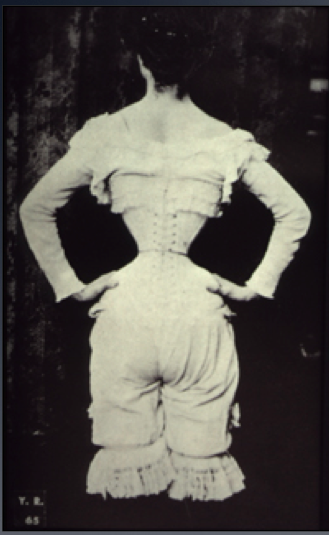
Tightlacing (also called corset training) is the practice of wearing an increasingly tightly laced corset to achieve cosmetic modifications to the figure and posture or to experience the sensation of bodily restriction. The process originates in mid-19th century Europe and was highly controversial. At the peak of the prevalence of tightlacing, there was much public backlash both from medical doctors and dress reformers, and it was often ridiculed as vain by the general public. Due to a combination of evolving fashion trends, social change regarding the roles of women, and material shortages brought on by World War I and II, tightlacing, and corsets in general, fell out of favor entirely by the early 20th century.
The corset was a standard undergarment in Western dress for about 400 years beginning in the late 16th century and ending around the beginning of the 20th century. However, the practice of tightlacing began only in the late 1820s and 1830s, after the advent of the steel eyelet in 1827. The use of steel in both eyelets and boning allowed wearers to lace their corsets significantly tighter without damaging the garment.
Additionally, corsets were among the first garments to be mass-manufactured via assembly line. This increased the accessibility of high-quality corsets and meant that middle- and lower-class women could purchase corsets where before they may have worn corded "jumps". Dress historian David Kunzle maintains that tightlacing was largely the domain of middle to lower middle class women hoping to increase their station in life; he estimates that the average corseted waist size of the 1880s was approximately 21 inches (53 cm), with an uncorseted waist size of about 27 inches (69 cm).
In the late years of the Victorian era, medical reports and rumors claimed that tightlacing was fatally detrimental to health (see Victorian dress reform). Women who suffered to achieve small waists were also condemned for their vanity and excoriated from the pulpit as slaves to fashion. Dress reformers exhorted women to abandon the tyranny of stays and free their waists for work and healthy exercise, with an emphasis on the negative consequences to one's reproductive system.
Despite the efforts of dress reformers to eliminate the corset, and despite medical and clerical warnings, women persisted in tightlacing, although a number of corsets were created that purported to alleviate effects on the wearers' bodies. By the 1910s and 20s, the corset had begun to fall out of fashion entirely, driven by both cultural and practical changes. The need for steel during World War I and World War II made corsets a luxury rather than a necessity. At the same time, first-wave feminism, the Artistic Dress movement, and the flapper subculture popularized less exaggerated silhouettes, and elasticated girdles and brassieres began to rise in popularity to create a less rigidly shaped figure. Although the structured, corseted wasp-waist made a resurgence after World War II in the form of the New Look, there was soon backlash with hippie culture; meanwhile, the rise of popular fitness culture meant that diet, liposuction, and exercise became the preferred methods of achieving a thin waist. Corsets were no longer fashionable, but they entered the underworld of the fetish, along with items such as bondage gear and vinyl catsuits, as well as alternative and runway fashions, as seen in the work of Vivienne Westwood or in the goth subculture. They are often worn as top garments rather than underwear. Historical reenactors often wear corsets, but few tightlace.
Achieving extremely small waist sizes requires a long period of training with ever-smaller corsets, ideally during one's pre-teen or teen years. A number of accounts of the corset training process take place under the regime of a finishing school, as achieving a very small waist was thought to make a woman appear refined and fashionable and thus increase the wearer's ability to attract a suitable husband.
Although there was no standardized system of corset training, some contemporary accounts give us an idea of what this training period was like. Corsets were begun at whatever age one's mother or female guardian felt was appropriate, which could be as young as seven or as old as 18 or 19.
Each of my own daughters – I have four – on her seventh birthday was provided with a snugly-fitting pair of corsets, which she wore from that time out, by night as well as by day, unless in case of decided illness. As the child grew, more bones were added, and the chest and hip measure was increased, but no alteration was made in the waist, and no expansion being allowed during the hours of sleep, its tenuity was retained and there was no necessity of resorting to tight-lacing, which becomes requisite where corsets are not worn until the figure has grown large.
Hub AI
Tightlacing AI simulator
(@Tightlacing_simulator)
Tightlacing
Tightlacing (also called corset training) is the practice of wearing an increasingly tightly laced corset to achieve cosmetic modifications to the figure and posture or to experience the sensation of bodily restriction. The process originates in mid-19th century Europe and was highly controversial. At the peak of the prevalence of tightlacing, there was much public backlash both from medical doctors and dress reformers, and it was often ridiculed as vain by the general public. Due to a combination of evolving fashion trends, social change regarding the roles of women, and material shortages brought on by World War I and II, tightlacing, and corsets in general, fell out of favor entirely by the early 20th century.
The corset was a standard undergarment in Western dress for about 400 years beginning in the late 16th century and ending around the beginning of the 20th century. However, the practice of tightlacing began only in the late 1820s and 1830s, after the advent of the steel eyelet in 1827. The use of steel in both eyelets and boning allowed wearers to lace their corsets significantly tighter without damaging the garment.
Additionally, corsets were among the first garments to be mass-manufactured via assembly line. This increased the accessibility of high-quality corsets and meant that middle- and lower-class women could purchase corsets where before they may have worn corded "jumps". Dress historian David Kunzle maintains that tightlacing was largely the domain of middle to lower middle class women hoping to increase their station in life; he estimates that the average corseted waist size of the 1880s was approximately 21 inches (53 cm), with an uncorseted waist size of about 27 inches (69 cm).
In the late years of the Victorian era, medical reports and rumors claimed that tightlacing was fatally detrimental to health (see Victorian dress reform). Women who suffered to achieve small waists were also condemned for their vanity and excoriated from the pulpit as slaves to fashion. Dress reformers exhorted women to abandon the tyranny of stays and free their waists for work and healthy exercise, with an emphasis on the negative consequences to one's reproductive system.
Despite the efforts of dress reformers to eliminate the corset, and despite medical and clerical warnings, women persisted in tightlacing, although a number of corsets were created that purported to alleviate effects on the wearers' bodies. By the 1910s and 20s, the corset had begun to fall out of fashion entirely, driven by both cultural and practical changes. The need for steel during World War I and World War II made corsets a luxury rather than a necessity. At the same time, first-wave feminism, the Artistic Dress movement, and the flapper subculture popularized less exaggerated silhouettes, and elasticated girdles and brassieres began to rise in popularity to create a less rigidly shaped figure. Although the structured, corseted wasp-waist made a resurgence after World War II in the form of the New Look, there was soon backlash with hippie culture; meanwhile, the rise of popular fitness culture meant that diet, liposuction, and exercise became the preferred methods of achieving a thin waist. Corsets were no longer fashionable, but they entered the underworld of the fetish, along with items such as bondage gear and vinyl catsuits, as well as alternative and runway fashions, as seen in the work of Vivienne Westwood or in the goth subculture. They are often worn as top garments rather than underwear. Historical reenactors often wear corsets, but few tightlace.
Achieving extremely small waist sizes requires a long period of training with ever-smaller corsets, ideally during one's pre-teen or teen years. A number of accounts of the corset training process take place under the regime of a finishing school, as achieving a very small waist was thought to make a woman appear refined and fashionable and thus increase the wearer's ability to attract a suitable husband.
Although there was no standardized system of corset training, some contemporary accounts give us an idea of what this training period was like. Corsets were begun at whatever age one's mother or female guardian felt was appropriate, which could be as young as seven or as old as 18 or 19.
Each of my own daughters – I have four – on her seventh birthday was provided with a snugly-fitting pair of corsets, which she wore from that time out, by night as well as by day, unless in case of decided illness. As the child grew, more bones were added, and the chest and hip measure was increased, but no alteration was made in the waist, and no expansion being allowed during the hours of sleep, its tenuity was retained and there was no necessity of resorting to tight-lacing, which becomes requisite where corsets are not worn until the figure has grown large.
Recent media